

220
• The transduction map has an informational counterpart in the calibration map
(Fig. 7.15).
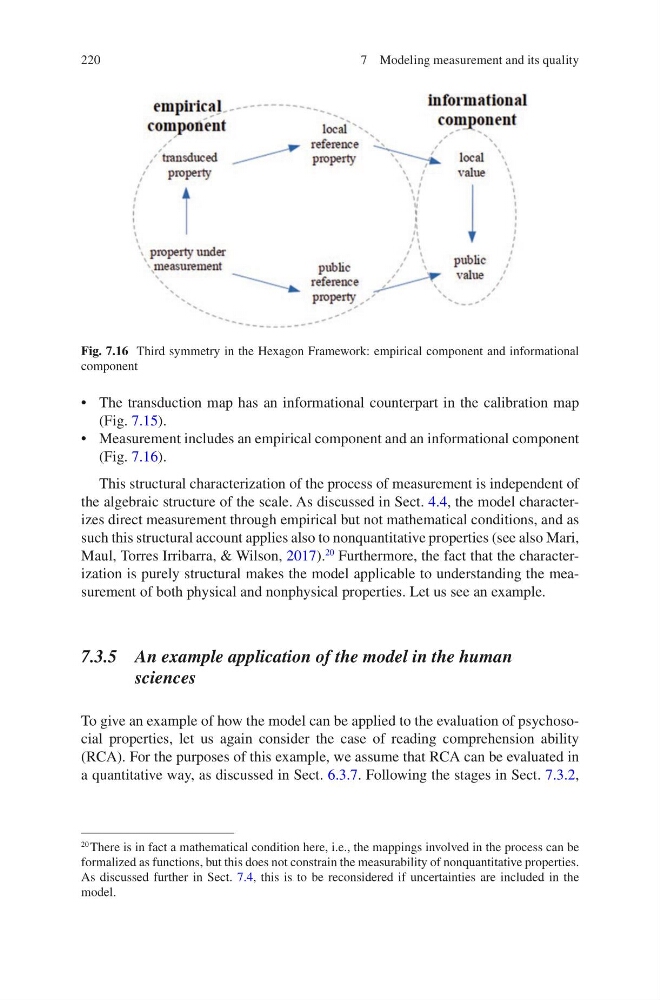
• Measurement includes an empirical component and an informational component
(Fig. 7.16).
This structural characterization of the process of measurement is independent of
the algebraic structure of the scale. As discussed in Sect. 4.4, the model characterizes direct measurement through empirical but not mathematical conditions, and as
such this structural account applies also to nonquantitative properties (see also Mari,
Maul, Torres Irribarra, & Wilson, 2017).
20
Furthermore, the fact that the characterization is purely structural makes the model applicable to understanding the measurement of both physical and nonphysical properties. Let us see an example.
7.3.5 An example application of the model in the human
sciences
To give an example of how the model can be applied to the evaluation of psychosocial properties, let us again consider the case of reading comprehension ability
(RCA). For the purposes of this example, we assume that RCA can be evaluated in
a quantitative way, as discussed in Sect. 6.3.7. Following the stages in Sect. 7.3.2,
20 There is in fact a mathematical condition here, i.e., the mappings involved in the process can be
formalized as functions, but this does not constrain the measurability of nonquantitative properties.
As discussed further in Sect. 7.4, this is to be reconsidered if uncertainties are included in the
model.
Fig. 7.16 Third symmetry in the Hexagon Framework: empirical component and informational
component
7 Modeling measurement and its quality
• The transduction map has an informational counterpart in the calibration map
(Fig. 7.15).
• Measurement includes an empirical component and an informational component
(Fig. 7.16).
This structural characterization of the process of measurement is independent of
the algebraic structure of the scale. As discussed in Sect. 4.4, the model characterizes direct measurement through empirical but not mathematical conditions, and as
such this structural account applies also to nonquantitative properties (see also Mari,
Maul, Torres Irribarra, & Wilson, 2017).
20
Furthermore, the fact that the characterization is purely structural makes the model applicable to understanding the measurement of both physical and nonphysical properties. Let us see an example.
7.3.5 An example application of the model in the human
sciences
To give an example of how the model can be applied to the evaluation of psychosocial properties, let us again consider the case of reading comprehension ability
(RCA). For the purposes of this example, we assume that RCA can be evaluated in
a quantitative way, as discussed in Sect. 6.3.7. Following the stages in Sect. 7.3.2,
20 There is in fact a mathematical condition here, i.e., the mappings involved in the process can be
formalized as functions, but this does not constrain the measurability of nonquantitative properties.
As discussed further in Sect. 7.4, this is to be reconsidered if uncertainties are included in the
model.
Fig. 7.16 Third symmetry in the Hexagon Framework: empirical component and informational
component
7 Modeling measurement and its quality