

188
of Y and Z to P is referred to as reflective in the context of latent variable modeling
(see, e.g., Edwards & Bagozzi, 2000).
The second measurement-related reason for the importance of knowledge of
such functional relations is that they may become the basis for indirect methods of
measurement (see Sect. 7.2), in which the results of prior direct measurements are
used as input properties for the computation of a value of the output property (i.e.,
the measurand), as, for example, when densities are measured by computing ratios
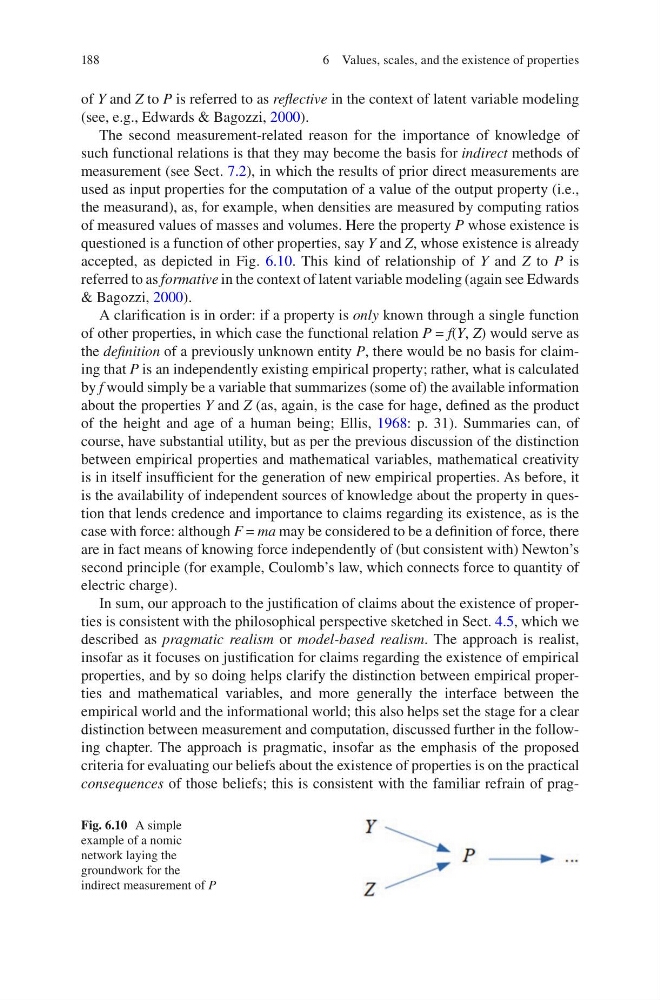
of measured values of masses and volumes. Here the property P whose existence is
questioned is a function of other properties, say Y and Z, whose existence is already
accepted, as depicted in Fig. 6.10. This kind of relationship of Y and Z to P is
referred to as formative in the context of latent variable modeling (again see Edwards
& Bagozzi, 2000).
A clarification is in order: if a property is only known through a single function
of other properties, in which case the functional relation P = f(Y, Z) would serve as
the definition of a previously unknown entity P, there would be no basis for claiming that P is an independently existing empirical property; rather, what is calculated
by f would simply be a variable that summarizes (some of) the available information
about the properties Y and Z (as, again, is the case for hage, defined as the product
of the height and age of a human being; Ellis, 1968: p. 31). Summaries can, of
course, have substantial utility, but as per the previous discussion of the distinction
between empirical properties and mathematical variables, mathematical creativity
is in itself insufficient for the generation of new empirical properties. As before, it
is the availability of independent sources of knowledge about the property in question that lends credence and importance to claims regarding its existence, as is the
case with force: although F = ma may be considered to be a definition of force, there
are in fact means of knowing force independently of (but consistent with) Newton’s
second principle (for example, Coulomb’s law, which connects force to quantity of
electric charge).
In sum, our approach to the justification of claims about the existence of properties is consistent with the philosophical perspective sketched in Sect. 4.5, which we
described as pragmatic realism or model-based realism. The approach is realist,
insofar as it focuses on justification for claims regarding the existence of empirical
properties, and by so doing helps clarify the distinction between empirical properties and mathematical variables, and more generally the interface between the
empirical world and the informational world; this also helps set the stage for a clear
distinction between measurement and computation, discussed further in the following chapter. The approach is pragmatic, insofar as the emphasis of the proposed
criteria for evaluating our beliefs about the existence of properties is on the practical
consequences of those beliefs; this is consistent with the familiar refrain of pragFig. 6.10 A simple
example of a nomic
network laying the
groundwork for the
indirect measurement of P
6 Values, scales, and the existence of properties
of Y and Z to P is referred to as reflective in the context of latent variable modeling
(see, e.g., Edwards & Bagozzi, 2000).
The second measurement-related reason for the importance of knowledge of
such functional relations is that they may become the basis for indirect methods of
measurement (see Sect. 7.2), in which the results of prior direct measurements are
used as input properties for the computation of a value of the output property (i.e.,
the measurand), as, for example, when densities are measured by computing ratios
of measured values of masses and volumes. Here the property P whose existence is
questioned is a function of other properties, say Y and Z, whose existence is already
accepted, as depicted in Fig. 6.10. This kind of relationship of Y and Z to P is
referred to as formative in the context of latent variable modeling (again see Edwards
& Bagozzi, 2000).
A clarification is in order: if a property is only known through a single function
of other properties, in which case the functional relation P = f(Y, Z) would serve as
the definition of a previously unknown entity P, there would be no basis for claiming that P is an independently existing empirical property; rather, what is calculated
by f would simply be a variable that summarizes (some of) the available information
about the properties Y and Z (as, again, is the case for hage, defined as the product
of the height and age of a human being; Ellis, 1968: p. 31). Summaries can, of
course, have substantial utility, but as per the previous discussion of the distinction
between empirical properties and mathematical variables, mathematical creativity
is in itself insufficient for the generation of new empirical properties. As before, it
is the availability of independent sources of knowledge about the property in question that lends credence and importance to claims regarding its existence, as is the
case with force: although F = ma may be considered to be a definition of force, there
are in fact means of knowing force independently of (but consistent with) Newton’s
second principle (for example, Coulomb’s law, which connects force to quantity of
electric charge).
In sum, our approach to the justification of claims about the existence of properties is consistent with the philosophical perspective sketched in Sect. 4.5, which we
described as pragmatic realism or model-based realism. The approach is realist,
insofar as it focuses on justification for claims regarding the existence of empirical
properties, and by so doing helps clarify the distinction between empirical properties and mathematical variables, and more generally the interface between the
empirical world and the informational world; this also helps set the stage for a clear
distinction between measurement and computation, discussed further in the following chapter. The approach is pragmatic, insofar as the emphasis of the proposed
criteria for evaluating our beliefs about the existence of properties is on the practical
consequences of those beliefs; this is consistent with the familiar refrain of pragFig. 6.10 A simple
example of a nomic
network laying the
groundwork for the
indirect measurement of P
6 Values, scales, and the existence of properties