

187
course, this is not the only way in which hardness is known: even simple lived experience can corroborate our common sense about the ways in which objects made of
different materials interact with one another; this is further corroborated by alternative methods for measuring hardness such as via observation of indentations under
specified conditions. In other words, we have access to knowledge about the property of hardness also independently of f, and this knowledge is consistent with what
f models as the cause of Y. This shows that the procedure of checking which objects
scratch which other objects does not define hardness, but instead may become a
method for evaluating it.
52
Thus, as investigations reveal functional relations connecting P to multiple phenomena (properties, outcomes, events, etc.) whose existence can be assessed independently of such relations, P becomes part of a system of interrelated properties,
sometimes called a nomic network.
53
The identification of such relations (referred to
in the VIM as a “set of quantities [or more generally, properties] together with a set
of noncontradictory equations relating those quantities”, JCGM, 2012: 1.3) is
important not only because it expands the explanatory and predictive value of
knowledge of P,
54
but also for two additional reasons specifically related to measurement. The first is that such knowledge may suggest alternative methods for
directly measuring a given property: for example, temperatures could also be measured by means of differences of electric potential via the thermoelectric effect, and
reading comprehension abilities could also be measured by observing how well an
individual is able to carry out a set of instructions after having read a relevant text.
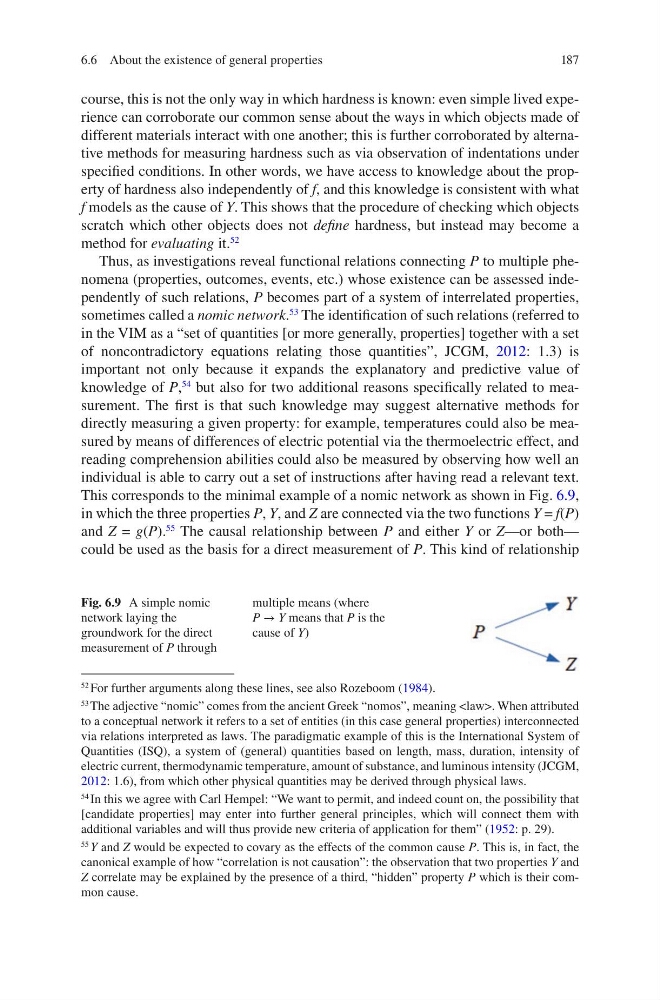
This corresponds to the minimal example of a nomic network as shown in Fig. 6.9,
in which the three properties P, Y, and Z are connected via the two functions Y = f(P)
and Z = g(P).
55
The causal relationship between P and either Y or Z—or both—
could be used as the basis for a direct measurement of P. This kind of relationship
52 For further arguments along these lines, see also Rozeboom (1984).
53 The adjective “nomic” comes from the ancient Greek “nomos”, meaning. When attributed
to a conceptual network it refers to a set of entities (in this case general properties) interconnected
via relations interpreted as laws. The paradigmatic example of this is the International System of
Quantities (ISQ), a system of (general) quantities based on length, mass, duration, intensity of
electric current, thermodynamic temperature, amount of substance, and luminous intensity (JCGM,
2012: 1.6), from which other physical quantities may be derived through physical laws.
54 In this we agree with Carl Hempel: “We want to permit, and indeed count on, the possibility that
[candidate properties] may enter into further general principles, which will connect them with
additional variables and will thus provide new criteria of application for them” (1952: p. 29).
55 Y and Z would be expected to covary as the effects of the common cause P. This is, in fact, the
canonical example of how “correlation is not causation”: the observation that two properties Y and
Z correlate may be explained by the presence of a third, “hidden” property P which is their common cause.
Fig. 6.9 A simple nomic
network laying the
groundwork for the direct
measurement of P through
multiple means (where
P → Y means that P is the
cause of Y)
6.6 About the existence of general properties
course, this is not the only way in which hardness is known: even simple lived experience can corroborate our common sense about the ways in which objects made of
different materials interact with one another; this is further corroborated by alternative methods for measuring hardness such as via observation of indentations under
specified conditions. In other words, we have access to knowledge about the property of hardness also independently of f, and this knowledge is consistent with what
f models as the cause of Y. This shows that the procedure of checking which objects
scratch which other objects does not define hardness, but instead may become a
method for evaluating it.
52
Thus, as investigations reveal functional relations connecting P to multiple phenomena (properties, outcomes, events, etc.) whose existence can be assessed independently of such relations, P becomes part of a system of interrelated properties,
sometimes called a nomic network.
53
The identification of such relations (referred to
in the VIM as a “set of quantities [or more generally, properties] together with a set
of noncontradictory equations relating those quantities”, JCGM, 2012: 1.3) is
important not only because it expands the explanatory and predictive value of
knowledge of P,
54
but also for two additional reasons specifically related to measurement. The first is that such knowledge may suggest alternative methods for
directly measuring a given property: for example, temperatures could also be measured by means of differences of electric potential via the thermoelectric effect, and
reading comprehension abilities could also be measured by observing how well an
individual is able to carry out a set of instructions after having read a relevant text.
This corresponds to the minimal example of a nomic network as shown in Fig. 6.9,
in which the three properties P, Y, and Z are connected via the two functions Y = f(P)
and Z = g(P).
55
The causal relationship between P and either Y or Z—or both—
could be used as the basis for a direct measurement of P. This kind of relationship
52 For further arguments along these lines, see also Rozeboom (1984).
53 The adjective “nomic” comes from the ancient Greek “nomos”, meaning
to a conceptual network it refers to a set of entities (in this case general properties) interconnected
via relations interpreted as laws. The paradigmatic example of this is the International System of
Quantities (ISQ), a system of (general) quantities based on length, mass, duration, intensity of
electric current, thermodynamic temperature, amount of substance, and luminous intensity (JCGM,
2012: 1.6), from which other physical quantities may be derived through physical laws.
54 In this we agree with Carl Hempel: “We want to permit, and indeed count on, the possibility that
[candidate properties] may enter into further general principles, which will connect them with
additional variables and will thus provide new criteria of application for them” (1952: p. 29).
55 Y and Z would be expected to covary as the effects of the common cause P. This is, in fact, the
canonical example of how “correlation is not causation”: the observation that two properties Y and
Z correlate may be explained by the presence of a third, “hidden” property P which is their common cause.
Fig. 6.9 A simple nomic
network laying the
groundwork for the direct
measurement of P through
multiple means (where
P → Y means that P is the
cause of Y)
6.6 About the existence of general properties