

130
R3
,
kg true
b : _
.
is heavy rod a 3 4567
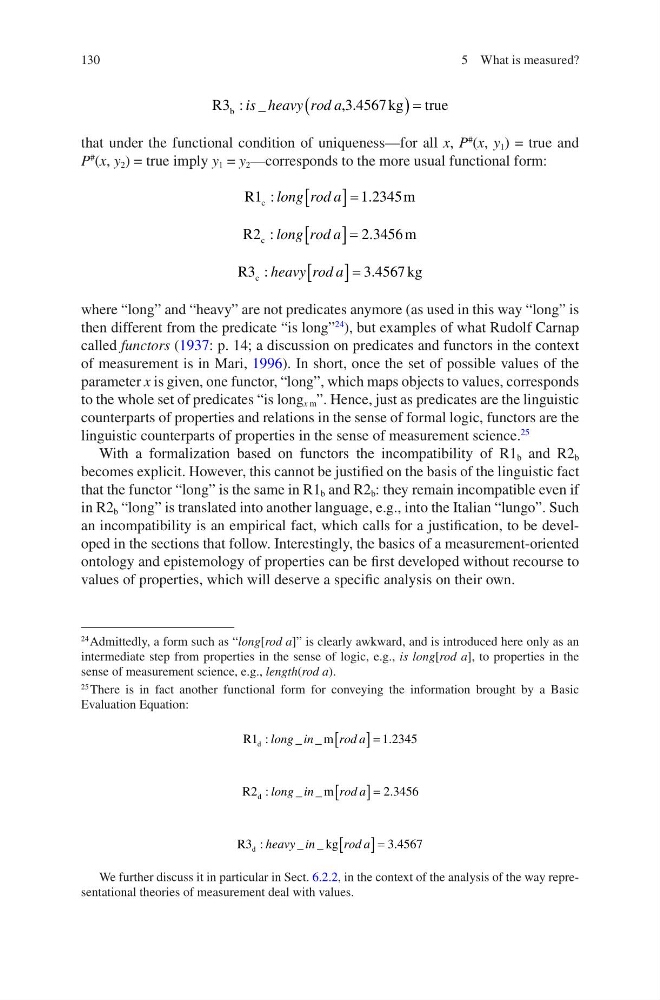
that under the functional condition of uniqueness—for all x, P
#
(x, y 1 ) = true and
P
#
(x, y 2 ) = true imply y 1 = y 2 —corresponds to the more usual functional form:
R1
m
c :
.
long rod a
>
@ 1 2345
R2
m
c :
.
long rod a
>
@ 2 3456
R3
kg
c :
.
heavy rod a
>
@ 3 4567
where “long” and “heavy” are not predicates anymore (as used in this way “long” is
then different from the predicate “is long”
24
), but examples of what Rudolf Carnap
called functors (1937: p. 14; a discussion on predicates and functors in the context
of measurement is in Mari, 1996). In short, once the set of possible values of the
parameter x is given, one functor, “long”, which maps objects to values, corresponds
to the whole set of predicates “is long x m ”. Hence, just as predicates are the linguistic
counterparts of properties and relations in the sense of formal logic, functors are the
linguistic counterparts of properties in the sense of measurement science.
25
With a formalization based on functors the incompatibility of R1 b and R2 b
becomes explicit. However, this cannot be justified on the basis of the linguistic fact
that the functor “long” is the same in R1 b and R2 b : they remain incompatible even if
in R2 b “long” is translated into another language, e.g., into the Italian “lungo”. Such
an incompatibility is an empirical fact, which calls for a justification, to be developed in the sections that follow. Interestingly, the basics of a measurement-oriented
ontology and epistemology of properties can be first developed without recourse to
values of properties, which will deserve a specific analysis on their own.
24 Admittedly, a form such as “long[rod a]” is clearly awkward, and is introduced here only as an
intermediate step from properties in the sense of logic, e.g., is long[rod a], to properties in the
sense of measurement science, e.g., length(rod a).
25 There is in fact another functional form for conveying the information brought by a Basic
Evaluation Equation:
R1
m
d :
_ _
.
long in
rod a
>
@ 1 2345
R2
m
d :
_ _
.
long in
rod a
>
@ 2 3456
R3
kg
d :
_ _
.
heavy in
rod a
>
@ 3 4567
We further discuss it in particular in Sect. 6.2.2, in the context of the analysis of the way representational theories of measurement deal with values.
5 What is measured?
R3
,
kg true
b : _
.
is heavy rod a 3 4567
that under the functional condition of uniqueness—for all x, P
#
(x, y 1 ) = true and
P
#
(x, y 2 ) = true imply y 1 = y 2 —corresponds to the more usual functional form:
R1
m
c :
.
long rod a
>
@ 1 2345
R2
m
c :
.
long rod a
>
@ 2 3456
R3
kg
c :
.
heavy rod a
>
@ 3 4567
where “long” and “heavy” are not predicates anymore (as used in this way “long” is
then different from the predicate “is long”
24
), but examples of what Rudolf Carnap
called functors (1937: p. 14; a discussion on predicates and functors in the context
of measurement is in Mari, 1996). In short, once the set of possible values of the
parameter x is given, one functor, “long”, which maps objects to values, corresponds
to the whole set of predicates “is long x m ”. Hence, just as predicates are the linguistic
counterparts of properties and relations in the sense of formal logic, functors are the
linguistic counterparts of properties in the sense of measurement science.
25
With a formalization based on functors the incompatibility of R1 b and R2 b
becomes explicit. However, this cannot be justified on the basis of the linguistic fact
that the functor “long” is the same in R1 b and R2 b : they remain incompatible even if
in R2 b “long” is translated into another language, e.g., into the Italian “lungo”. Such
an incompatibility is an empirical fact, which calls for a justification, to be developed in the sections that follow. Interestingly, the basics of a measurement-oriented
ontology and epistemology of properties can be first developed without recourse to
values of properties, which will deserve a specific analysis on their own.
24 Admittedly, a form such as “long[rod a]” is clearly awkward, and is introduced here only as an
intermediate step from properties in the sense of logic, e.g., is long[rod a], to properties in the
sense of measurement science, e.g., length(rod a).
25 There is in fact another functional form for conveying the information brought by a Basic
Evaluation Equation:
R1
m
d :
_ _
.
long in
rod a
>
@ 1 2345
R2
m
d :
_ _
.
long in
rod a
>
@ 2 3456
R3
kg
d :
_ _
.
heavy in
rod a
>
@ 3 4567
We further discuss it in particular in Sect. 6.2.2, in the context of the analysis of the way representational theories of measurement deal with values.
5 What is measured?