

129
5.2.4 From properties of formal logic to properties of
measurement science
Since a Basic Evaluation Equation such as
length rod a
>
@ 1 2345
.
m
can be rewritten in the predicative form as
is
long rod a
_ .
_ _
1 2345 m
t rue
one could conclude that these expressions convey exactly the same information.
This is not the case, and a consideration of the differences allows us to highlight
some fundamental features of properties (in the sense of measurement science, the
meaning to which we implicitly refer henceforth).
Consider the three (logical) equations:
R1
m
t rue
: _ .
_ _
is
long rod a
1 2345
R2
m
t rue
: _ .
_ _
is
long rod a
2 3456
R3
kg
true
: _ .
_ _
is
heavy rod a
3 4567
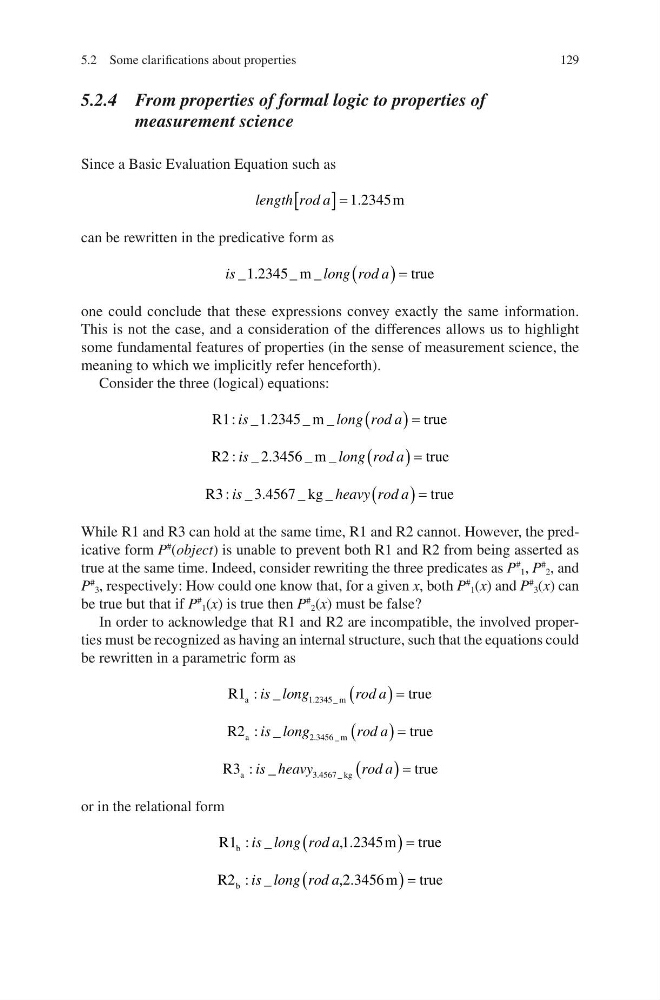
While R1 and R3 can hold at the same time, R1 and R2 cannot. However, the predicative form P
#
(object) is unable to prevent both R1 and R2 from being asserted as
true at the same time. Indeed, consider rewriting the three predicates as P
# 1 , P
# 2 , and
P
# 3 , respectively: How could one know that, for a given x, both P
# 1 (x) and P
# 3 (x) can
be true but that if P
# 1 (x) is true then P
# 2 (x) must be false?
In order to acknowledge that R1 and R2 are incompatible, the involved properties must be recognized as having an internal structure, such that the equations could
be rewritten in a parametric form as
R1
true
a
m
: _
.
_
is long
rod a
1 2345
R2
true
a
m
: _
.
_
is long
rod a
2 3456
R3
true
a
k g
: _
.
_
is heavy
r od a
3 4567
or in the relational form
R1
,
m true
b : _
.
is long rod a 1 2345
R2
,
m true
b : _
.
is long rod a 2 3456
5.2 Some clarifications about properties
5.2.4 From properties of formal logic to properties of
measurement science
Since a Basic Evaluation Equation such as
length rod a
>
@ 1 2345
.
m
can be rewritten in the predicative form as
is
long rod a
_ .
_ _
1 2345 m
t rue
one could conclude that these expressions convey exactly the same information.
This is not the case, and a consideration of the differences allows us to highlight
some fundamental features of properties (in the sense of measurement science, the
meaning to which we implicitly refer henceforth).
Consider the three (logical) equations:
R1
m
t rue
: _ .
_ _
is
long rod a
1 2345
R2
m
t rue
: _ .
_ _
is
long rod a
2 3456
R3
kg
true
: _ .
_ _
is
heavy rod a
3 4567
While R1 and R3 can hold at the same time, R1 and R2 cannot. However, the predicative form P
#
(object) is unable to prevent both R1 and R2 from being asserted as
true at the same time. Indeed, consider rewriting the three predicates as P
# 1 , P
# 2 , and
P
# 3 , respectively: How could one know that, for a given x, both P
# 1 (x) and P
# 3 (x) can
be true but that if P
# 1 (x) is true then P
# 2 (x) must be false?
In order to acknowledge that R1 and R2 are incompatible, the involved properties must be recognized as having an internal structure, such that the equations could
be rewritten in a parametric form as
R1
true
a
m
: _
.
_
is long
rod a
1 2345
R2
true
a
m
: _
.
_
is long
rod a
2 3456
R3
true
a
k g
: _
.
_
is heavy
r od a
3 4567
or in the relational form
R1
,
m true
b : _
.
is long rod a 1 2345
R2
,
m true
b : _
.
is long rod a 2 3456
5.2 Some clarifications about properties