

126
5.2.2 Properties and predicates
In the philosophical tradition, and in formal logic in particular, a property is what a
predicate designates,
18
and is therefore a Boolean entity that either applies or does
not apply to a given object, or, as more commonly said, that a given object either has
or does not have. The distinction between predicates (as well as characteristics) and
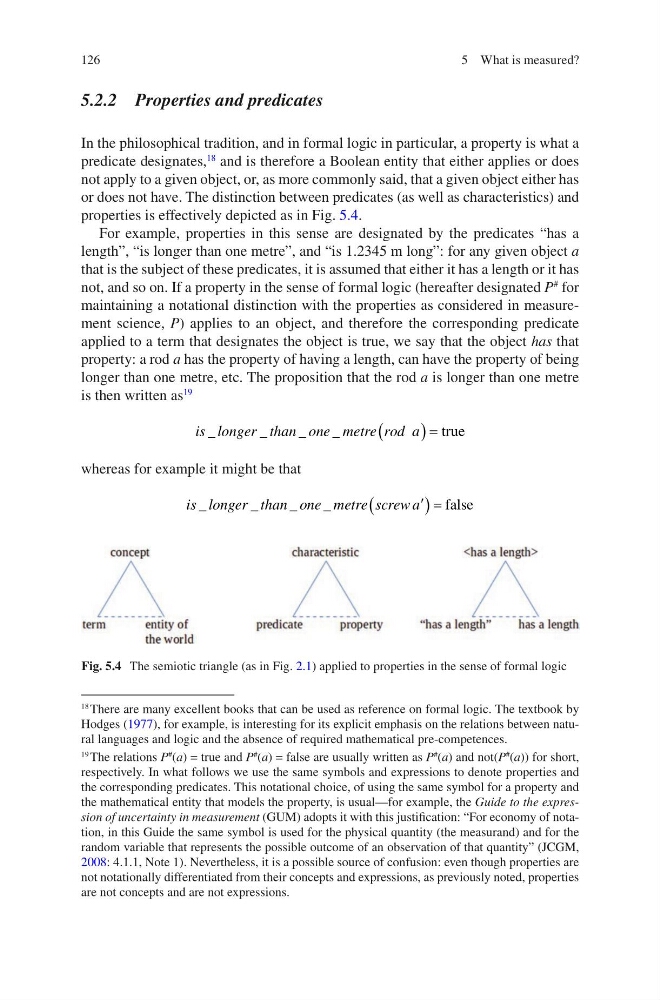
properties is effectively depicted as in Fig. 5.4.
For example, properties in this sense are designated by the predicates “has a
length”, “is longer than one metre”, and “is 1.2345 m long”: for any given object a
that is the subject of these predicates, it is assumed that either it has a length or it has
not, and so on. If a property in the sense of formal logic (hereafter designated P
#
for
maintaining a notational distinction with the properties as considered in measurement science, P) applies to an object, and therefore the corresponding predicate
applied to a term that designates the object is true, we say that the object has that
property: a rod a has the property of having a length, can have the property of being
longer than one metre, etc. The proposition that the rod a is longer than one metre
is then written as
19
is longer than one metre rod a
_
_
_
_
true
whereas for example it might be that
is longer than one metre screw a
_
_
_
_
c
false
18 There are many excellent books that can be used as reference on formal logic. The textbook by
Hodges (1977), for example, is interesting for its explicit emphasis on the relations between natural languages and logic and the absence of required mathematical pre-competences.
19 The relations P
#
(a) = true and P
#
(a) = false are usually written as P
#
(a) and not(P
# (a)) for short,
respectively. In what follows we use the same symbols and expressions to denote properties and
the corresponding predicates. This notational choice, of using the same symbol for a property and
the mathematical entity that models the property, is usual—for example, the Guide to the expression of uncertainty in measurement (GUM) adopts it with this justification: “For economy of notation, in this Guide the same symbol is used for the physical quantity (the measurand) and for the
random variable that represents the possible outcome of an observation of that quantity” (JCGM,
2008: 4.1.1, Note 1). Nevertheless, it is a possible source of confusion: even though properties are
not notationally differentiated from their concepts and expressions, as previously noted, properties
are not concepts and are not expressions.
Fig. 5.4 The semiotic triangle (as in Fig. 2.1) applied to properties in the sense of formal logic
5 What is measured?
5.2.2 Properties and predicates
In the philosophical tradition, and in formal logic in particular, a property is what a
predicate designates,
18
and is therefore a Boolean entity that either applies or does
not apply to a given object, or, as more commonly said, that a given object either has
or does not have. The distinction between predicates (as well as characteristics) and
properties is effectively depicted as in Fig. 5.4.
For example, properties in this sense are designated by the predicates “has a
length”, “is longer than one metre”, and “is 1.2345 m long”: for any given object a
that is the subject of these predicates, it is assumed that either it has a length or it has
not, and so on. If a property in the sense of formal logic (hereafter designated P
#
for
maintaining a notational distinction with the properties as considered in measurement science, P) applies to an object, and therefore the corresponding predicate
applied to a term that designates the object is true, we say that the object has that
property: a rod a has the property of having a length, can have the property of being
longer than one metre, etc. The proposition that the rod a is longer than one metre
is then written as
19
is longer than one metre rod a
_
_
_
_
true
whereas for example it might be that
is longer than one metre screw a
_
_
_
_
c
false
18 There are many excellent books that can be used as reference on formal logic. The textbook by
Hodges (1977), for example, is interesting for its explicit emphasis on the relations between natural languages and logic and the absence of required mathematical pre-competences.
19 The relations P
#
(a) = true and P
#
(a) = false are usually written as P
#
(a) and not(P
# (a)) for short,
respectively. In what follows we use the same symbols and expressions to denote properties and
the corresponding predicates. This notational choice, of using the same symbol for a property and
the mathematical entity that models the property, is usual—for example, the Guide to the expression of uncertainty in measurement (GUM) adopts it with this justification: “For economy of notation, in this Guide the same symbol is used for the physical quantity (the measurand) and for the
random variable that represents the possible outcome of an observation of that quantity” (JCGM,
2008: 4.1.1, Note 1). Nevertheless, it is a possible source of confusion: even though properties are
not notationally differentiated from their concepts and expressions, as previously noted, properties
are not concepts and are not expressions.
Fig. 5.4 The semiotic triangle (as in Fig. 2.1) applied to properties in the sense of formal logic
5 What is measured?