

124
generally has multiple modes of interaction with its environment, and each corresponds to a property of the object. In fact, against radical operationalism, it may be
discovered that the same property is the cause of distinct modes of interaction.
17
According to the tripartition introduced in Sect. 2.1, properties of objects are
then, at least preliminarily, claimed to be entities of the world, not conceptual entities and not linguistic entities (as discussed further in Sect. 5.3). For example, that
an object floats in water is a fact that can be observed or experimentally assessed,
and is independent of the information that we may have on the object and its properties. That is, objects floated before Archimedes’ explanation in terms of the relation
between the weight and the shape of the object and the density of the water. In other
words, a property of an object can be conceptualized and given a term, but it is not
itself a concept or a linguistic expression. Of course, there can be disputable observations and mistaken reports of observations: what we assume here is just that at
least some interactions are uncontroversially observed, and that there must be something in the empirical world, thus independent of our conceptions, which causes
those interactions.
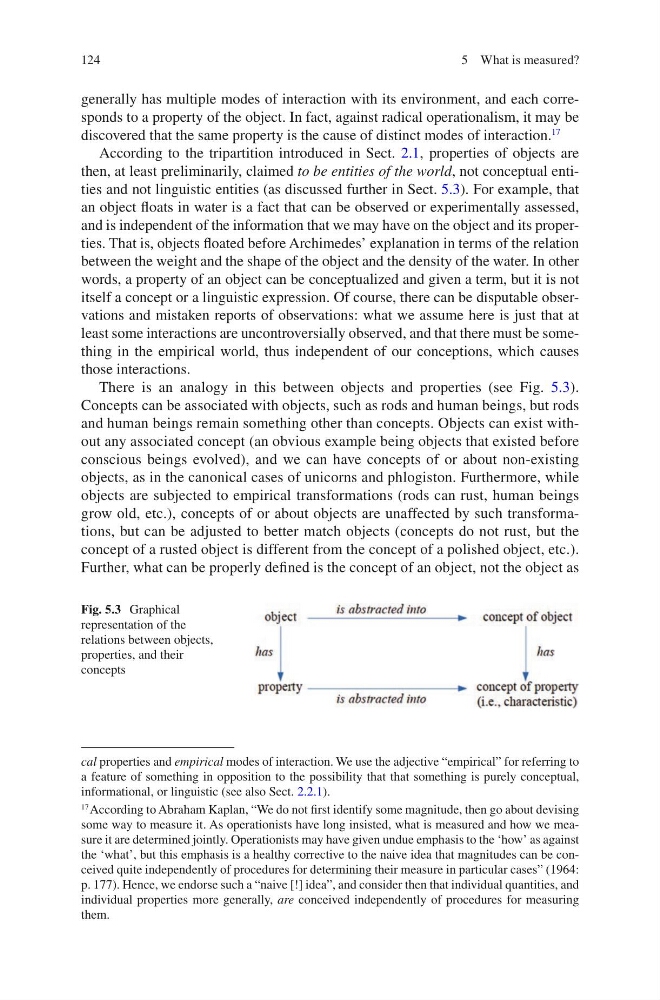
There is an analogy in this between objects and properties (see Fig. 5.3).
Concepts can be associated with objects, such as rods and human beings, but rods
and human beings remain something other than concepts. Objects can exist without any associated concept (an obvious example being objects that existed before
conscious beings evolved), and we can have concepts of or about non-existing
objects, as in the canonical cases of unicorns and phlogiston. Furthermore, while
objects are subjected to empirical transformations (rods can rust, human beings
grow old, etc.), concepts of or about objects are unaffected by such transformations, but can be adjusted to better match objects (concepts do not rust, but the
concept of a rusted object is different from the concept of a polished object, etc.).
Further, what can be properly defined is the concept of an object, not the object as
cal properties and empirical modes of interaction. We use the adjective “empirical” for referring to
a feature of something in opposition to the possibility that that something is purely conceptual,
informational, or linguistic (see also Sect. 2.2.1).
17 According to Abraham Kaplan, “We do not first identify some magnitude, then go about devising
some way to measure it. As operationists have long insisted, what is measured and how we measure it are determined jointly. Operationists may have given undue emphasis to the ‘how’ as against
the ‘what’, but this emphasis is a healthy corrective to the naive idea that magnitudes can be conceived quite independently of procedures for determining their measure in particular cases” (1964:
p. 177). Hence, we endorse such a “naive [!] idea”, and consider then that individual quantities, and
individual properties more generally, are conceived independently of procedures for measuring
them.
Fig. 5.3 Graphical
representation of the
relations between objects,
properties, and their
concepts
5 What is measured?
generally has multiple modes of interaction with its environment, and each corresponds to a property of the object. In fact, against radical operationalism, it may be
discovered that the same property is the cause of distinct modes of interaction.
17
According to the tripartition introduced in Sect. 2.1, properties of objects are
then, at least preliminarily, claimed to be entities of the world, not conceptual entities and not linguistic entities (as discussed further in Sect. 5.3). For example, that
an object floats in water is a fact that can be observed or experimentally assessed,
and is independent of the information that we may have on the object and its properties. That is, objects floated before Archimedes’ explanation in terms of the relation
between the weight and the shape of the object and the density of the water. In other
words, a property of an object can be conceptualized and given a term, but it is not
itself a concept or a linguistic expression. Of course, there can be disputable observations and mistaken reports of observations: what we assume here is just that at
least some interactions are uncontroversially observed, and that there must be something in the empirical world, thus independent of our conceptions, which causes
those interactions.
There is an analogy in this between objects and properties (see Fig. 5.3).
Concepts can be associated with objects, such as rods and human beings, but rods
and human beings remain something other than concepts. Objects can exist without any associated concept (an obvious example being objects that existed before
conscious beings evolved), and we can have concepts of or about non-existing
objects, as in the canonical cases of unicorns and phlogiston. Furthermore, while
objects are subjected to empirical transformations (rods can rust, human beings
grow old, etc.), concepts of or about objects are unaffected by such transformations, but can be adjusted to better match objects (concepts do not rust, but the
concept of a rusted object is different from the concept of a polished object, etc.).
Further, what can be properly defined is the concept of an object, not the object as
cal properties and empirical modes of interaction. We use the adjective “empirical” for referring to
a feature of something in opposition to the possibility that that something is purely conceptual,
informational, or linguistic (see also Sect. 2.2.1).
17 According to Abraham Kaplan, “We do not first identify some magnitude, then go about devising
some way to measure it. As operationists have long insisted, what is measured and how we measure it are determined jointly. Operationists may have given undue emphasis to the ‘how’ as against
the ‘what’, but this emphasis is a healthy corrective to the naive idea that magnitudes can be conceived quite independently of procedures for determining their measure in particular cases” (1964:
p. 177). Hence, we endorse such a “naive [!] idea”, and consider then that individual quantities, and
individual properties more generally, are conceived independently of procedures for measuring
them.
Fig. 5.3 Graphical
representation of the
relations between objects,
properties, and their
concepts
5 What is measured?