

96
ing, of weighing and of measuring; or, more exactly, no one ever sought to get
beyond the practical uses of number, weight, measure in the imprecision of everyday life” (Koyré, 1948). The Euclidean characterization of measure was maintained,
but complemented with an interest in discovering physical transduction effects (see
Sect. 2.3) and designing and producing devices that implement them. This emphasis
on experimental activities was very effective in “making measurable” properties
that had never been measured before, such as pressure and temperature, and later
electrical and magnetic quantities. This triggered a new interest for scientists, and
more specifically physicists (who were called “natural philosophers” at the time of
Galileo and Newton), to develop instrumentation, on their own or through novel
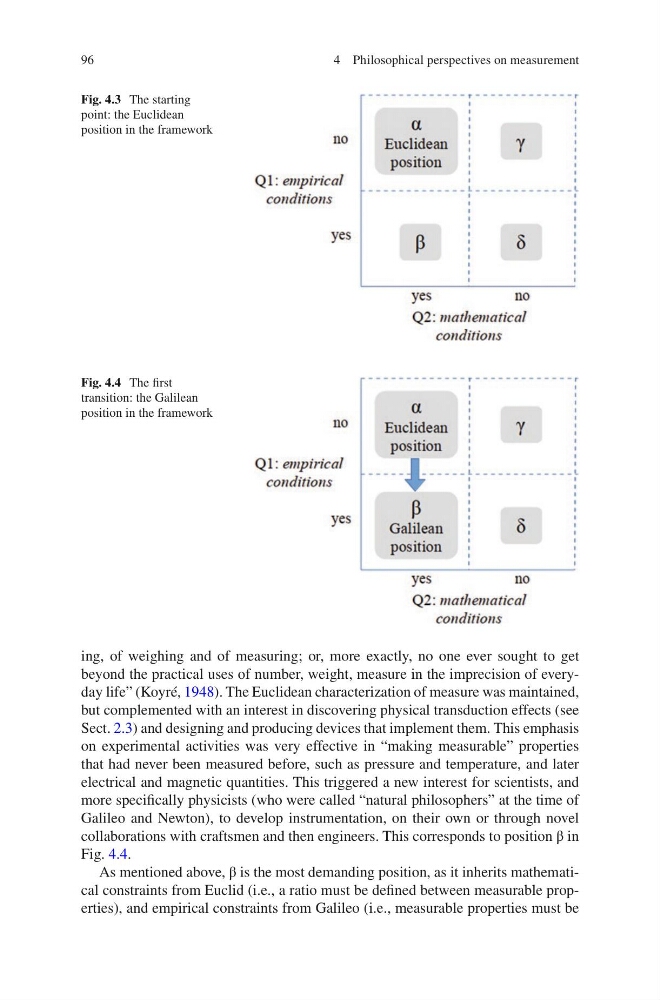
collaborations with craftsmen and then engineers. This corresponds to position β in
Fig. 4.4.
As mentioned above, β is the most demanding position, as it inherits mathematical constraints from Euclid (i.e., a ratio must be defined between measurable properties), and empirical constraints from Galileo (i.e., measurable properties must be
Fig. 4.4 The first
transition: the Galilean
position in the framework
Fig. 4.3 The starting
point: the Euclidean
position in the framework
4 Philosophical perspectives on measurement
ing, of weighing and of measuring; or, more exactly, no one ever sought to get
beyond the practical uses of number, weight, measure in the imprecision of everyday life” (Koyré, 1948). The Euclidean characterization of measure was maintained,
but complemented with an interest in discovering physical transduction effects (see
Sect. 2.3) and designing and producing devices that implement them. This emphasis
on experimental activities was very effective in “making measurable” properties
that had never been measured before, such as pressure and temperature, and later
electrical and magnetic quantities. This triggered a new interest for scientists, and
more specifically physicists (who were called “natural philosophers” at the time of
Galileo and Newton), to develop instrumentation, on their own or through novel
collaborations with craftsmen and then engineers. This corresponds to position β in
Fig. 4.4.
As mentioned above, β is the most demanding position, as it inherits mathematical constraints from Euclid (i.e., a ratio must be defined between measurable properties), and empirical constraints from Galileo (i.e., measurable properties must be
Fig. 4.4 The first
transition: the Galilean
position in the framework
Fig. 4.3 The starting
point: the Euclidean
position in the framework
4 Philosophical perspectives on measurement