

95
measured by the less; a ratio is a sort of relation in respect of size between two magnitudes of the same kind” (Book 5, definitions 1–3). What is at stake with this concept of (note, not ) was clearly pointed out by Augustus
De Morgan: “the term ‘measure’ is used conversely to ‘multiple’; […] hence [if] A
and B have a common measure [they] are said to be commensurable” (1836: p. 9).
21
Not surprisingly, then, in this context the English term “measurement” (also written
“mensuration” in the past) mainly refers to procedural demonstrations of geometric
propositions, such as “the area of any circle is equal to a right-angled triangle in
which one of the sides about the right angle is equal to the radius, and the other to
the circumference, of the circle”, as taken from Archimedes’ short treatise titled
“Measurement of a Circle” (Heath, 1897: pp. 91–98). Of course, as discussed in the
previous chapter, no experimental activities are expected here, or even allowed,
according to Euclid: “in the geometrical constructions employed in the Elements
[…] empirical proofs by means of measurement are strictly forbidden” (Fitzpatrick,
2008; in his introductory notes to his translation of Euclid’s Elements). Hence, this
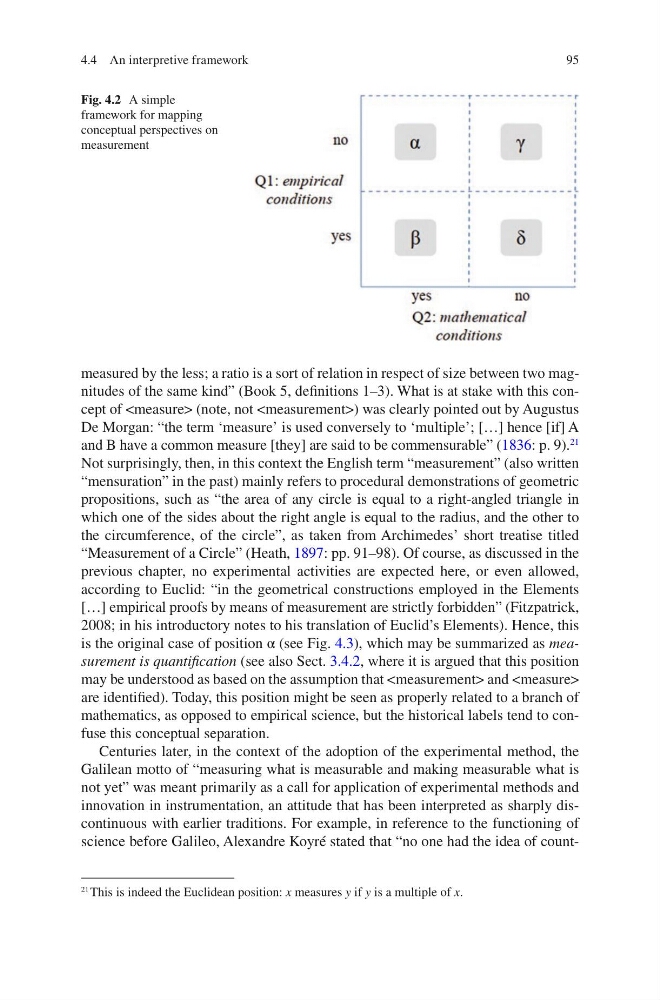
is the original case of position α (see Fig. 4.3), which may be summarized as measurement is quantification (see also Sect. 3.4.2, where it is argued that this position
may be understood as based on the assumption that and
are identified). Today, this position might be seen as properly related to a branch of
mathematics, as opposed to empirical science, but the historical labels tend to confuse this conceptual separation.
Centuries later, in the context of the adoption of the experimental method, the
Galilean motto of “measuring what is measurable and making measurable what is
not yet” was meant primarily as a call for application of experimental methods and
innovation in instrumentation, an attitude that has been interpreted as sharply discontinuous with earlier traditions. For example, in reference to the functioning of
science before Galileo, Alexandre Koyré stated that “no one had the idea of count21 This is indeed the Euclidean position: x measures y if y is a multiple of x.
Fig. 4.2 A simple
framework for mapping
conceptual perspectives on
measurement
4.4 An interpretive framework
measured by the less; a ratio is a sort of relation in respect of size between two magnitudes of the same kind” (Book 5, definitions 1–3). What is at stake with this concept of
De Morgan: “the term ‘measure’ is used conversely to ‘multiple’; […] hence [if] A
and B have a common measure [they] are said to be commensurable” (1836: p. 9).
21
Not surprisingly, then, in this context the English term “measurement” (also written
“mensuration” in the past) mainly refers to procedural demonstrations of geometric
propositions, such as “the area of any circle is equal to a right-angled triangle in
which one of the sides about the right angle is equal to the radius, and the other to
the circumference, of the circle”, as taken from Archimedes’ short treatise titled
“Measurement of a Circle” (Heath, 1897: pp. 91–98). Of course, as discussed in the
previous chapter, no experimental activities are expected here, or even allowed,
according to Euclid: “in the geometrical constructions employed in the Elements
[…] empirical proofs by means of measurement are strictly forbidden” (Fitzpatrick,
2008; in his introductory notes to his translation of Euclid’s Elements). Hence, this
is the original case of position α (see Fig. 4.3), which may be summarized as measurement is quantification (see also Sect. 3.4.2, where it is argued that this position
may be understood as based on the assumption that
are identified). Today, this position might be seen as properly related to a branch of
mathematics, as opposed to empirical science, but the historical labels tend to confuse this conceptual separation.
Centuries later, in the context of the adoption of the experimental method, the
Galilean motto of “measuring what is measurable and making measurable what is
not yet” was meant primarily as a call for application of experimental methods and
innovation in instrumentation, an attitude that has been interpreted as sharply discontinuous with earlier traditions. For example, in reference to the functioning of
science before Galileo, Alexandre Koyré stated that “no one had the idea of count21 This is indeed the Euclidean position: x measures y if y is a multiple of x.
Fig. 4.2 A simple
framework for mapping
conceptual perspectives on
measurement
4.4 An interpretive framework