

3.2 Results
81
p53 activation after treated with PhR was tested by using a fixed peptide concentration
of 40 µM from 0 to 48 hours. Apparent p53 and MDM2 accumulation both in protein
and mRNA levels was detected, with the highest mRNA level observed slightly before
the highest protein level (Fig. 3.18b). Recently, Lahav et al. reported that cell death
depends on the accumulation kinetics of p53 [46]. With HCT-116 Venus knock-in
cell line (p53-VKI) (a kind gift from the Lahav laboratory), we detected a more rapid
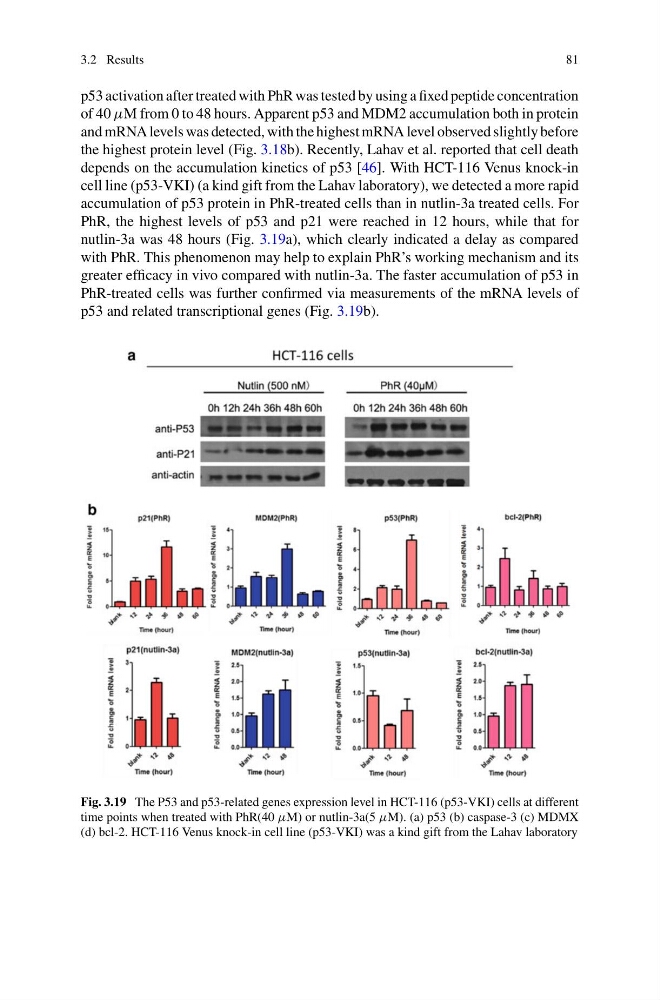
accumulation of p53 protein in PhR-treated cells than in nutlin-3a treated cells. For
PhR, the highest levels of p53 and p21 were reached in 12 hours, while that for
nutlin-3a was 48 hours (Fig. 3.19a), which clearly indicated a delay as compared
with PhR. This phenomenon may help to explain PhR’s working mechanism and its
greater efficacy in vivo compared with nutlin-3a. The faster accumulation of p53 in
PhR-treated cells was further confirmed via measurements of the mRNA levels of
p53 and related transcriptional genes (Fig. 3.19b).
Fig. 3.19 The P53 and p53-related genes expression level in HCT-116 (p53-VKI) cells at different
time points when treated with PhR(40 µM) or nutlin-3a(5 µM). (a) p53 (b) caspase-3 (c) MDMX
(d) bcl-2. HCT-116 Venus knock-in cell line (p53-VKI) was a kind gift from the Lahav laboratory
81
p53 activation after treated with PhR was tested by using a fixed peptide concentration
of 40 µM from 0 to 48 hours. Apparent p53 and MDM2 accumulation both in protein
and mRNA levels was detected, with the highest mRNA level observed slightly before
the highest protein level (Fig. 3.18b). Recently, Lahav et al. reported that cell death
depends on the accumulation kinetics of p53 [46]. With HCT-116 Venus knock-in
cell line (p53-VKI) (a kind gift from the Lahav laboratory), we detected a more rapid
accumulation of p53 protein in PhR-treated cells than in nutlin-3a treated cells. For
PhR, the highest levels of p53 and p21 were reached in 12 hours, while that for
nutlin-3a was 48 hours (Fig. 3.19a), which clearly indicated a delay as compared
with PhR. This phenomenon may help to explain PhR’s working mechanism and its
greater efficacy in vivo compared with nutlin-3a. The faster accumulation of p53 in
PhR-treated cells was further confirmed via measurements of the mRNA levels of
p53 and related transcriptional genes (Fig. 3.19b).
Fig. 3.19 The P53 and p53-related genes expression level in HCT-116 (p53-VKI) cells at different
time points when treated with PhR(40 µM) or nutlin-3a(5 µM). (a) p53 (b) caspase-3 (c) MDMX
(d) bcl-2. HCT-116 Venus knock-in cell line (p53-VKI) was a kind gift from the Lahav laboratory