

44
2 Synthesis of In-Tether Chiral Center Peptides …
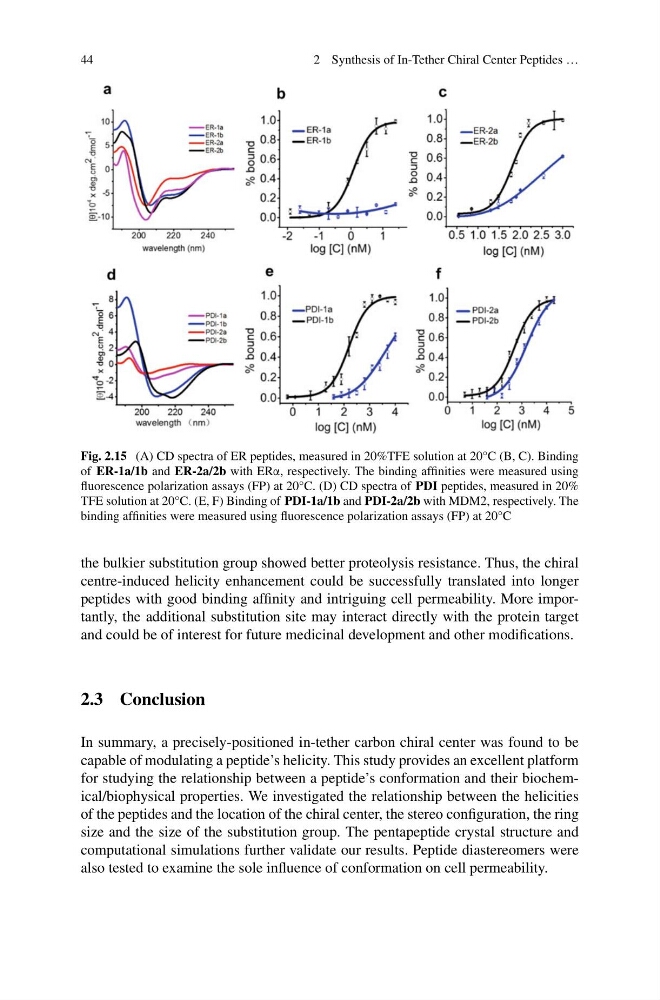
Fig. 2.15 (A) CD spectra of ER peptides, measured in 20%TFE solution at 20°C (B, C). Binding
of ER-1a/1b and ER-2a/2b with ERα, respectively. The binding affinities were measured using
fluorescence polarization assays (FP) at 20°C. (D) CD spectra of PDI peptides, measured in 20%
TFE solution at 20°C. (E, F) Binding of PDI-1a/1b and PDI-2a/2b with MDM2, respectively. The
binding affinities were measured using fluorescence polarization assays (FP) at 20°C
the bulkier substitution group showed better proteolysis resistance. Thus, the chiral
centre-induced helicity enhancement could be successfully translated into longer
peptides with good binding affinity and intriguing cell permeability. More importantly, the additional substitution site may interact directly with the protein target
and could be of interest for future medicinal development and other modifications.
2.3 Conclusion
In summary, a precisely-positioned in-tether carbon chiral center was found to be
capable of modulating a peptide’s helicity. This study provides an excellent platform
for studying the relationship between a peptide’s conformation and their biochemical/biophysical properties. We investigated the relationship between the helicities
of the peptides and the location of the chiral center, the stereo configuration, the ring
size and the size of the substitution group. The pentapeptide crystal structure and
computational simulations further validate our results. Peptide diastereomers were
also tested to examine the sole influence of conformation on cell permeability.
2 Synthesis of In-Tether Chiral Center Peptides …
Fig. 2.15 (A) CD spectra of ER peptides, measured in 20%TFE solution at 20°C (B, C). Binding
of ER-1a/1b and ER-2a/2b with ERα, respectively. The binding affinities were measured using
fluorescence polarization assays (FP) at 20°C. (D) CD spectra of PDI peptides, measured in 20%
TFE solution at 20°C. (E, F) Binding of PDI-1a/1b and PDI-2a/2b with MDM2, respectively. The
binding affinities were measured using fluorescence polarization assays (FP) at 20°C
the bulkier substitution group showed better proteolysis resistance. Thus, the chiral
centre-induced helicity enhancement could be successfully translated into longer
peptides with good binding affinity and intriguing cell permeability. More importantly, the additional substitution site may interact directly with the protein target
and could be of interest for future medicinal development and other modifications.
2.3 Conclusion
In summary, a precisely-positioned in-tether carbon chiral center was found to be
capable of modulating a peptide’s helicity. This study provides an excellent platform
for studying the relationship between a peptide’s conformation and their biochemical/biophysical properties. We investigated the relationship between the helicities
of the peptides and the location of the chiral center, the stereo configuration, the ring
size and the size of the substitution group. The pentapeptide crystal structure and
computational simulations further validate our results. Peptide diastereomers were
also tested to examine the sole influence of conformation on cell permeability.