

8
1 Introduction
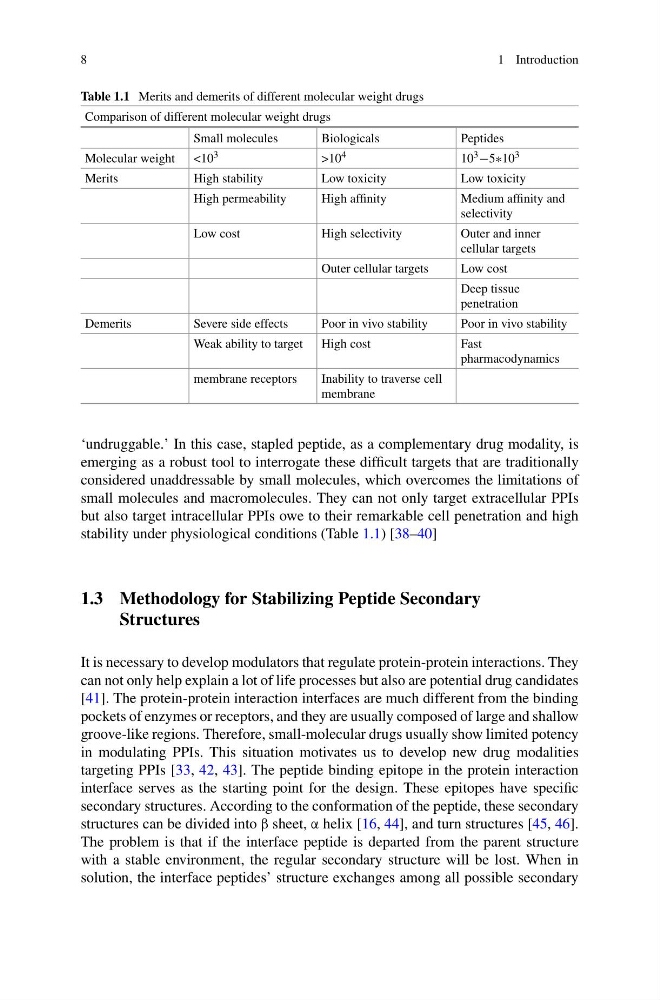
Table 1.1 Merits and demerits of different molecular weight drugs
Comparison of different molecular weight drugs
Small molecules
Biologicals
Peptides
Molecular weight <10 3
>10 4
10 3 −5∗10 3
Merits
High stability
Low toxicity
Low toxicity
High permeability
High affinity
Medium affinity and
selectivity
Low cost
High selectivity
Outer and inner
cellular targets
Outer cellular targets
Low cost
Deep tissue
penetration
Demerits
Severe side effects
Poor in vivo stability
Poor in vivo stability
Weak ability to target High cost
Fast
pharmacodynamics
membrane receptors
Inability to traverse cell
membrane
‘undruggable.’ In this case, stapled peptide, as a complementary drug modality, is
emerging as a robust tool to interrogate these difficult targets that are traditionally
considered unaddressable by small molecules, which overcomes the limitations of
small molecules and macromolecules. They can not only target extracellular PPIs
but also target intracellular PPIs owe to their remarkable cell penetration and high
stability under physiological conditions (Table 1.1) [38–40]
1.3 Methodology for Stabilizing Peptide Secondary
Structures
It is necessary to develop modulators that regulate protein-protein interactions. They
can not only help explain a lot of life processes but also are potential drug candidates
[41]. The protein-protein interaction interfaces are much different from the binding
pockets of enzymes or receptors, and they are usually composed of large and shallow
groove-like regions. Therefore, small-molecular drugs usually show limited potency
in modulating PPIs. This situation motivates us to develop new drug modalities
targeting PPIs [33, 42, 43]. The peptide binding epitope in the protein interaction
interface serves as the starting point for the design. These epitopes have specific
secondary structures. According to the conformation of the peptide, these secondary
structures can be divided into β sheet, α helix [16, 44], and turn structures [45, 46].
The problem is that if the interface peptide is departed from the parent structure
with a stable environment, the regular secondary structure will be lost. When in
solution, the interface peptides’ structure exchanges among all possible secondary
1 Introduction
Table 1.1 Merits and demerits of different molecular weight drugs
Comparison of different molecular weight drugs
Small molecules
Biologicals
Peptides
Molecular weight <10 3
>10 4
10 3 −5∗10 3
Merits
High stability
Low toxicity
Low toxicity
High permeability
High affinity
Medium affinity and
selectivity
Low cost
High selectivity
Outer and inner
cellular targets
Outer cellular targets
Low cost
Deep tissue
penetration
Demerits
Severe side effects
Poor in vivo stability
Poor in vivo stability
Weak ability to target High cost
Fast
pharmacodynamics
membrane receptors
Inability to traverse cell
membrane
‘undruggable.’ In this case, stapled peptide, as a complementary drug modality, is
emerging as a robust tool to interrogate these difficult targets that are traditionally
considered unaddressable by small molecules, which overcomes the limitations of
small molecules and macromolecules. They can not only target extracellular PPIs
but also target intracellular PPIs owe to their remarkable cell penetration and high
stability under physiological conditions (Table 1.1) [38–40]
1.3 Methodology for Stabilizing Peptide Secondary
Structures
It is necessary to develop modulators that regulate protein-protein interactions. They
can not only help explain a lot of life processes but also are potential drug candidates
[41]. The protein-protein interaction interfaces are much different from the binding
pockets of enzymes or receptors, and they are usually composed of large and shallow
groove-like regions. Therefore, small-molecular drugs usually show limited potency
in modulating PPIs. This situation motivates us to develop new drug modalities
targeting PPIs [33, 42, 43]. The peptide binding epitope in the protein interaction
interface serves as the starting point for the design. These epitopes have specific
secondary structures. According to the conformation of the peptide, these secondary
structures can be divided into β sheet, α helix [16, 44], and turn structures [45, 46].
The problem is that if the interface peptide is departed from the parent structure
with a stable environment, the regular secondary structure will be lost. When in
solution, the interface peptides’ structure exchanges among all possible secondary