

2
1 Introduction
spots aligned in the surface of specific PPIs. Based on this, a lot of promising PPI
inhibitors have been developed for a variety of targets [5–7].
1.1.2 Classification of Protein-Protein Interactions
In general, the area of the PPIs interaction interface is between 1000 and 6000 Å
2
[8]. When the interaction area is less than 2000 Å
2 , the entire interaction position
is limited to one site. For PPIs with a larger interaction area, their interaction area
is composed of several scattered areas, and these distributed areas are separated by
amino acids exposed to the solvent [9]. It is worth pointing out that there is no simple
linear correlation between the interaction area and the binding ability. Compared with
non-critical sites, hot spot amino acids play a key role in binding [4]. A data analysis
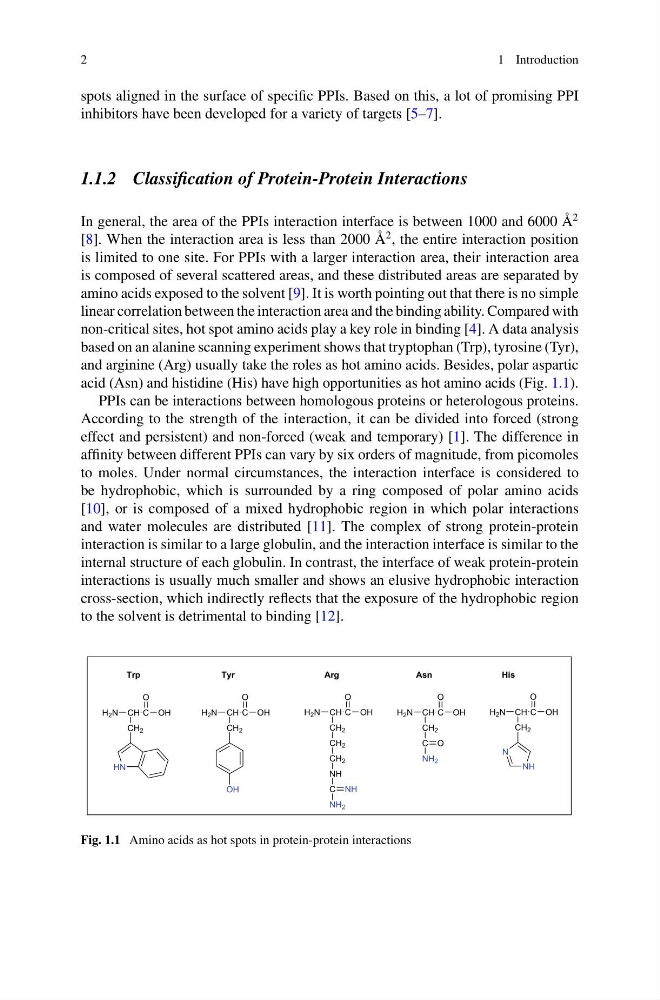
based on an alanine scanning experiment shows that tryptophan (Trp), tyrosine (Tyr),
and arginine (Arg) usually take the roles as hot amino acids. Besides, polar aspartic
acid (Asn) and histidine (His) have high opportunities as hot amino acids (Fig. 1.1).
PPIs can be interactions between homologous proteins or heterologous proteins.
According to the strength of the interaction, it can be divided into forced (strong
effect and persistent) and non-forced (weak and temporary) [1]. The difference in
affinity between different PPIs can vary by six orders of magnitude, from picomoles
to moles. Under normal circumstances, the interaction interface is considered to
be hydrophobic, which is surrounded by a ring composed of polar amino acids
[10], or is composed of a mixed hydrophobic region in which polar interactions
and water molecules are distributed [11]. The complex of strong protein-protein
interaction is similar to a large globulin, and the interaction interface is similar to the
internal structure of each globulin. In contrast, the interface of weak protein-protein
interactions is usually much smaller and shows an elusive hydrophobic interaction
cross-section, which indirectly reflects that the exposure of the hydrophobic region
to the solvent is detrimental to binding [12].
H 2 N CH C
CH 2
OH
O
HN
H 2 N CH C
CH 2
OH
O
OH
H 2 N CH C
CH 2
OH
O
CH 2
CH 2
NH
C
NH 2
NH
H 2 N CH C
CH 2
OH
O
C
NH 2
O
H 2 N CH C
CH 2
OH
O
N
NH
Trp
Tyr
Arg
Asn
His
Fig. 1.1 Amino acids as hot spots in protein-protein interactions
1 Introduction
spots aligned in the surface of specific PPIs. Based on this, a lot of promising PPI
inhibitors have been developed for a variety of targets [5–7].
1.1.2 Classification of Protein-Protein Interactions
In general, the area of the PPIs interaction interface is between 1000 and 6000 Å
2
[8]. When the interaction area is less than 2000 Å
2 , the entire interaction position
is limited to one site. For PPIs with a larger interaction area, their interaction area
is composed of several scattered areas, and these distributed areas are separated by
amino acids exposed to the solvent [9]. It is worth pointing out that there is no simple
linear correlation between the interaction area and the binding ability. Compared with
non-critical sites, hot spot amino acids play a key role in binding [4]. A data analysis
based on an alanine scanning experiment shows that tryptophan (Trp), tyrosine (Tyr),
and arginine (Arg) usually take the roles as hot amino acids. Besides, polar aspartic
acid (Asn) and histidine (His) have high opportunities as hot amino acids (Fig. 1.1).
PPIs can be interactions between homologous proteins or heterologous proteins.
According to the strength of the interaction, it can be divided into forced (strong
effect and persistent) and non-forced (weak and temporary) [1]. The difference in
affinity between different PPIs can vary by six orders of magnitude, from picomoles
to moles. Under normal circumstances, the interaction interface is considered to
be hydrophobic, which is surrounded by a ring composed of polar amino acids
[10], or is composed of a mixed hydrophobic region in which polar interactions
and water molecules are distributed [11]. The complex of strong protein-protein
interaction is similar to a large globulin, and the interaction interface is similar to the
internal structure of each globulin. In contrast, the interface of weak protein-protein
interactions is usually much smaller and shows an elusive hydrophobic interaction
cross-section, which indirectly reflects that the exposure of the hydrophobic region
to the solvent is detrimental to binding [12].
H 2 N CH C
CH 2
OH
O
HN
H 2 N CH C
CH 2
OH
O
OH
H 2 N CH C
CH 2
OH
O
CH 2
CH 2
NH
C
NH 2
NH
H 2 N CH C
CH 2
OH
O
C
NH 2
O
H 2 N CH C
CH 2
OH
O
N
NH
Trp
Tyr
Arg
Asn
His
Fig. 1.1 Amino acids as hot spots in protein-protein interactions