

capacity of ocean basins (the container). Changing the volume of water in the ocean involves a process of contraction
or thermal expansion, capture or release of this water by
another reservoir (e.g., ice caps), subducted down with
hydrated minerals in the mantle or released through degassing at oceanic ridges. Although the volume of water present
in the atmosphere in vapor and liquid form (*13,000 km
3 )
is fundamental to the functioning of the climate system, it is
negligible compared to the volume of water contained in the
ocean basins (*1347 million km
3 ). Variations in water
volumes in ocean basins on a time scale of between 1 and
100 ka is due to the formation or melting of ice caps. The
quantity of water held in the form of ice can lead to eustatic
variations of more than 100 m. At the geological time scale,
the presence of ice at the poles is an episodic phenomenon,
because it implies the presence of a continent in a near-polar
position and climate conditions allowing the formation of
permanent snow cover. For example, glaciation covered the
southern part of the Gondwana continent (which corresponds to the southern part of South America, the southern
part of Africa, the southern part of the Arabian Peninsula,
parts of India and Australia and the whole of Antarctica,
these areas having been united at one time) for about
70 million years (335–265 Ma), marked by alternating
phases of growth and melting of the ice cap. The Gondwana
ice sheet at its climax may have sequestered a volume of
water of approximately 200 m (compared with 70 m for the
Antarctic cap of today). Finally, water storage in lakes, rivers
(*0.26 million km
3 ) and in underground reservoirs
(*9 million km
3
) makes a very marginal contribution.
The most frequently cited mechanism to explain sea level
changes over the scale of geological time is oceanic crustal
production rates and extruded oceanic plateaus. In the 1980s,
the oceanic production rate was estimated for the last
180 Ma. For the lower Cretaceous it was estimated to be
twice as high as today, while a drop of about 50% over the
last 50 million years was found. However these estimates
have been called into question following new estimates of
accretion rates and normalized fluxes which suggested
variations in the fluxes with an amplitude of 30% or less
around the present value (Cogné and Humler 2006). Such
estimates could challenge the role of the ridges in sea level
variations. The Wilson cycles, i.e. the construction followed
by the fragmentation of a supercontinent, have been identified as a possible mechanism to explain the first-order
eustatic variations. Indeed, fragmentation periods produce
young oceanic crust. The volume occupied by the ridges at
the expense of the old crust lost by subduction reduces the
total volume of the oceans and raises their level, and conversely during the period of supercontinent construction, the
total volume of the ridges decreases and the level of the
oceans drops. In other words, the average age of the oceans
reflects the first-order eustatic variations. It is thus a major
challenge to develop plate motion models than can provide
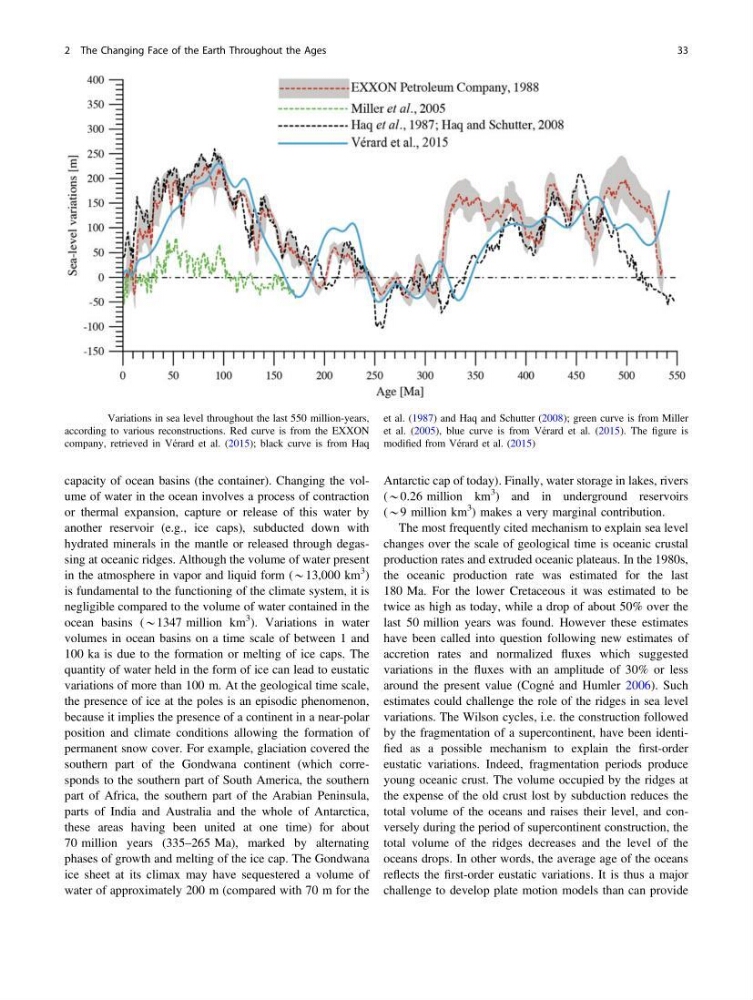
Fig. 2.4 Variations in sea level throughout the last 550 million-years,
according to various reconstructions. Red curve is from the EXXON
company, retrieved in Vérard et al. (2015); black curve is from Haq
et al. (1987) and Haq and Schutter (2008); green curve is from Miller
et al. (2005), blue curve is from Vérard et al. (2015). The figure is
modified from Vérard et al. (2015)
2 The Changing Face of the Earth Throughout the Ages
33
or thermal expansion, capture or release of this water by
another reservoir (e.g., ice caps), subducted down with
hydrated minerals in the mantle or released through degassing at oceanic ridges. Although the volume of water present
in the atmosphere in vapor and liquid form (*13,000 km
3 )
is fundamental to the functioning of the climate system, it is
negligible compared to the volume of water contained in the
ocean basins (*1347 million km
3 ). Variations in water
volumes in ocean basins on a time scale of between 1 and
100 ka is due to the formation or melting of ice caps. The
quantity of water held in the form of ice can lead to eustatic
variations of more than 100 m. At the geological time scale,
the presence of ice at the poles is an episodic phenomenon,
because it implies the presence of a continent in a near-polar
position and climate conditions allowing the formation of
permanent snow cover. For example, glaciation covered the
southern part of the Gondwana continent (which corresponds to the southern part of South America, the southern
part of Africa, the southern part of the Arabian Peninsula,
parts of India and Australia and the whole of Antarctica,
these areas having been united at one time) for about
70 million years (335–265 Ma), marked by alternating
phases of growth and melting of the ice cap. The Gondwana
ice sheet at its climax may have sequestered a volume of
water of approximately 200 m (compared with 70 m for the
Antarctic cap of today). Finally, water storage in lakes, rivers
(*0.26 million km
3 ) and in underground reservoirs
(*9 million km
3
) makes a very marginal contribution.
The most frequently cited mechanism to explain sea level
changes over the scale of geological time is oceanic crustal
production rates and extruded oceanic plateaus. In the 1980s,
the oceanic production rate was estimated for the last
180 Ma. For the lower Cretaceous it was estimated to be
twice as high as today, while a drop of about 50% over the
last 50 million years was found. However these estimates
have been called into question following new estimates of
accretion rates and normalized fluxes which suggested
variations in the fluxes with an amplitude of 30% or less
around the present value (Cogné and Humler 2006). Such
estimates could challenge the role of the ridges in sea level
variations. The Wilson cycles, i.e. the construction followed
by the fragmentation of a supercontinent, have been identified as a possible mechanism to explain the first-order
eustatic variations. Indeed, fragmentation periods produce
young oceanic crust. The volume occupied by the ridges at
the expense of the old crust lost by subduction reduces the
total volume of the oceans and raises their level, and conversely during the period of supercontinent construction, the
total volume of the ridges decreases and the level of the
oceans drops. In other words, the average age of the oceans
reflects the first-order eustatic variations. It is thus a major
challenge to develop plate motion models than can provide
Fig. 2.4 Variations in sea level throughout the last 550 million-years,
according to various reconstructions. Red curve is from the EXXON
company, retrieved in Vérard et al. (2015); black curve is from Haq
et al. (1987) and Haq and Schutter (2008); green curve is from Miller
et al. (2005), blue curve is from Vérard et al. (2015). The figure is
modified from Vérard et al. (2015)
2 The Changing Face of the Earth Throughout the Ages
33