

Holocene, they have come to slightly different conclusions
about the origin of this evolution. All of the studies, however, attribute the main source of variation to solar radiation
and a change in the seasonal cycle.
The first simulations were carried out with a model of
intermediate complexity dedicated to the study of this phenomenon (Clement et al. 2000). The area covered by the
model was limited to the tropical Pacific Ocean. The different equations are treated with regard to their difference
from the mean state. These simulations do not therefore
explicitly include changes in the seasonal cycle brought
about by changes in insolation during the Holocene. Nevertheless, they have helped to improve our understanding of
the response by the tropical ocean to changes in surface
fluxes. The basic mechanism implies a behavioral difference
between the western part of the basin, where warm waters
accumulate, and the eastern part, where equatorial upwelling
develops. During the northern polar summer, the increase in
insolation warms the western part of the basin more than the
east. It increases the temperature gradient across the basin
and, strengthens the easterly trade winds and hence favors
the development of equatorial upwelling and the temperature
gradient. This feedback is called the Bjerknes mechanism
(1969).
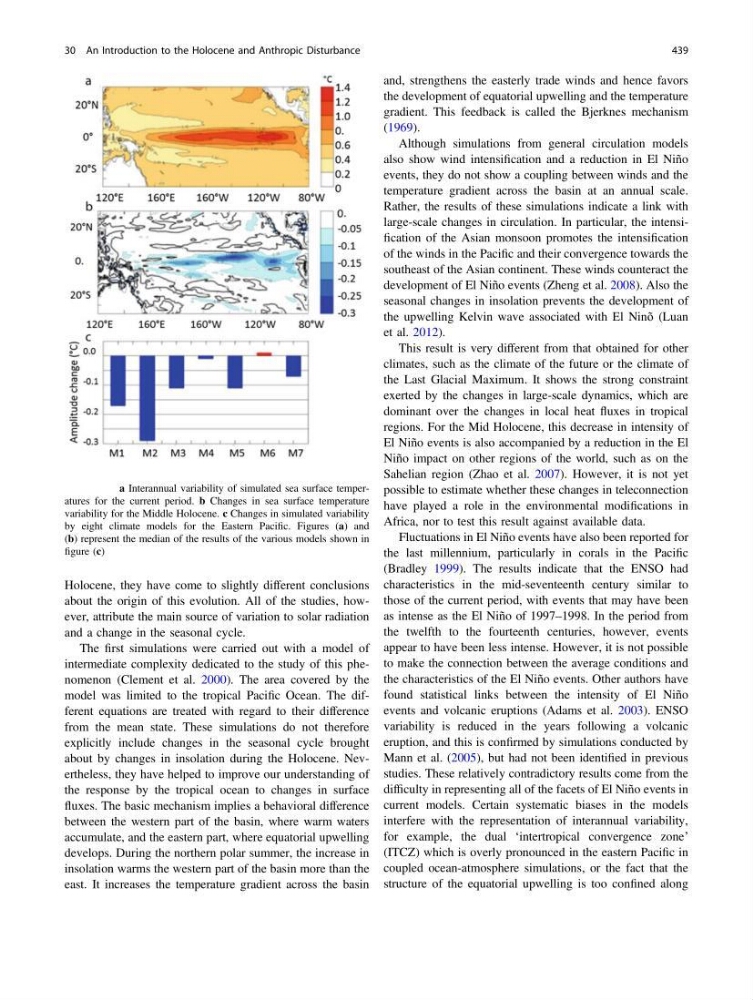
Although simulations from general circulation models
also show wind intensification and a reduction in El Niño
events, they do not show a coupling between winds and the
temperature gradient across the basin at an annual scale.
Rather, the results of these simulations indicate a link with
large-scale changes in circulation. In particular, the intensification of the Asian monsoon promotes the intensification
of the winds in the Pacific and their convergence towards the
southeast of the Asian continent. These winds counteract the
development of El Niño events (Zheng et al. 2008). Also the
seasonal changes in insolation prevents the development of
the upwelling Kelvin wave associated with El Ninõ (Luan
et al. 2012).
This result is very different from that obtained for other
climates, such as the climate of the future or the climate of
the Last Glacial Maximum. It shows the strong constraint
exerted by the changes in large-scale dynamics, which are
dominant over the changes in local heat fluxes in tropical
regions. For the Mid Holocene, this decrease in intensity of
El Niño events is also accompanied by a reduction in the El
Niño impact on other regions of the world, such as on the
Sahelian region (Zhao et al. 2007). However, it is not yet
possible to estimate whether these changes in teleconnection
have played a role in the environmental modifications in
Africa, nor to test this result against available data.
Fluctuations in El Niño events have also been reported for
the last millennium, particularly in corals in the Pacific
(Bradley 1999). The results indicate that the ENSO had
characteristics in the mid-seventeenth century similar to
those of the current period, with events that may have been
as intense as the El Niño of 1997–1998. In the period from
the twelfth to the fourteenth centuries, however, events
appear to have been less intense. However, it is not possible
to make the connection between the average conditions and
the characteristics of the El Niño events. Other authors have
found statistical links between the intensity of El Niño
events and volcanic eruptions (Adams et al. 2003). ENSO
variability is reduced in the years following a volcanic
eruption, and this is confirmed by simulations conducted by
Mann et al. (2005), but had not been identified in previous
studies. These relatively contradictory results come from the
difficulty in representing all of the facets of El Niño events in
current models. Certain systematic biases in the models
interfere with the representation of interannual variability,
for example, the dual ‘intertropical convergence zone’
(ITCZ) which is overly pronounced in the eastern Pacific in
coupled ocean-atmosphere simulations, or the fact that the
structure of the equatorial upwelling is too confined along
Fig. 30.11 a Interannual variability of simulated sea surface temperatures for the current period. b Changes in sea surface temperature
variability for the Middle Holocene. c Changes in simulated variability
by eight climate models for the Eastern Pacific. Figures (a) and
(b) represent the median of the results of the various models shown in
figure (c)
30 An Introduction to the Holocene and Anthropic Disturbance
439
about the origin of this evolution. All of the studies, however, attribute the main source of variation to solar radiation
and a change in the seasonal cycle.
The first simulations were carried out with a model of
intermediate complexity dedicated to the study of this phenomenon (Clement et al. 2000). The area covered by the
model was limited to the tropical Pacific Ocean. The different equations are treated with regard to their difference
from the mean state. These simulations do not therefore
explicitly include changes in the seasonal cycle brought
about by changes in insolation during the Holocene. Nevertheless, they have helped to improve our understanding of
the response by the tropical ocean to changes in surface
fluxes. The basic mechanism implies a behavioral difference
between the western part of the basin, where warm waters
accumulate, and the eastern part, where equatorial upwelling
develops. During the northern polar summer, the increase in
insolation warms the western part of the basin more than the
east. It increases the temperature gradient across the basin
and, strengthens the easterly trade winds and hence favors
the development of equatorial upwelling and the temperature
gradient. This feedback is called the Bjerknes mechanism
(1969).
Although simulations from general circulation models
also show wind intensification and a reduction in El Niño
events, they do not show a coupling between winds and the
temperature gradient across the basin at an annual scale.
Rather, the results of these simulations indicate a link with
large-scale changes in circulation. In particular, the intensification of the Asian monsoon promotes the intensification
of the winds in the Pacific and their convergence towards the
southeast of the Asian continent. These winds counteract the
development of El Niño events (Zheng et al. 2008). Also the
seasonal changes in insolation prevents the development of
the upwelling Kelvin wave associated with El Ninõ (Luan
et al. 2012).
This result is very different from that obtained for other
climates, such as the climate of the future or the climate of
the Last Glacial Maximum. It shows the strong constraint
exerted by the changes in large-scale dynamics, which are
dominant over the changes in local heat fluxes in tropical
regions. For the Mid Holocene, this decrease in intensity of
El Niño events is also accompanied by a reduction in the El
Niño impact on other regions of the world, such as on the
Sahelian region (Zhao et al. 2007). However, it is not yet
possible to estimate whether these changes in teleconnection
have played a role in the environmental modifications in
Africa, nor to test this result against available data.
Fluctuations in El Niño events have also been reported for
the last millennium, particularly in corals in the Pacific
(Bradley 1999). The results indicate that the ENSO had
characteristics in the mid-seventeenth century similar to
those of the current period, with events that may have been
as intense as the El Niño of 1997–1998. In the period from
the twelfth to the fourteenth centuries, however, events
appear to have been less intense. However, it is not possible
to make the connection between the average conditions and
the characteristics of the El Niño events. Other authors have
found statistical links between the intensity of El Niño
events and volcanic eruptions (Adams et al. 2003). ENSO
variability is reduced in the years following a volcanic
eruption, and this is confirmed by simulations conducted by
Mann et al. (2005), but had not been identified in previous
studies. These relatively contradictory results come from the
difficulty in representing all of the facets of El Niño events in
current models. Certain systematic biases in the models
interfere with the representation of interannual variability,
for example, the dual ‘intertropical convergence zone’
(ITCZ) which is overly pronounced in the eastern Pacific in
coupled ocean-atmosphere simulations, or the fact that the
structure of the equatorial upwelling is too confined along
Fig. 30.11 a Interannual variability of simulated sea surface temperatures for the current period. b Changes in sea surface temperature
variability for the Middle Holocene. c Changes in simulated variability
by eight climate models for the Eastern Pacific. Figures (a) and
(b) represent the median of the results of the various models shown in
figure (c)
30 An Introduction to the Holocene and Anthropic Disturbance
439