

less amplified in the case of an interactive ocean than in
older simulations, carried out with atmospheric models
forced by the current SST.
The Role of Vegetation
Another factor that affects the characteristics of the monsoon
is changing vegetation. Vegetation modifies the surface
albedo and the ways in which soil water is used. Depending
on the type of vegetation, water losses through interception,
evaporation from bare soil and transpiration are distributed
differently. All climate models incorporate a more or less
complex land surface model to determine the exchanges of
heat and water between the surface and the atmosphere. The
types of vegetation and the resulting surface characteristics
(albedo, roughness, resistance to evaporation) are prescribed
from current data. Simulations of the Middle Holocene tend
to underestimate the hydrological changes in the Sahelian
region (Joussaume et al. 1999). Vegetation characteristics
are generally set in line with current ones although pollen
data indicate changes in vegetation (Jolly 1998). Change in
vegetation, not taken into account in these simulations, is a
likely candidate to explain this underestimate.
The first coupled atmosphere-vegetation simulations
involved an iterative coupling between climate and vegetation. For this, a vegetation model was used to simulate a
vegetation in equilibrium with the climate produced by the
atmospheric model and then was reintroduced as a boundary
condition to the climate model (Claussen and Gayler 1997;
de Noblet 1996). The process is reiterated until climate and
vegetation are in equilibrium, i.e. with no major difference
between two iterations. New versions of land surface models
include the carbon cycle and vegetation dynamics (Krinner
2005), which allows for interactive representation of vegetation changes, taking into account both slow changes in
vegetation (replacement of one vegetation type by another)
and the interactions of these vegetation changes with the
climate. There are still many uncertainties in how these
couplings are represented, which results in marked differences in the amplitude of how vegetation reinforces precipitation in monsoon regions (Braconnot et al. 2007b).
Nevertheless, some of the broad outlines appear robust.
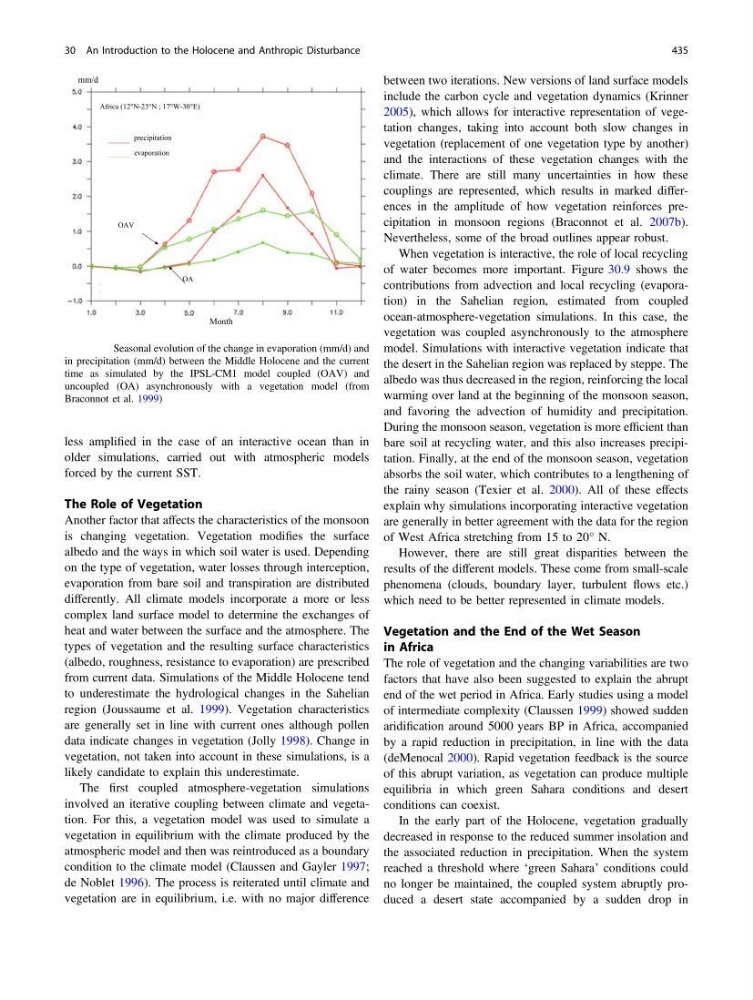
When vegetation is interactive, the role of local recycling
of water becomes more important. Figure 30.9 shows the
contributions from advection and local recycling (evaporation) in the Sahelian region, estimated from coupled
ocean-atmosphere-vegetation simulations. In this case, the
vegetation was coupled asynchronously to the atmosphere
model. Simulations with interactive vegetation indicate that
the desert in the Sahelian region was replaced by steppe. The
albedo was thus decreased in the region, reinforcing the local
warming over land at the beginning of the monsoon season,
and favoring the advection of humidity and precipitation.
During the monsoon season, vegetation is more efficient than
bare soil at recycling water, and this also increases precipitation. Finally, at the end of the monsoon season, vegetation
absorbs the soil water, which contributes to a lengthening of
the rainy season (Texier et al. 2000). All of these effects
explain why simulations incorporating interactive vegetation
are generally in better agreement with the data for the region
of West Africa stretching from 15 to 20° N.
However, there are still great disparities between the
results of the different models. These come from small-scale
phenomena (clouds, boundary layer, turbulent flows etc.)
which need to be better represented in climate models.
Vegetation and the End of the Wet Season
in Africa
The role of vegetation and the changing variabilities are two
factors that have also been suggested to explain the abrupt
end of the wet period in Africa. Early studies using a model
of intermediate complexity (Claussen 1999) showed sudden
aridification around 5000 years BP in Africa, accompanied
by a rapid reduction in precipitation, in line with the data
(deMenocal 2000). Rapid vegetation feedback is the source
of this abrupt variation, as vegetation can produce multiple
equilibria in which green Sahara conditions and desert
conditions can coexist.
In the early part of the Holocene, vegetation gradually
decreased in response to the reduced summer insolation and
the associated reduction in precipitation. When the system
reached a threshold where ‘green Sahara’ conditions could
no longer be maintained, the coupled system abruptly produced a desert state accompanied by a sudden drop in
Africa (12°N-23°N ; 17°W-30°E)
mm/d
Month
OAV
OA
evaporation
precipitation
Fig. 30.9 Seasonal evolution of the change in evaporation (mm/d) and
in precipitation (mm/d) between the Middle Holocene and the current
time as simulated by the IPSL-CM1 model coupled (OAV) and
uncoupled (OA) asynchronously with a vegetation model (from
Braconnot et al. 1999)
30 An Introduction to the Holocene and Anthropic Disturbance
435
older simulations, carried out with atmospheric models
forced by the current SST.
The Role of Vegetation
Another factor that affects the characteristics of the monsoon
is changing vegetation. Vegetation modifies the surface
albedo and the ways in which soil water is used. Depending
on the type of vegetation, water losses through interception,
evaporation from bare soil and transpiration are distributed
differently. All climate models incorporate a more or less
complex land surface model to determine the exchanges of
heat and water between the surface and the atmosphere. The
types of vegetation and the resulting surface characteristics
(albedo, roughness, resistance to evaporation) are prescribed
from current data. Simulations of the Middle Holocene tend
to underestimate the hydrological changes in the Sahelian
region (Joussaume et al. 1999). Vegetation characteristics
are generally set in line with current ones although pollen
data indicate changes in vegetation (Jolly 1998). Change in
vegetation, not taken into account in these simulations, is a
likely candidate to explain this underestimate.
The first coupled atmosphere-vegetation simulations
involved an iterative coupling between climate and vegetation. For this, a vegetation model was used to simulate a
vegetation in equilibrium with the climate produced by the
atmospheric model and then was reintroduced as a boundary
condition to the climate model (Claussen and Gayler 1997;
de Noblet 1996). The process is reiterated until climate and
vegetation are in equilibrium, i.e. with no major difference
between two iterations. New versions of land surface models
include the carbon cycle and vegetation dynamics (Krinner
2005), which allows for interactive representation of vegetation changes, taking into account both slow changes in
vegetation (replacement of one vegetation type by another)
and the interactions of these vegetation changes with the
climate. There are still many uncertainties in how these
couplings are represented, which results in marked differences in the amplitude of how vegetation reinforces precipitation in monsoon regions (Braconnot et al. 2007b).
Nevertheless, some of the broad outlines appear robust.
When vegetation is interactive, the role of local recycling
of water becomes more important. Figure 30.9 shows the
contributions from advection and local recycling (evaporation) in the Sahelian region, estimated from coupled
ocean-atmosphere-vegetation simulations. In this case, the
vegetation was coupled asynchronously to the atmosphere
model. Simulations with interactive vegetation indicate that
the desert in the Sahelian region was replaced by steppe. The
albedo was thus decreased in the region, reinforcing the local
warming over land at the beginning of the monsoon season,
and favoring the advection of humidity and precipitation.
During the monsoon season, vegetation is more efficient than
bare soil at recycling water, and this also increases precipitation. Finally, at the end of the monsoon season, vegetation
absorbs the soil water, which contributes to a lengthening of
the rainy season (Texier et al. 2000). All of these effects
explain why simulations incorporating interactive vegetation
are generally in better agreement with the data for the region
of West Africa stretching from 15 to 20° N.
However, there are still great disparities between the
results of the different models. These come from small-scale
phenomena (clouds, boundary layer, turbulent flows etc.)
which need to be better represented in climate models.
Vegetation and the End of the Wet Season
in Africa
The role of vegetation and the changing variabilities are two
factors that have also been suggested to explain the abrupt
end of the wet period in Africa. Early studies using a model
of intermediate complexity (Claussen 1999) showed sudden
aridification around 5000 years BP in Africa, accompanied
by a rapid reduction in precipitation, in line with the data
(deMenocal 2000). Rapid vegetation feedback is the source
of this abrupt variation, as vegetation can produce multiple
equilibria in which green Sahara conditions and desert
conditions can coexist.
In the early part of the Holocene, vegetation gradually
decreased in response to the reduced summer insolation and
the associated reduction in precipitation. When the system
reached a threshold where ‘green Sahara’ conditions could
no longer be maintained, the coupled system abruptly produced a desert state accompanied by a sudden drop in
Africa (12°N-23°N ; 17°W-30°E)
mm/d
Month
OAV
OA
evaporation
precipitation
Fig. 30.9 Seasonal evolution of the change in evaporation (mm/d) and
in precipitation (mm/d) between the Middle Holocene and the current
time as simulated by the IPSL-CM1 model coupled (OAV) and
uncoupled (OA) asynchronously with a vegetation model (from
Braconnot et al. 1999)
30 An Introduction to the Holocene and Anthropic Disturbance
435