

greenhouse gases into the atmosphere to be detectable in the
glacial and sedimentary archives (Ruddiman 2007).
Climate Reconstructions for the Holocene
The Different Archives
The reconstruction of climate conditions during the Holocene poses several major challenges for the scientific community. The low amplitude of the variations in mean
temperature, compared to the amplitude observed during the
glacial ages, makes it difficult to use the usual indicators to
identify a signal. Moreover, the need to take sub-annual time
scales into account to describe the significant events means
pushing the interpretation of many climate indicators to the
limit, or else finding new ones compared to the ones traditionally used in paleoclimatology.
The typology of paleoclimate indicators for the Holocene
allows them to be divided into two main categories: natural
archives and societal archives. The characteristics of these
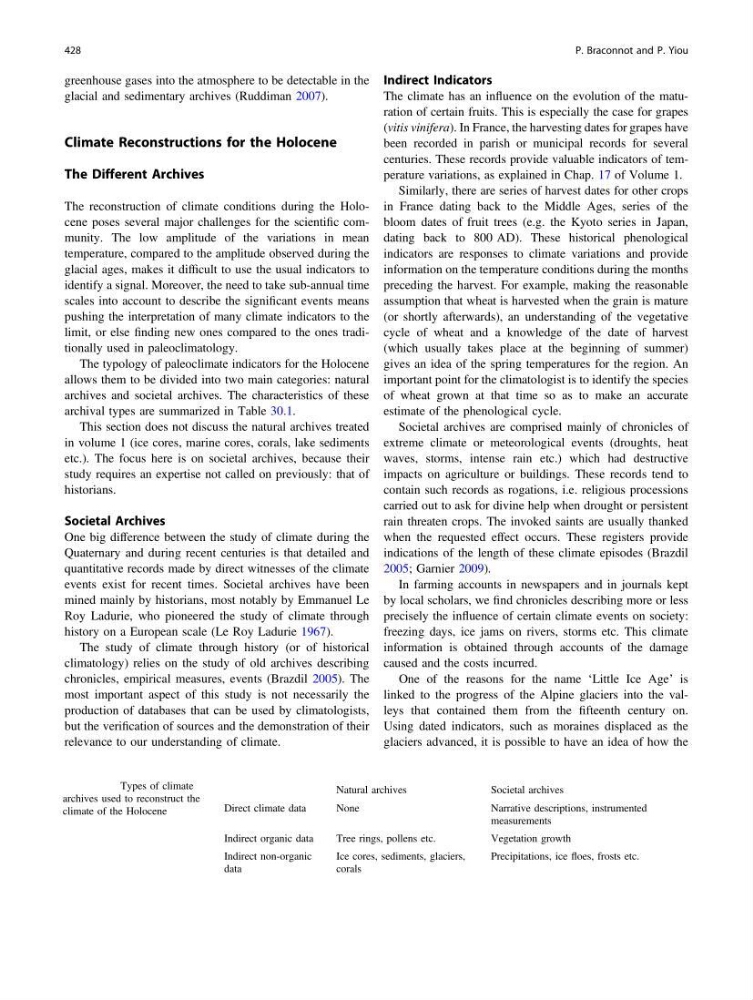
archival types are summarized in Table 30.1.
This section does not discuss the natural archives treated
in volume 1 (ice cores, marine cores, corals, lake sediments
etc.). The focus here is on societal archives, because their
study requires an expertise not called on previously: that of
historians.
Societal Archives
One big difference between the study of climate during the
Quaternary and during recent centuries is that detailed and
quantitative records made by direct witnesses of the climate
events exist for recent times. Societal archives have been
mined mainly by historians, most notably by Emmanuel Le
Roy Ladurie, who pioneered the study of climate through
history on a European scale (Le Roy Ladurie 1967).
The study of climate through history (or of historical
climatology) relies on the study of old archives describing
chronicles, empirical measures, events (Brazdil 2005). The
most important aspect of this study is not necessarily the
production of databases that can be used by climatologists,
but the verification of sources and the demonstration of their
relevance to our understanding of climate.
Indirect Indicators
The climate has an influence on the evolution of the maturation of certain fruits. This is especially the case for grapes
(vitis vinifera). In France, the harvesting dates for grapes have
been recorded in parish or municipal records for several
centuries. These records provide valuable indicators of temperature variations, as explained in Chap. 17 of Volume 1.
Similarly, there are series of harvest dates for other crops
in France dating back to the Middle Ages, series of the
bloom dates of fruit trees (e.g. the Kyoto series in Japan,
dating back to 800 AD). These historical phenological
indicators are responses to climate variations and provide
information on the temperature conditions during the months
preceding the harvest. For example, making the reasonable
assumption that wheat is harvested when the grain is mature
(or shortly afterwards), an understanding of the vegetative
cycle of wheat and a knowledge of the date of harvest
(which usually takes place at the beginning of summer)
gives an idea of the spring temperatures for the region. An
important point for the climatologist is to identify the species
of wheat grown at that time so as to make an accurate
estimate of the phenological cycle.
Societal archives are comprised mainly of chronicles of
extreme climate or meteorological events (droughts, heat
waves, storms, intense rain etc.) which had destructive
impacts on agriculture or buildings. These records tend to
contain such records as rogations, i.e. religious processions
carried out to ask for divine help when drought or persistent
rain threaten crops. The invoked saints are usually thanked
when the requested effect occurs. These registers provide
indications of the length of these climate episodes (Brazdil
2005; Garnier 2009).
In farming accounts in newspapers and in journals kept
by local scholars, we find chronicles describing more or less
precisely the influence of certain climate events on society:
freezing days, ice jams on rivers, storms etc. This climate
information is obtained through accounts of the damage
caused and the costs incurred.
One of the reasons for the name ‘Little Ice Age’ is
linked to the progress of the Alpine glaciers into the valleys that contained them from the fifteenth century on.
Using dated indicators, such as moraines displaced as the
glaciers advanced, it is possible to have an idea of how the
Table 30.1 Types of climate
archives used to reconstruct the
climate of the Holocene
Natural archives
Societal archives
Direct climate data
None
Narrative descriptions, instrumented
measurements
Indirect organic data
Tree rings, pollens etc.
Vegetation growth
Indirect non-organic
data
Ice cores, sediments, glaciers,
corals
Precipitations, ice floes, frosts etc.
428
P. Braconnot and P. Yiou
glacial and sedimentary archives (Ruddiman 2007).
Climate Reconstructions for the Holocene
The Different Archives
The reconstruction of climate conditions during the Holocene poses several major challenges for the scientific community. The low amplitude of the variations in mean
temperature, compared to the amplitude observed during the
glacial ages, makes it difficult to use the usual indicators to
identify a signal. Moreover, the need to take sub-annual time
scales into account to describe the significant events means
pushing the interpretation of many climate indicators to the
limit, or else finding new ones compared to the ones traditionally used in paleoclimatology.
The typology of paleoclimate indicators for the Holocene
allows them to be divided into two main categories: natural
archives and societal archives. The characteristics of these
archival types are summarized in Table 30.1.
This section does not discuss the natural archives treated
in volume 1 (ice cores, marine cores, corals, lake sediments
etc.). The focus here is on societal archives, because their
study requires an expertise not called on previously: that of
historians.
Societal Archives
One big difference between the study of climate during the
Quaternary and during recent centuries is that detailed and
quantitative records made by direct witnesses of the climate
events exist for recent times. Societal archives have been
mined mainly by historians, most notably by Emmanuel Le
Roy Ladurie, who pioneered the study of climate through
history on a European scale (Le Roy Ladurie 1967).
The study of climate through history (or of historical
climatology) relies on the study of old archives describing
chronicles, empirical measures, events (Brazdil 2005). The
most important aspect of this study is not necessarily the
production of databases that can be used by climatologists,
but the verification of sources and the demonstration of their
relevance to our understanding of climate.
Indirect Indicators
The climate has an influence on the evolution of the maturation of certain fruits. This is especially the case for grapes
(vitis vinifera). In France, the harvesting dates for grapes have
been recorded in parish or municipal records for several
centuries. These records provide valuable indicators of temperature variations, as explained in Chap. 17 of Volume 1.
Similarly, there are series of harvest dates for other crops
in France dating back to the Middle Ages, series of the
bloom dates of fruit trees (e.g. the Kyoto series in Japan,
dating back to 800 AD). These historical phenological
indicators are responses to climate variations and provide
information on the temperature conditions during the months
preceding the harvest. For example, making the reasonable
assumption that wheat is harvested when the grain is mature
(or shortly afterwards), an understanding of the vegetative
cycle of wheat and a knowledge of the date of harvest
(which usually takes place at the beginning of summer)
gives an idea of the spring temperatures for the region. An
important point for the climatologist is to identify the species
of wheat grown at that time so as to make an accurate
estimate of the phenological cycle.
Societal archives are comprised mainly of chronicles of
extreme climate or meteorological events (droughts, heat
waves, storms, intense rain etc.) which had destructive
impacts on agriculture or buildings. These records tend to
contain such records as rogations, i.e. religious processions
carried out to ask for divine help when drought or persistent
rain threaten crops. The invoked saints are usually thanked
when the requested effect occurs. These registers provide
indications of the length of these climate episodes (Brazdil
2005; Garnier 2009).
In farming accounts in newspapers and in journals kept
by local scholars, we find chronicles describing more or less
precisely the influence of certain climate events on society:
freezing days, ice jams on rivers, storms etc. This climate
information is obtained through accounts of the damage
caused and the costs incurred.
One of the reasons for the name ‘Little Ice Age’ is
linked to the progress of the Alpine glaciers into the valleys that contained them from the fifteenth century on.
Using dated indicators, such as moraines displaced as the
glaciers advanced, it is possible to have an idea of how the
Table 30.1 Types of climate
archives used to reconstruct the
climate of the Holocene
Natural archives
Societal archives
Direct climate data
None
Narrative descriptions, instrumented
measurements
Indirect organic data
Tree rings, pollens etc.
Vegetation growth
Indirect non-organic
data
Ice cores, sediments, glaciers,
corals
Precipitations, ice floes, frosts etc.
428
P. Braconnot and P. Yiou