

the water column. These highly saline bottom waters are
likely to form around Antarctica, due to the salt deposits that
occur during the formation of sea ice. Indeed, thanks to the
continental shelf, these very salty waters are able to flow
along the topography (Ohshima et al. 2013) and reach the
abyss of the Southern Ocean. The consequences for the
carbon cycle of this ocean configuration are considerable.
With a mechanism of this type, it is possible to store a lot of
carbon at the bottom of the ocean and to explain the low
level of atmospheric CO 2 . This mechanism was recently
confirmed in a relatively simple model coupling climate and
carbon cycle (Bouttes et al. 2011). This makes it possible to
formulate a scenario that accounts for the glacial-interglacial
cycles, both in terms of changes in the expanse of the ice
sheets, but also in terms of atmospheric CO 2 and hence
global climate (Paillard and Parrenin 2004), as shown in
Fig. 28.9.
In this model, terminations are explicitly induced by an
increase in atmospheric CO 2 , itself caused by the previous
glacial maximum, which destabilizes the stratification of the
deep ocean. Since this model is based on a bi-modal system,
it correctly reproduces certain characteristics already present
in even simpler models (Paillard 1998), such as the possibility of switching between dominant periodicities, from
23,000-year cycles before the Quaternary glaciations became
established, to 41,000-year cycles 3 million years ago, and
then to 100,000-year cycles in the last million years.
Pre-quaternary Astronomical Cycles
Periodic variations of insolation have existed throughout the
history of our planet. Although their effects on the climate
have been particularly marked for about a million years
-120
-100
-80
-60
-40
-20
0
5
1 0
1 5
2 0
Age (kyr BP)
200
220
240
260
280
2
Atmospheric CO (ppm)
-440
-430
-420
-410
-400
Antarctic
temperature
(Dome C)
470
480
490
500
510
520
530
Sea level
(from corals)
insolation
(65°N, 21st june)
CO 2
Dome C
δD (‰)
Sea level
(meters below current level)
Insolation (W/m 2
)
MWP 1A
25
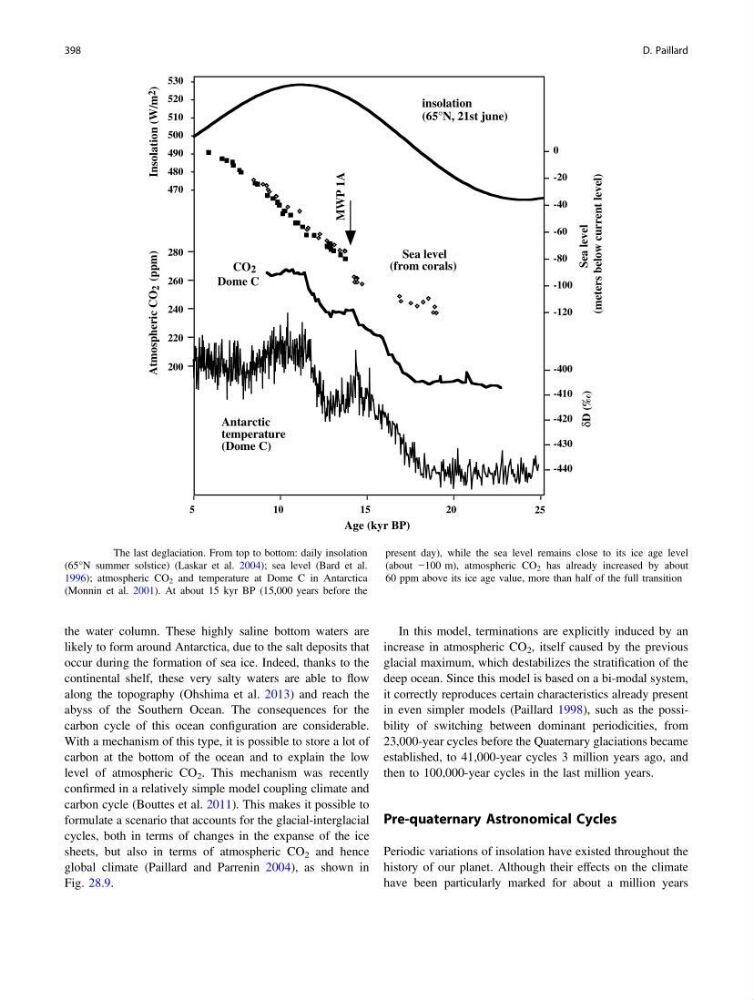
Fig. 28.8 The last deglaciation. From top to bottom: daily insolation
(65°N summer solstice) (Laskar et al. 2004); sea level (Bard et al.
1996); atmospheric CO 2 and temperature at Dome C in Antarctica
(Monnin et al. 2001). At about 15 kyr BP (15,000 years before the
present day), while the sea level remains close to its ice age level
(about −100 m), atmospheric CO 2 has already increased by about
60 ppm above its ice age value, more than half of the full transition
398
D. Paillard
likely to form around Antarctica, due to the salt deposits that
occur during the formation of sea ice. Indeed, thanks to the
continental shelf, these very salty waters are able to flow
along the topography (Ohshima et al. 2013) and reach the
abyss of the Southern Ocean. The consequences for the
carbon cycle of this ocean configuration are considerable.
With a mechanism of this type, it is possible to store a lot of
carbon at the bottom of the ocean and to explain the low
level of atmospheric CO 2 . This mechanism was recently
confirmed in a relatively simple model coupling climate and
carbon cycle (Bouttes et al. 2011). This makes it possible to
formulate a scenario that accounts for the glacial-interglacial
cycles, both in terms of changes in the expanse of the ice
sheets, but also in terms of atmospheric CO 2 and hence
global climate (Paillard and Parrenin 2004), as shown in
Fig. 28.9.
In this model, terminations are explicitly induced by an
increase in atmospheric CO 2 , itself caused by the previous
glacial maximum, which destabilizes the stratification of the
deep ocean. Since this model is based on a bi-modal system,
it correctly reproduces certain characteristics already present
in even simpler models (Paillard 1998), such as the possibility of switching between dominant periodicities, from
23,000-year cycles before the Quaternary glaciations became
established, to 41,000-year cycles 3 million years ago, and
then to 100,000-year cycles in the last million years.
Pre-quaternary Astronomical Cycles
Periodic variations of insolation have existed throughout the
history of our planet. Although their effects on the climate
have been particularly marked for about a million years
-120
-100
-80
-60
-40
-20
0
5
1 0
1 5
2 0
Age (kyr BP)
200
220
240
260
280
2
Atmospheric CO (ppm)
-440
-430
-420
-410
-400
Antarctic
temperature
(Dome C)
470
480
490
500
510
520
530
Sea level
(from corals)
insolation
(65°N, 21st june)
CO 2
Dome C
δD (‰)
Sea level
(meters below current level)
Insolation (W/m 2
)
MWP 1A
25
Fig. 28.8 The last deglaciation. From top to bottom: daily insolation
(65°N summer solstice) (Laskar et al. 2004); sea level (Bard et al.
1996); atmospheric CO 2 and temperature at Dome C in Antarctica
(Monnin et al. 2001). At about 15 kyr BP (15,000 years before the
present day), while the sea level remains close to its ice age level
(about −100 m), atmospheric CO 2 has already increased by about
60 ppm above its ice age value, more than half of the full transition
398
D. Paillard