

(McLennan and Jones 2006). The reduction in the height of
the water column could have led to a drop in pressure and a
destabilization of the methane hydrates in sediments. There
may be a link between these regional eruptions and the
PETM, although this assumption needs to be tested by more
precise dating. Another hypothesis is that a significant
change in ocean circulation could have significantly warmed
the deep waters (by 4–5 °C), causing the destabilization of
gas hydrates stored in sediments and initiating the PETM.
Conclusions
The reconstruction of climates on the scale of geological
time is still open to discussion. The main difficulty lies in the
fact that climate and biogeochemical cycles cannot be dissociated. There are numerous indicators of geochemical and
climatic changes, but they are always difficult to interpret
because of their indirect nature. The numerical models used
are often very simple, taking a global average approach in
most studies, which does not explicitly take into consideration the many parameters of the climate system. Yet ancient
climates also represent an amazing testing-ground where
new techniques can be developed and innovative ideas can
be explored. In this field of study, climate models, initially
developed to understand the evolution of current climate, are
applied to extreme conditions, and the extent to which they
are suitable is questionable. One limitation is the simplistic
way the changing geographical configuration of the past is
taken into account due to the lack of precise information.
This is a climate factor of the highest importance and we are
not sure that complex models, such as atmospheric general
circulation models coupled with ocean-atmospheric models,
react correctly when boundary conditions are changed in
such a drastic manner.
Nevertheless, the refining of analytical techniques and
models, the process of trial and error, the successes and the
failures allow us to discover a general history of the Earth’s
climate at the same time as multicellular organisms evolved.
One of the major debates of recent years has been around the
link between the level of atmospheric CO 2 and the evolution
of climate during the Phanerozoic, which appear to have
been decoupled during certain major events. Given the
enormous uncertainties that exist in the reconstruction of
CO 2 levels using isotopic methods or based on paleontological data (Royer 2006) and taking into account the
uncertainties around isotope-based climate reconstructions,
it is not possible to claim the existence or non-existence of a
decorrelation between CO 2 level on one side and climate on
the other. However, the use of a new generation of models
that closely couples the carbon cycle with climate by taking
into account the spatial variability of the processes suggests
a coherence in the joint history of CO 2 and climate, in line
with the major climate trends of the Mesozoic (Donnadieu
et al. 2006). Similarly, the emergence of isotopic techniques
allowing the reconstruction of the climate with increasingly
fine latitudinal resolution makes it possible to reconsider the
commonly studied events in the climate history of our planet. New consolidated images appear, in which atmospheric
CO 2 is a key driver of climate change but is modulated by
first order factors, such as the paleogeographic configuration,
largely ignored for a long time, or the more or less periodic
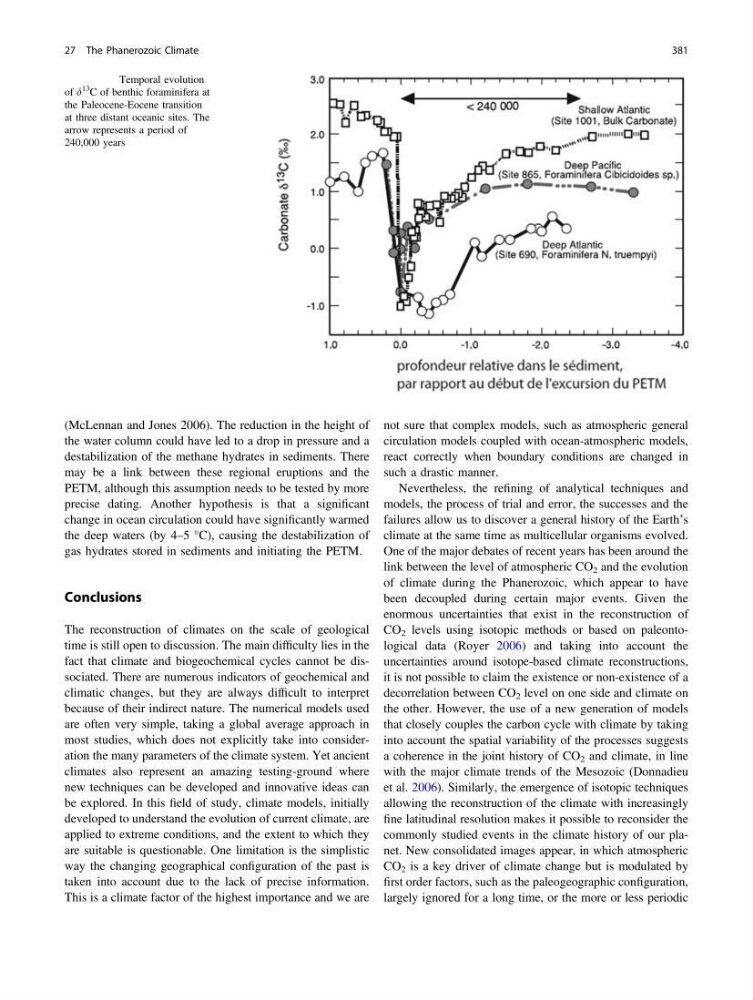
Fig. 27.16 Temporal evolution
of d
13
C of benthic foraminifera at
the Paleocene-Eocene transition
at three distant oceanic sites. The
arrow represents a period of
240,000 years
27 The Phanerozoic Climate
381
the water column could have led to a drop in pressure and a
destabilization of the methane hydrates in sediments. There
may be a link between these regional eruptions and the
PETM, although this assumption needs to be tested by more
precise dating. Another hypothesis is that a significant
change in ocean circulation could have significantly warmed
the deep waters (by 4–5 °C), causing the destabilization of
gas hydrates stored in sediments and initiating the PETM.
Conclusions
The reconstruction of climates on the scale of geological
time is still open to discussion. The main difficulty lies in the
fact that climate and biogeochemical cycles cannot be dissociated. There are numerous indicators of geochemical and
climatic changes, but they are always difficult to interpret
because of their indirect nature. The numerical models used
are often very simple, taking a global average approach in
most studies, which does not explicitly take into consideration the many parameters of the climate system. Yet ancient
climates also represent an amazing testing-ground where
new techniques can be developed and innovative ideas can
be explored. In this field of study, climate models, initially
developed to understand the evolution of current climate, are
applied to extreme conditions, and the extent to which they
are suitable is questionable. One limitation is the simplistic
way the changing geographical configuration of the past is
taken into account due to the lack of precise information.
This is a climate factor of the highest importance and we are
not sure that complex models, such as atmospheric general
circulation models coupled with ocean-atmospheric models,
react correctly when boundary conditions are changed in
such a drastic manner.
Nevertheless, the refining of analytical techniques and
models, the process of trial and error, the successes and the
failures allow us to discover a general history of the Earth’s
climate at the same time as multicellular organisms evolved.
One of the major debates of recent years has been around the
link between the level of atmospheric CO 2 and the evolution
of climate during the Phanerozoic, which appear to have
been decoupled during certain major events. Given the
enormous uncertainties that exist in the reconstruction of
CO 2 levels using isotopic methods or based on paleontological data (Royer 2006) and taking into account the
uncertainties around isotope-based climate reconstructions,
it is not possible to claim the existence or non-existence of a
decorrelation between CO 2 level on one side and climate on
the other. However, the use of a new generation of models
that closely couples the carbon cycle with climate by taking
into account the spatial variability of the processes suggests
a coherence in the joint history of CO 2 and climate, in line
with the major climate trends of the Mesozoic (Donnadieu
et al. 2006). Similarly, the emergence of isotopic techniques
allowing the reconstruction of the climate with increasingly
fine latitudinal resolution makes it possible to reconsider the
commonly studied events in the climate history of our planet. New consolidated images appear, in which atmospheric
CO 2 is a key driver of climate change but is modulated by
first order factors, such as the paleogeographic configuration,
largely ignored for a long time, or the more or less periodic
Fig. 27.16 Temporal evolution
of d
13
C of benthic foraminifera at
the Paleocene-Eocene transition
at three distant oceanic sites. The
arrow represents a period of
240,000 years
27 The Phanerozoic Climate
381