

and of increased weathering bringing additional nutrients to
the ocean and causing intense blooms in the oceanic biosphere. These would have led to increased oxygen consumption in the surface waters and the establishment of
large-scale anoxia. Moreover, these anoxic events are correlated with second-order fluctuations of the sea level (a few
tens of meters), thereby disturbing the weathering of carbonate platforms which alternate between being emerged
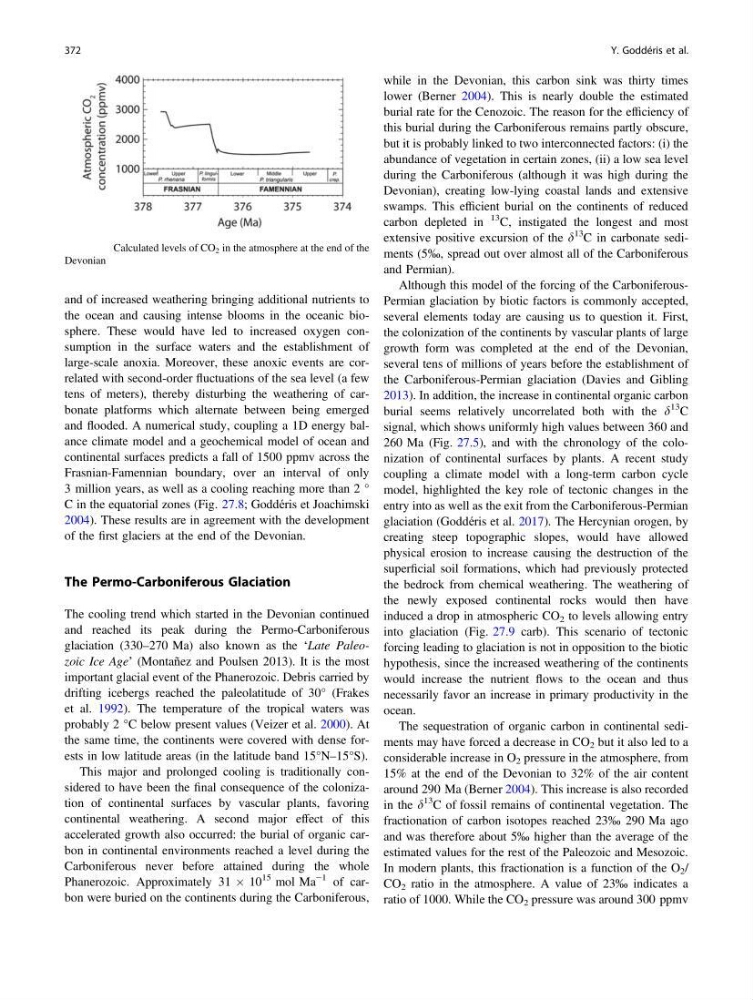
and flooded. A numerical study, coupling a 1D energy balance climate model and a geochemical model of ocean and
continental surfaces predicts a fall of 1500 ppmv across the
Frasnian-Famennian boundary, over an interval of only
3 million years, as well as a cooling reaching more than 2 °
C in the equatorial zones (Fig. 27.8; Goddéris et Joachimski
2004). These results are in agreement with the development
of the first glaciers at the end of the Devonian.
The Permo-Carboniferous Glaciation
The cooling trend which started in the Devonian continued
and reached its peak during the Permo-Carboniferous
glaciation (330–270 Ma) also known as the ‘Late Paleozoic Ice Age’ (Montañez and Poulsen 2013). It is the most
important glacial event of the Phanerozoic. Debris carried by
drifting icebergs reached the paleolatitude of 30° (Frakes
et al. 1992). The temperature of the tropical waters was
probably 2 °C below present values (Veizer et al. 2000). At
the same time, the continents were covered with dense forests in low latitude areas (in the latitude band 15°N–15°S).
This major and prolonged cooling is traditionally considered to have been the final consequence of the colonization of continental surfaces by vascular plants, favoring
continental weathering. A second major effect of this
accelerated growth also occurred: the burial of organic carbon in continental environments reached a level during the
Carboniferous never before attained during the whole
Phanerozoic. Approximately 31 Â 10
15 mol Ma
−1 of carbon were buried on the continents during the Carboniferous,
while in the Devonian, this carbon sink was thirty times
lower (Berner 2004). This is nearly double the estimated
burial rate for the Cenozoic. The reason for the efficiency of
this burial during the Carboniferous remains partly obscure,
but it is probably linked to two interconnected factors: (i) the
abundance of vegetation in certain zones, (ii) a low sea level
during the Carboniferous (although it was high during the
Devonian), creating low-lying coastal lands and extensive
swamps. This efficient burial on the continents of reduced
carbon depleted in
13 C, instigated the longest and most
extensive positive excursion of the d
13 C in carbonate sediments (5‰, spread out over almost all of the Carboniferous
and Permian).
Although this model of the forcing of the CarboniferousPermian glaciation by biotic factors is commonly accepted,
several elements today are causing us to question it. First,
the colonization of the continents by vascular plants of large
growth form was completed at the end of the Devonian,
several tens of millions of years before the establishment of
the Carboniferous-Permian glaciation (Davies and Gibling
2013). In addition, the increase in continental organic carbon
burial seems relatively uncorrelated both with the d
13 C
signal, which shows uniformly high values between 360 and
260 Ma (Fig. 27.5), and with the chronology of the colonization of continental surfaces by plants. A recent study
coupling a climate model with a long-term carbon cycle
model, highlighted the key role of tectonic changes in the
entry into as well as the exit from the Carboniferous-Permian
glaciation (Goddéris et al. 2017). The Hercynian orogen, by
creating steep topographic slopes, would have allowed
physical erosion to increase causing the destruction of the
superficial soil formations, which had previously protected
the bedrock from chemical weathering. The weathering of
the newly exposed continental rocks would then have
induced a drop in atmospheric CO 2 to levels allowing entry
into glaciation (Fig. 27.9 carb). This scenario of tectonic
forcing leading to glaciation is not in opposition to the biotic
hypothesis, since the increased weathering of the continents
would increase the nutrient flows to the ocean and thus
necessarily favor an increase in primary productivity in the
ocean.
The sequestration of organic carbon in continental sediments may have forced a decrease in CO 2 but it also led to a
considerable increase in O 2 pressure in the atmosphere, from
15% at the end of the Devonian to 32% of the air content
around 290 Ma (Berner 2004). This increase is also recorded
in the d
13 C of fossil remains of continental vegetation. The
fractionation of carbon isotopes reached 23‰ 290 Ma ago
and was therefore about 5‰ higher than the average of the
estimated values for the rest of the Paleozoic and Mesozoic.
In modern plants, this fractionation is a function of the O 2 /
CO 2 ratio in the atmosphere. A value of 23‰ indicates a
ratio of 1000. While the CO 2 pressure was around 300 ppmv
Fig. 27.8 Calculated levels of CO 2 in the atmosphere at the end of the
Devonian
372
Y. Goddéris et al.
the ocean and causing intense blooms in the oceanic biosphere. These would have led to increased oxygen consumption in the surface waters and the establishment of
large-scale anoxia. Moreover, these anoxic events are correlated with second-order fluctuations of the sea level (a few
tens of meters), thereby disturbing the weathering of carbonate platforms which alternate between being emerged
and flooded. A numerical study, coupling a 1D energy balance climate model and a geochemical model of ocean and
continental surfaces predicts a fall of 1500 ppmv across the
Frasnian-Famennian boundary, over an interval of only
3 million years, as well as a cooling reaching more than 2 °
C in the equatorial zones (Fig. 27.8; Goddéris et Joachimski
2004). These results are in agreement with the development
of the first glaciers at the end of the Devonian.
The Permo-Carboniferous Glaciation
The cooling trend which started in the Devonian continued
and reached its peak during the Permo-Carboniferous
glaciation (330–270 Ma) also known as the ‘Late Paleozoic Ice Age’ (Montañez and Poulsen 2013). It is the most
important glacial event of the Phanerozoic. Debris carried by
drifting icebergs reached the paleolatitude of 30° (Frakes
et al. 1992). The temperature of the tropical waters was
probably 2 °C below present values (Veizer et al. 2000). At
the same time, the continents were covered with dense forests in low latitude areas (in the latitude band 15°N–15°S).
This major and prolonged cooling is traditionally considered to have been the final consequence of the colonization of continental surfaces by vascular plants, favoring
continental weathering. A second major effect of this
accelerated growth also occurred: the burial of organic carbon in continental environments reached a level during the
Carboniferous never before attained during the whole
Phanerozoic. Approximately 31 Â 10
15 mol Ma
−1 of carbon were buried on the continents during the Carboniferous,
while in the Devonian, this carbon sink was thirty times
lower (Berner 2004). This is nearly double the estimated
burial rate for the Cenozoic. The reason for the efficiency of
this burial during the Carboniferous remains partly obscure,
but it is probably linked to two interconnected factors: (i) the
abundance of vegetation in certain zones, (ii) a low sea level
during the Carboniferous (although it was high during the
Devonian), creating low-lying coastal lands and extensive
swamps. This efficient burial on the continents of reduced
carbon depleted in
13 C, instigated the longest and most
extensive positive excursion of the d
13 C in carbonate sediments (5‰, spread out over almost all of the Carboniferous
and Permian).
Although this model of the forcing of the CarboniferousPermian glaciation by biotic factors is commonly accepted,
several elements today are causing us to question it. First,
the colonization of the continents by vascular plants of large
growth form was completed at the end of the Devonian,
several tens of millions of years before the establishment of
the Carboniferous-Permian glaciation (Davies and Gibling
2013). In addition, the increase in continental organic carbon
burial seems relatively uncorrelated both with the d
13 C
signal, which shows uniformly high values between 360 and
260 Ma (Fig. 27.5), and with the chronology of the colonization of continental surfaces by plants. A recent study
coupling a climate model with a long-term carbon cycle
model, highlighted the key role of tectonic changes in the
entry into as well as the exit from the Carboniferous-Permian
glaciation (Goddéris et al. 2017). The Hercynian orogen, by
creating steep topographic slopes, would have allowed
physical erosion to increase causing the destruction of the
superficial soil formations, which had previously protected
the bedrock from chemical weathering. The weathering of
the newly exposed continental rocks would then have
induced a drop in atmospheric CO 2 to levels allowing entry
into glaciation (Fig. 27.9 carb). This scenario of tectonic
forcing leading to glaciation is not in opposition to the biotic
hypothesis, since the increased weathering of the continents
would increase the nutrient flows to the ocean and thus
necessarily favor an increase in primary productivity in the
ocean.
The sequestration of organic carbon in continental sediments may have forced a decrease in CO 2 but it also led to a
considerable increase in O 2 pressure in the atmosphere, from
15% at the end of the Devonian to 32% of the air content
around 290 Ma (Berner 2004). This increase is also recorded
in the d
13 C of fossil remains of continental vegetation. The
fractionation of carbon isotopes reached 23‰ 290 Ma ago
and was therefore about 5‰ higher than the average of the
estimated values for the rest of the Paleozoic and Mesozoic.
In modern plants, this fractionation is a function of the O 2 /
CO 2 ratio in the atmosphere. A value of 23‰ indicates a
ratio of 1000. While the CO 2 pressure was around 300 ppmv
Fig. 27.8 Calculated levels of CO 2 in the atmosphere at the end of the
Devonian
372
Y. Goddéris et al.