

increase in pressure of CO 2 in the air and a warming of
the climate (Goddéris et al. 2014).
The Phanerozoic Terrestrial Paleothermostat
The short residence time (200,000 years) of carbon in the
exosphere, as well as the reaction time of ocean alkalinity
(3000 years) impose the following near-equal relationship
between the fluxes of inorganic carbon, ignoring any possible imbalances in the organic carbon cycle (see Chap. 5):
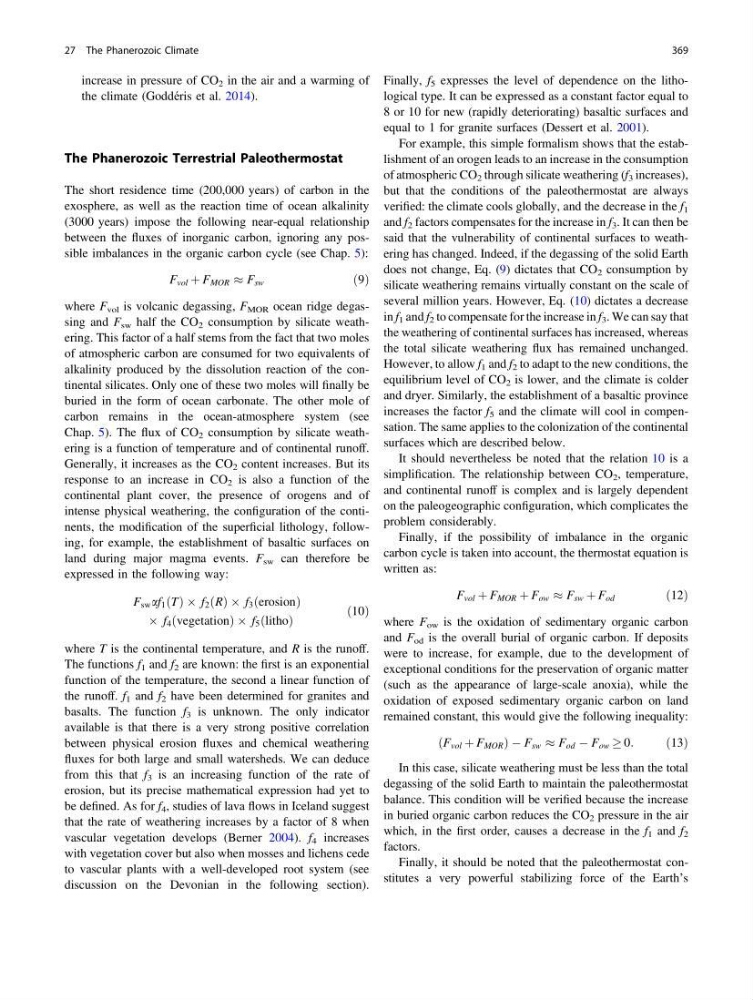
F vol þ F MOR % F sw
ð9Þ
where F vol is volcanic degassing, F MOR ocean ridge degassing and F sw half the CO 2 consumption by silicate weathering. This factor of a half stems from the fact that two moles
of atmospheric carbon are consumed for two equivalents of
alkalinity produced by the dissolution reaction of the continental silicates. Only one of these two moles will finally be
buried in the form of ocean carbonate. The other mole of
carbon remains in the ocean-atmosphere system (see
Chap. 5). The flux of CO 2 consumption by silicate weathering is a function of temperature and of continental runoff.
Generally, it increases as the CO 2 content increases. But its
response to an increase in CO 2 is also a function of the
continental plant cover, the presence of orogens and of
intense physical weathering, the configuration of the continents, the modification of the superficial lithology, following, for example, the establishment of basaltic surfaces on
land during major magma events. F sw can therefore be
expressed in the following way:
F sw af 1 T
ð Þ Â f 2 R
ð Þ Â f 3 ðerosionÞ
 f 4 ðvegetationÞ Â f 5 litho
ð
Þ
ð10Þ
where T is the continental temperature, and R is the runoff.
The functions f 1 and f 2 are known: the first is an exponential
function of the temperature, the second a linear function of
the runoff. f 1 and f 2 have been determined for granites and
basalts. The function f 3 is unknown. The only indicator
available is that there is a very strong positive correlation
between physical erosion fluxes and chemical weathering
fluxes for both large and small watersheds. We can deduce
from this that f 3 is an increasing function of the rate of
erosion, but its precise mathematical expression had yet to
be defined. As for f 4 , studies of lava flows in Iceland suggest
that the rate of weathering increases by a factor of 8 when
vascular vegetation develops (Berner 2004). f 4 increases
with vegetation cover but also when mosses and lichens cede
to vascular plants with a well-developed root system (see
discussion on the Devonian in the following section).
Finally, f 5 expresses the level of dependence on the lithological type. It can be expressed as a constant factor equal to
8 or 10 for new (rapidly deteriorating) basaltic surfaces and
equal to 1 for granite surfaces (Dessert et al. 2001).
For example, this simple formalism shows that the establishment of an orogen leads to an increase in the consumption
of atmospheric CO 2 through silicate weathering (f 3 increases),
but that the conditions of the paleothermostat are always
verified: the climate cools globally, and the decrease in the f 1
and f 2 factors compensates for the increase in f 3 . It can then be
said that the vulnerability of continental surfaces to weathering has changed. Indeed, if the degassing of the solid Earth
does not change, Eq. (9) dictates that CO 2 consumption by
silicate weathering remains virtually constant on the scale of
several million years. However, Eq. (10) dictates a decrease
in f 1 and f 2 to compensate for the increase in f 3 . We can say that
the weathering of continental surfaces has increased, whereas
the total silicate weathering flux has remained unchanged.
However, to allow f 1 and f 2 to adapt to the new conditions, the
equilibrium level of CO 2 is lower, and the climate is colder
and dryer. Similarly, the establishment of a basaltic province
increases the factor f 5 and the climate will cool in compensation. The same applies to the colonization of the continental
surfaces which are described below.
It should nevertheless be noted that the relation 10 is a
simplification. The relationship between CO 2 , temperature,
and continental runoff is complex and is largely dependent
on the paleogeographic configuration, which complicates the
problem considerably.
Finally, if the possibility of imbalance in the organic
carbon cycle is taken into account, the thermostat equation is
written as:
F vol þ F MOR þ F ow % F sw þ F od
ð12Þ
where F ow is the oxidation of sedimentary organic carbon
and F od is the overall burial of organic carbon. If deposits
were to increase, for example, due to the development of
exceptional conditions for the preservation of organic matter
(such as the appearance of large-scale anoxia), while the
oxidation of exposed sedimentary organic carbon on land
remained constant, this would give the following inequality:
ðF vol þ F MOR Þ À F sw % F od À F ow ! 0:
ð13Þ
In this case, silicate weathering must be less than the total
degassing of the solid Earth to maintain the paleothermostat
balance. This condition will be verified because the increase
in buried organic carbon reduces the CO 2 pressure in the air
which, in the first order, causes a decrease in the f 1 and f 2
factors.
Finally, it should be noted that the paleothermostat constitutes a very powerful stabilizing force of the Earth’s
27 The Phanerozoic Climate
369
the climate (Goddéris et al. 2014).
The Phanerozoic Terrestrial Paleothermostat
The short residence time (200,000 years) of carbon in the
exosphere, as well as the reaction time of ocean alkalinity
(3000 years) impose the following near-equal relationship
between the fluxes of inorganic carbon, ignoring any possible imbalances in the organic carbon cycle (see Chap. 5):
F vol þ F MOR % F sw
ð9Þ
where F vol is volcanic degassing, F MOR ocean ridge degassing and F sw half the CO 2 consumption by silicate weathering. This factor of a half stems from the fact that two moles
of atmospheric carbon are consumed for two equivalents of
alkalinity produced by the dissolution reaction of the continental silicates. Only one of these two moles will finally be
buried in the form of ocean carbonate. The other mole of
carbon remains in the ocean-atmosphere system (see
Chap. 5). The flux of CO 2 consumption by silicate weathering is a function of temperature and of continental runoff.
Generally, it increases as the CO 2 content increases. But its
response to an increase in CO 2 is also a function of the
continental plant cover, the presence of orogens and of
intense physical weathering, the configuration of the continents, the modification of the superficial lithology, following, for example, the establishment of basaltic surfaces on
land during major magma events. F sw can therefore be
expressed in the following way:
F sw af 1 T
ð Þ Â f 2 R
ð Þ Â f 3 ðerosionÞ
 f 4 ðvegetationÞ Â f 5 litho
ð
Þ
ð10Þ
where T is the continental temperature, and R is the runoff.
The functions f 1 and f 2 are known: the first is an exponential
function of the temperature, the second a linear function of
the runoff. f 1 and f 2 have been determined for granites and
basalts. The function f 3 is unknown. The only indicator
available is that there is a very strong positive correlation
between physical erosion fluxes and chemical weathering
fluxes for both large and small watersheds. We can deduce
from this that f 3 is an increasing function of the rate of
erosion, but its precise mathematical expression had yet to
be defined. As for f 4 , studies of lava flows in Iceland suggest
that the rate of weathering increases by a factor of 8 when
vascular vegetation develops (Berner 2004). f 4 increases
with vegetation cover but also when mosses and lichens cede
to vascular plants with a well-developed root system (see
discussion on the Devonian in the following section).
Finally, f 5 expresses the level of dependence on the lithological type. It can be expressed as a constant factor equal to
8 or 10 for new (rapidly deteriorating) basaltic surfaces and
equal to 1 for granite surfaces (Dessert et al. 2001).
For example, this simple formalism shows that the establishment of an orogen leads to an increase in the consumption
of atmospheric CO 2 through silicate weathering (f 3 increases),
but that the conditions of the paleothermostat are always
verified: the climate cools globally, and the decrease in the f 1
and f 2 factors compensates for the increase in f 3 . It can then be
said that the vulnerability of continental surfaces to weathering has changed. Indeed, if the degassing of the solid Earth
does not change, Eq. (9) dictates that CO 2 consumption by
silicate weathering remains virtually constant on the scale of
several million years. However, Eq. (10) dictates a decrease
in f 1 and f 2 to compensate for the increase in f 3 . We can say that
the weathering of continental surfaces has increased, whereas
the total silicate weathering flux has remained unchanged.
However, to allow f 1 and f 2 to adapt to the new conditions, the
equilibrium level of CO 2 is lower, and the climate is colder
and dryer. Similarly, the establishment of a basaltic province
increases the factor f 5 and the climate will cool in compensation. The same applies to the colonization of the continental
surfaces which are described below.
It should nevertheless be noted that the relation 10 is a
simplification. The relationship between CO 2 , temperature,
and continental runoff is complex and is largely dependent
on the paleogeographic configuration, which complicates the
problem considerably.
Finally, if the possibility of imbalance in the organic
carbon cycle is taken into account, the thermostat equation is
written as:
F vol þ F MOR þ F ow % F sw þ F od
ð12Þ
where F ow is the oxidation of sedimentary organic carbon
and F od is the overall burial of organic carbon. If deposits
were to increase, for example, due to the development of
exceptional conditions for the preservation of organic matter
(such as the appearance of large-scale anoxia), while the
oxidation of exposed sedimentary organic carbon on land
remained constant, this would give the following inequality:
ðF vol þ F MOR Þ À F sw % F od À F ow ! 0:
ð13Þ
In this case, silicate weathering must be less than the total
degassing of the solid Earth to maintain the paleothermostat
balance. This condition will be verified because the increase
in buried organic carbon reduces the CO 2 pressure in the air
which, in the first order, causes a decrease in the f 1 and f 2
factors.
Finally, it should be noted that the paleothermostat constitutes a very powerful stabilizing force of the Earth’s
27 The Phanerozoic Climate
369