

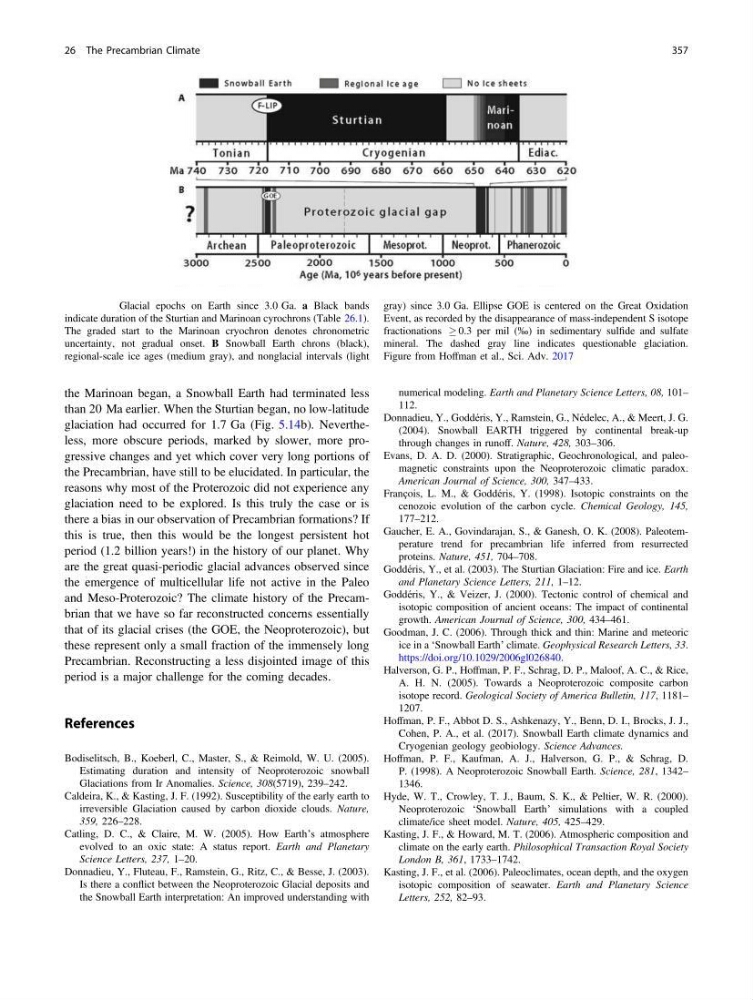
the Marinoan began, a Snowball Earth had terminated less
than 20 Ma earlier. When the Sturtian began, no low-latitude
glaciation had occurred for 1.7 Ga (Fig. 5.14b). Nevertheless, more obscure periods, marked by slower, more progressive changes and yet which cover very long portions of
the Precambrian, have still to be elucidated. In particular, the
reasons why most of the Proterozoic did not experience any
glaciation need to be explored. Is this truly the case or is
there a bias in our observation of Precambrian formations? If
this is true, then this would be the longest persistent hot
period (1.2 billion years!) in the history of our planet. Why
are the great quasi-periodic glacial advances observed since
the emergence of multicellular life not active in the Paleo
and Meso-Proterozoic? The climate history of the Precambrian that we have so far reconstructed concerns essentially
that of its glacial crises (the GOE, the Neoproterozoic), but
these represent only a small fraction of the immensely long
Precambrian. Reconstructing a less disjointed image of this
period is a major challenge for the coming decades.
References
Bodiselitsch, B., Koeberl, C., Master, S., & Reimold, W. U. (2005).
Estimating duration and intensity of Neoproterozoic snowball
Glaciations from Ir Anomalies. Science, 308(5719), 239–242.
Caldeira, K., & Kasting, J. F. (1992). Susceptibility of the early earth to
irreversible Glaciation caused by carbon dioxide clouds. Nature,
359, 226–228.
Catling, D. C., & Claire, M. W. (2005). How Earth’s atmosphere
evolved to an oxic state: A status report. Earth and Planetary
Science Letters, 237, 1–20.
Donnadieu, Y., Fluteau, F., Ramstein, G., Ritz, C., & Besse, J. (2003).
Is there a conflict between the Neoproterozoic Glacial deposits and
the Snowball Earth interpretation: An improved understanding with
numerical modeling. Earth and Planetary Science Letters, 08, 101–
112.
Donnadieu, Y., Goddéris, Y., Ramstein, G., Nédelec, A., & Meert, J. G.
(2004). Snowball EARTH triggered by continental break-up
through changes in runoff. Nature, 428, 303–306.
Evans, D. A. D. (2000). Stratigraphic, Geochronological, and paleomagnetic constraints upon the Neoproterozoic climatic paradox.
American Journal of Science, 300, 347–433.
François, L. M., & Goddéris, Y. (1998). Isotopic constraints on the
cenozoic evolution of the carbon cycle. Chemical Geology, 145,
177–212.
Gaucher, E. A., Govindarajan, S., & Ganesh, O. K. (2008). Paleotemperature trend for precambrian life inferred from resurrected
proteins. Nature, 451, 704–708.
Goddéris, Y., et al. (2003). The Sturtian Glaciation: Fire and ice. Earth
and Planetary Science Letters, 211, 1–12.
Goddéris, Y., & Veizer, J. (2000). Tectonic control of chemical and
isotopic composition of ancient oceans: The impact of continental
growth. American Journal of Science, 300, 434–461.
Goodman, J. C. (2006). Through thick and thin: Marine and meteoric
ice in a ‘Snowball Earth’ climate. Geophysical Research Letters, 33.
https://doi.org/10.1029/2006gl026840.
Halverson, G. P., Hoffman, P. F., Schrag, D. P., Maloof, A. C., & Rice,
A. H. N. (2005). Towards a Neoproterozoic composite carbon
isotope record. Geological Society of America Bulletin, 117, 1181–
1207.
Hoffman, P. F., Abbot D. S., Ashkenazy, Y., Benn, D. I., Brocks, J. J.,
Cohen, P. A., et al. (2017). Snowball Earth climate dynamics and
Cryogenian geology geobiology. Science Advances.
Hoffman, P. F., Kaufman, A. J., Halverson, G. P., & Schrag, D.
P. (1998). A Neoproterozoic Snowball Earth. Science, 281, 1342–
1346.
Hyde, W. T., Crowley, T. J., Baum, S. K., & Peltier, W. R. (2000).
Neoproterozoic ‘Snowball Earth’ simulations with a coupled
climate/ice sheet model. Nature, 405, 425–429.
Kasting, J. F., & Howard, M. T. (2006). Atmospheric composition and
climate on the early earth. Philosophical Transaction Royal Society
London B, 361, 1733–1742.
Kasting, J. F., et al. (2006). Paleoclimates, ocean depth, and the oxygen
isotopic composition of seawater. Earth and Planetary Science
Letters, 252, 82–93.
Fig. 26.14 Glacial epochs on Earth since 3.0 Ga. a Black bands
indicate duration of the Sturtian and Marinoan cyrochrons (Table 26.1).
The graded start to the Marinoan cryochron denotes chronometric
uncertainty, not gradual onset. B Snowball Earth chrons (black),
regional-scale ice ages (medium gray), and nonglacial intervals (light
gray) since 3.0 Ga. Ellipse GOE is centered on the Great Oxidation
Event, as recorded by the disappearance of mass-independent S isotope
fractionations ! 0.3 per mil (‰) in sedimentary sulfide and sulfate
mineral. The dashed gray line indicates questionable glaciation.
Figure from Hoffman et al., Sci. Adv. 2017
26 The Precambrian Climate
357
than 20 Ma earlier. When the Sturtian began, no low-latitude
glaciation had occurred for 1.7 Ga (Fig. 5.14b). Nevertheless, more obscure periods, marked by slower, more progressive changes and yet which cover very long portions of
the Precambrian, have still to be elucidated. In particular, the
reasons why most of the Proterozoic did not experience any
glaciation need to be explored. Is this truly the case or is
there a bias in our observation of Precambrian formations? If
this is true, then this would be the longest persistent hot
period (1.2 billion years!) in the history of our planet. Why
are the great quasi-periodic glacial advances observed since
the emergence of multicellular life not active in the Paleo
and Meso-Proterozoic? The climate history of the Precambrian that we have so far reconstructed concerns essentially
that of its glacial crises (the GOE, the Neoproterozoic), but
these represent only a small fraction of the immensely long
Precambrian. Reconstructing a less disjointed image of this
period is a major challenge for the coming decades.
References
Bodiselitsch, B., Koeberl, C., Master, S., & Reimold, W. U. (2005).
Estimating duration and intensity of Neoproterozoic snowball
Glaciations from Ir Anomalies. Science, 308(5719), 239–242.
Caldeira, K., & Kasting, J. F. (1992). Susceptibility of the early earth to
irreversible Glaciation caused by carbon dioxide clouds. Nature,
359, 226–228.
Catling, D. C., & Claire, M. W. (2005). How Earth’s atmosphere
evolved to an oxic state: A status report. Earth and Planetary
Science Letters, 237, 1–20.
Donnadieu, Y., Fluteau, F., Ramstein, G., Ritz, C., & Besse, J. (2003).
Is there a conflict between the Neoproterozoic Glacial deposits and
the Snowball Earth interpretation: An improved understanding with
numerical modeling. Earth and Planetary Science Letters, 08, 101–
112.
Donnadieu, Y., Goddéris, Y., Ramstein, G., Nédelec, A., & Meert, J. G.
(2004). Snowball EARTH triggered by continental break-up
through changes in runoff. Nature, 428, 303–306.
Evans, D. A. D. (2000). Stratigraphic, Geochronological, and paleomagnetic constraints upon the Neoproterozoic climatic paradox.
American Journal of Science, 300, 347–433.
François, L. M., & Goddéris, Y. (1998). Isotopic constraints on the
cenozoic evolution of the carbon cycle. Chemical Geology, 145,
177–212.
Gaucher, E. A., Govindarajan, S., & Ganesh, O. K. (2008). Paleotemperature trend for precambrian life inferred from resurrected
proteins. Nature, 451, 704–708.
Goddéris, Y., et al. (2003). The Sturtian Glaciation: Fire and ice. Earth
and Planetary Science Letters, 211, 1–12.
Goddéris, Y., & Veizer, J. (2000). Tectonic control of chemical and
isotopic composition of ancient oceans: The impact of continental
growth. American Journal of Science, 300, 434–461.
Goodman, J. C. (2006). Through thick and thin: Marine and meteoric
ice in a ‘Snowball Earth’ climate. Geophysical Research Letters, 33.
https://doi.org/10.1029/2006gl026840.
Halverson, G. P., Hoffman, P. F., Schrag, D. P., Maloof, A. C., & Rice,
A. H. N. (2005). Towards a Neoproterozoic composite carbon
isotope record. Geological Society of America Bulletin, 117, 1181–
1207.
Hoffman, P. F., Abbot D. S., Ashkenazy, Y., Benn, D. I., Brocks, J. J.,
Cohen, P. A., et al. (2017). Snowball Earth climate dynamics and
Cryogenian geology geobiology. Science Advances.
Hoffman, P. F., Kaufman, A. J., Halverson, G. P., & Schrag, D.
P. (1998). A Neoproterozoic Snowball Earth. Science, 281, 1342–
1346.
Hyde, W. T., Crowley, T. J., Baum, S. K., & Peltier, W. R. (2000).
Neoproterozoic ‘Snowball Earth’ simulations with a coupled
climate/ice sheet model. Nature, 405, 425–429.
Kasting, J. F., & Howard, M. T. (2006). Atmospheric composition and
climate on the early earth. Philosophical Transaction Royal Society
London B, 361, 1733–1742.
Kasting, J. F., et al. (2006). Paleoclimates, ocean depth, and the oxygen
isotopic composition of seawater. Earth and Planetary Science
Letters, 252, 82–93.
Fig. 26.14 Glacial epochs on Earth since 3.0 Ga. a Black bands
indicate duration of the Sturtian and Marinoan cyrochrons (Table 26.1).
The graded start to the Marinoan cryochron denotes chronometric
uncertainty, not gradual onset. B Snowball Earth chrons (black),
regional-scale ice ages (medium gray), and nonglacial intervals (light
gray) since 3.0 Ga. Ellipse GOE is centered on the Great Oxidation
Event, as recorded by the disappearance of mass-independent S isotope
fractionations ! 0.3 per mil (‰) in sedimentary sulfide and sulfate
mineral. The dashed gray line indicates questionable glaciation.
Figure from Hoffman et al., Sci. Adv. 2017
26 The Precambrian Climate
357