

considered to be a low limit. The reasons it is difficult to melt
the ‘snowball’ Earth are multiple. One of these is that the
dryness of the atmosphere resulting from the very low
temperatures limits the formation of high-level clouds and
thus the greenhouse effect. Similarly, the virtual absence of
water vapor limits warming of the planet.
During the glaciation period, CO 2 accumulates in the
atmosphere. Indeed, the virtual disappearance of the
hydrological cycle means that atmospheric CO 2 is no longer
absorbed by continental weathering (Hoffman et al. 1998).
Carbon therefore accumulates in the atmosphere through
volcanic degassing. By taking the current degassing rate of
6.8 Â 10
12 mol of CO 2 per year, it takes 8 million years for
0.29 bar of CO 2 to accumulate in the atmosphere. This
timeframe is compatible with the estimates of the duration of
‘Snowball’ Earth (Bodiselitsch et al. 2005). However, this
only applies if all of the carbon sinks are stopped during
glaciation and this is not the case, since the existence of thin
ice allows a fracture at the ocean-atmosphere interface.
A surface area of 3000 km
2 of open water is sufficient to
ensure a massive diffusion of CO 2 into the ocean, ensuring
the balance between the ocean and the atmosphere (Le Hir
et al. 2007). Under these conditions, the ocean undergoes
major acidification (the pH drops to 6) and the weathering of
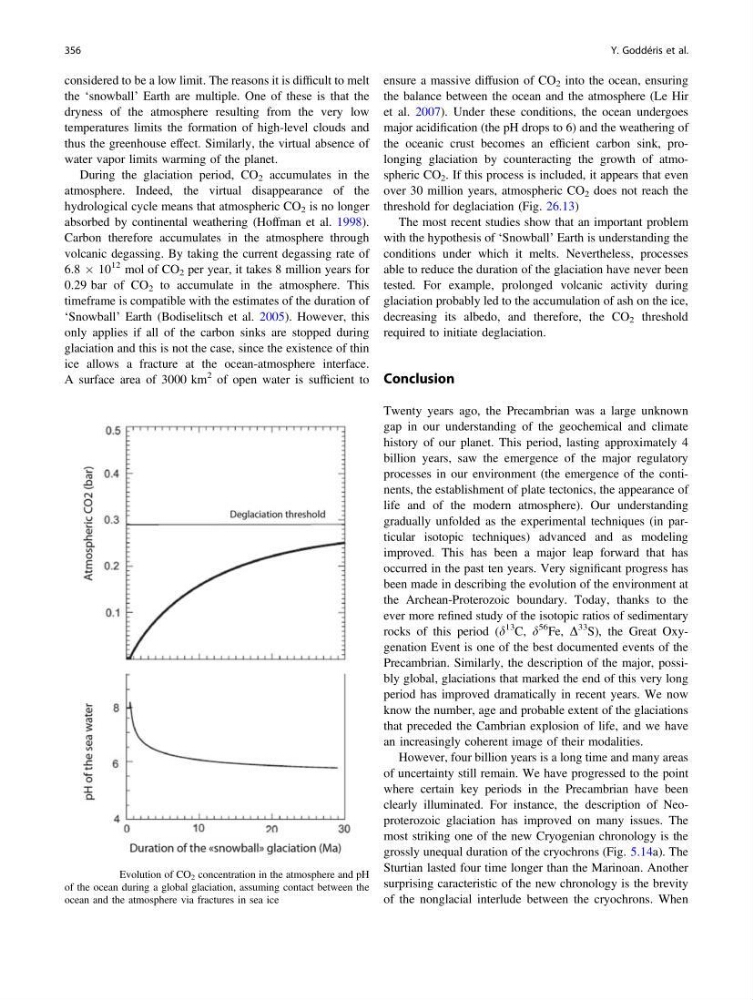
the oceanic crust becomes an efficient carbon sink, prolonging glaciation by counteracting the growth of atmospheric CO 2 . If this process is included, it appears that even
over 30 million years, atmospheric CO 2 does not reach the
threshold for deglaciation (Fig. 26.13)
The most recent studies show that an important problem
with the hypothesis of ‘Snowball’ Earth is understanding the
conditions under which it melts. Nevertheless, processes
able to reduce the duration of the glaciation have never been
tested. For example, prolonged volcanic activity during
glaciation probably led to the accumulation of ash on the ice,
decreasing its albedo, and therefore, the CO 2 threshold
required to initiate deglaciation.
Conclusion
Twenty years ago, the Precambrian was a large unknown
gap in our understanding of the geochemical and climate
history of our planet. This period, lasting approximately 4
billion years, saw the emergence of the major regulatory
processes in our environment (the emergence of the continents, the establishment of plate tectonics, the appearance of
life and of the modern atmosphere). Our understanding
gradually unfolded as the experimental techniques (in particular isotopic techniques) advanced and as modeling
improved. This has been a major leap forward that has
occurred in the past ten years. Very significant progress has
been made in describing the evolution of the environment at
the Archean-Proterozoic boundary. Today, thanks to the
ever more refined study of the isotopic ratios of sedimentary
rocks of this period (d
13 C, d
56 Fe, D
33 S), the Great Oxygenation Event is one of the best documented events of the
Precambrian. Similarly, the description of the major, possibly global, glaciations that marked the end of this very long
period has improved dramatically in recent years. We now
know the number, age and probable extent of the glaciations
that preceded the Cambrian explosion of life, and we have
an increasingly coherent image of their modalities.
However, four billion years is a long time and many areas
of uncertainty still remain. We have progressed to the point
where certain key periods in the Precambrian have been
clearly illuminated. For instance, the description of Neoproterozoic glaciation has improved on many issues. The
most striking one of the new Cryogenian chronology is the
grossly unequal duration of the cryochrons (Fig. 5.14a). The
Sturtian lasted four time longer than the Marinoan. Another
surprising caracteristic of the new chronology is the brevity
of the nonglacial interlude between the cryochrons. When
Fig. 26.13 Evolution of CO 2 concentration in the atmosphere and pH
of the ocean during a global glaciation, assuming contact between the
ocean and the atmosphere via fractures in sea ice
356
Y. Goddéris et al.
the ‘snowball’ Earth are multiple. One of these is that the
dryness of the atmosphere resulting from the very low
temperatures limits the formation of high-level clouds and
thus the greenhouse effect. Similarly, the virtual absence of
water vapor limits warming of the planet.
During the glaciation period, CO 2 accumulates in the
atmosphere. Indeed, the virtual disappearance of the
hydrological cycle means that atmospheric CO 2 is no longer
absorbed by continental weathering (Hoffman et al. 1998).
Carbon therefore accumulates in the atmosphere through
volcanic degassing. By taking the current degassing rate of
6.8 Â 10
12 mol of CO 2 per year, it takes 8 million years for
0.29 bar of CO 2 to accumulate in the atmosphere. This
timeframe is compatible with the estimates of the duration of
‘Snowball’ Earth (Bodiselitsch et al. 2005). However, this
only applies if all of the carbon sinks are stopped during
glaciation and this is not the case, since the existence of thin
ice allows a fracture at the ocean-atmosphere interface.
A surface area of 3000 km
2 of open water is sufficient to
ensure a massive diffusion of CO 2 into the ocean, ensuring
the balance between the ocean and the atmosphere (Le Hir
et al. 2007). Under these conditions, the ocean undergoes
major acidification (the pH drops to 6) and the weathering of
the oceanic crust becomes an efficient carbon sink, prolonging glaciation by counteracting the growth of atmospheric CO 2 . If this process is included, it appears that even
over 30 million years, atmospheric CO 2 does not reach the
threshold for deglaciation (Fig. 26.13)
The most recent studies show that an important problem
with the hypothesis of ‘Snowball’ Earth is understanding the
conditions under which it melts. Nevertheless, processes
able to reduce the duration of the glaciation have never been
tested. For example, prolonged volcanic activity during
glaciation probably led to the accumulation of ash on the ice,
decreasing its albedo, and therefore, the CO 2 threshold
required to initiate deglaciation.
Conclusion
Twenty years ago, the Precambrian was a large unknown
gap in our understanding of the geochemical and climate
history of our planet. This period, lasting approximately 4
billion years, saw the emergence of the major regulatory
processes in our environment (the emergence of the continents, the establishment of plate tectonics, the appearance of
life and of the modern atmosphere). Our understanding
gradually unfolded as the experimental techniques (in particular isotopic techniques) advanced and as modeling
improved. This has been a major leap forward that has
occurred in the past ten years. Very significant progress has
been made in describing the evolution of the environment at
the Archean-Proterozoic boundary. Today, thanks to the
ever more refined study of the isotopic ratios of sedimentary
rocks of this period (d
13 C, d
56 Fe, D
33 S), the Great Oxygenation Event is one of the best documented events of the
Precambrian. Similarly, the description of the major, possibly global, glaciations that marked the end of this very long
period has improved dramatically in recent years. We now
know the number, age and probable extent of the glaciations
that preceded the Cambrian explosion of life, and we have
an increasingly coherent image of their modalities.
However, four billion years is a long time and many areas
of uncertainty still remain. We have progressed to the point
where certain key periods in the Precambrian have been
clearly illuminated. For instance, the description of Neoproterozoic glaciation has improved on many issues. The
most striking one of the new Cryogenian chronology is the
grossly unequal duration of the cryochrons (Fig. 5.14a). The
Sturtian lasted four time longer than the Marinoan. Another
surprising caracteristic of the new chronology is the brevity
of the nonglacial interlude between the cryochrons. When
Fig. 26.13 Evolution of CO 2 concentration in the atmosphere and pH
of the ocean during a global glaciation, assuming contact between the
ocean and the atmosphere via fractures in sea ice
356
Y. Goddéris et al.