

of the shells of planktonic foraminifera from the Red Sea,
which record the large variations in salinity resulting from the
closing and opening of the Bab el Mandab Straits caused by
decreases and increases in sea level (Siddall et al. 2003).
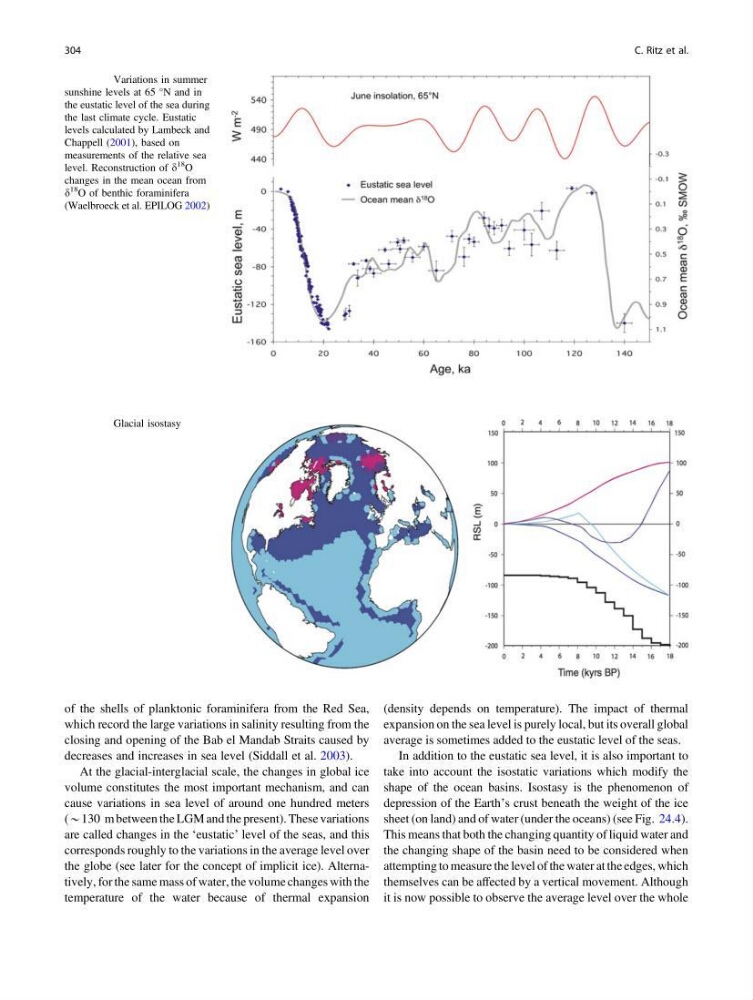
At the glacial-interglacial scale, the changes in global ice
volume constitutes the most important mechanism, and can
cause variations in sea level of around one hundred meters
(*130 m between the LGM and the present). These variations
are called changes in the ‘eustatic’ level of the seas, and this
corresponds roughly to the variations in the average level over
the globe (see later for the concept of implicit ice). Alternatively, for the same mass of water, the volume changes with the
temperature of the water because of thermal expansion
(density depends on temperature). The impact of thermal
expansion on the sea level is purely local, but its overall global
average is sometimes added to the eustatic level of the seas.
In addition to the eustatic sea level, it is also important to
take into account the isostatic variations which modify the
shape of the ocean basins. Isostasy is the phenomenon of
depression of the Earth’s crust beneath the weight of the ice
sheet (on land) and of water (under the oceans) (see Fig. 24.4).
This means that both the changing quantity of liquid water and
the changing shape of the basin need to be considered when
attempting to measure the level of the water at the edges, which
themselves can be affected by a vertical movement. Although
it is now possible to observe the average level over the whole
Fig. 24.3 Variations in summer
sunshine levels at 65 °N and in
the eustatic level of the sea during
the last climate cycle. Eustatic
levels calculated by Lambeck and
Chappell (2001), based on
measurements of the relative sea
level. Reconstruction of d
18
O
changes in the mean ocean from
d
18
O of benthic foraminifera
(Waelbroeck et al. EPILOG 2002)
Fig. 24.4 Glacial isostasy
304
C. Ritz et al.
which record the large variations in salinity resulting from the
closing and opening of the Bab el Mandab Straits caused by
decreases and increases in sea level (Siddall et al. 2003).
At the glacial-interglacial scale, the changes in global ice
volume constitutes the most important mechanism, and can
cause variations in sea level of around one hundred meters
(*130 m between the LGM and the present). These variations
are called changes in the ‘eustatic’ level of the seas, and this
corresponds roughly to the variations in the average level over
the globe (see later for the concept of implicit ice). Alternatively, for the same mass of water, the volume changes with the
temperature of the water because of thermal expansion
(density depends on temperature). The impact of thermal
expansion on the sea level is purely local, but its overall global
average is sometimes added to the eustatic level of the seas.
In addition to the eustatic sea level, it is also important to
take into account the isostatic variations which modify the
shape of the ocean basins. Isostasy is the phenomenon of
depression of the Earth’s crust beneath the weight of the ice
sheet (on land) and of water (under the oceans) (see Fig. 24.4).
This means that both the changing quantity of liquid water and
the changing shape of the basin need to be considered when
attempting to measure the level of the water at the edges, which
themselves can be affected by a vertical movement. Although
it is now possible to observe the average level over the whole
Fig. 24.3 Variations in summer
sunshine levels at 65 °N and in
the eustatic level of the sea during
the last climate cycle. Eustatic
levels calculated by Lambeck and
Chappell (2001), based on
measurements of the relative sea
level. Reconstruction of d
18
O
changes in the mean ocean from
d
18
O of benthic foraminifera
(Waelbroeck et al. EPILOG 2002)
Fig. 24.4 Glacial isostasy
304
C. Ritz et al.