

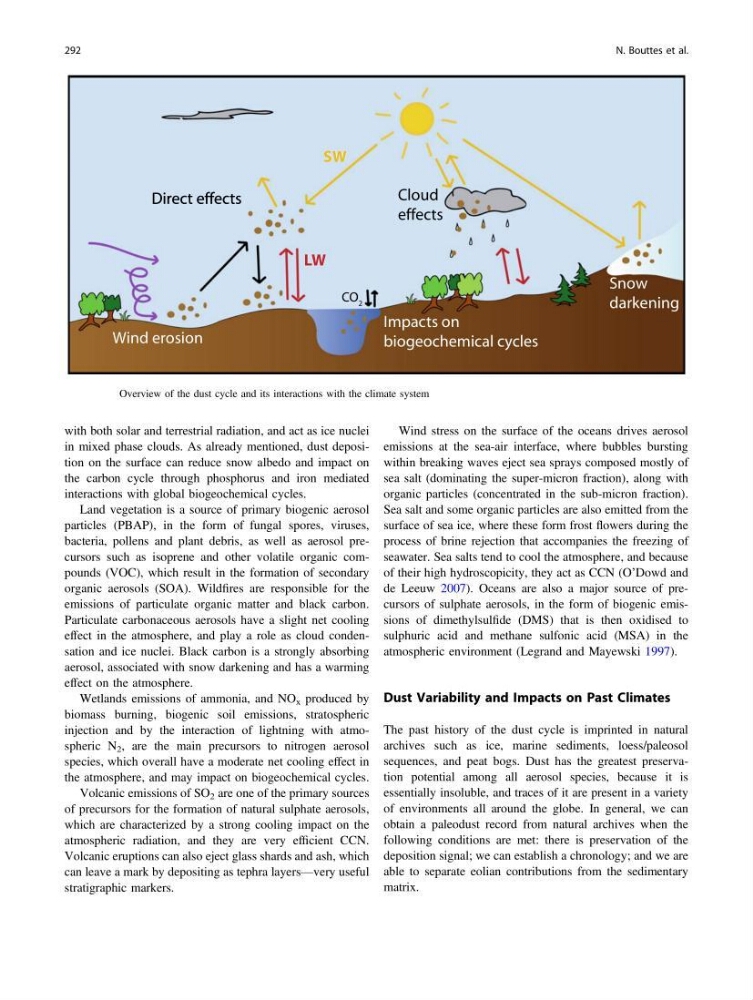
with both solar and terrestrial radiation, and act as ice nuclei
in mixed phase clouds. As already mentioned, dust deposition on the surface can reduce snow albedo and impact on
the carbon cycle through phosphorus and iron mediated
interactions with global biogeochemical cycles.
Land vegetation is a source of primary biogenic aerosol
particles (PBAP), in the form of fungal spores, viruses,
bacteria, pollens and plant debris, as well as aerosol precursors such as isoprene and other volatile organic compounds (VOC), which result in the formation of secondary
organic aerosols (SOA). Wildfires are responsible for the
emissions of particulate organic matter and black carbon.
Particulate carbonaceous aerosols have a slight net cooling
effect in the atmosphere, and play a role as cloud condensation and ice nuclei. Black carbon is a strongly absorbing
aerosol, associated with snow darkening and has a warming
effect on the atmosphere.
Wetlands emissions of ammonia, and NO x produced by
biomass burning, biogenic soil emissions, stratospheric
injection and by the interaction of lightning with atmospheric N 2 , are the main precursors to nitrogen aerosol
species, which overall have a moderate net cooling effect in
the atmosphere, and may impact on biogeochemical cycles.
Volcanic emissions of SO 2 are one of the primary sources
of precursors for the formation of natural sulphate aerosols,
which are characterized by a strong cooling impact on the
atmospheric radiation, and they are very efficient CCN.
Volcanic eruptions can also eject glass shards and ash, which
can leave a mark by depositing as tephra layers—very useful
stratigraphic markers.
Wind stress on the surface of the oceans drives aerosol
emissions at the sea-air interface, where bubbles bursting
within breaking waves eject sea sprays composed mostly of
sea salt (dominating the super-micron fraction), along with
organic particles (concentrated in the sub-micron fraction).
Sea salt and some organic particles are also emitted from the
surface of sea ice, where these form frost flowers during the
process of brine rejection that accompanies the freezing of
seawater. Sea salts tend to cool the atmosphere, and because
of their high hydroscopicity, they act as CCN (O’Dowd and
de Leeuw 2007). Oceans are also a major source of precursors of sulphate aerosols, in the form of biogenic emissions of dimethylsulfide (DMS) that is then oxidised to
sulphuric acid and methane sulfonic acid (MSA) in the
atmospheric environment (Legrand and Mayewski 1997).
Dust Variability and Impacts on Past Climates
The past history of the dust cycle is imprinted in natural
archives such as ice, marine sediments, loess/paleosol
sequences, and peat bogs. Dust has the greatest preservation potential among all aerosol species, because it is
essentially insoluble, and traces of it are present in a variety
of environments all around the globe. In general, we can
obtain a paleodust record from natural archives when the
following conditions are met: there is preservation of the
deposition signal; we can establish a chronology; and we are
able to separate eolian contributions from the sedimentary
matrix.
Snow
darkening
Wind erosion
Direct effects
SW
LW
CO 2
Cloud
effects
Direct effects
Impacts on
biogeochemical cycles
Fig. 23.17 Overview of the dust cycle and its interactions with the climate system
292
N. Bouttes et al.
in mixed phase clouds. As already mentioned, dust deposition on the surface can reduce snow albedo and impact on
the carbon cycle through phosphorus and iron mediated
interactions with global biogeochemical cycles.
Land vegetation is a source of primary biogenic aerosol
particles (PBAP), in the form of fungal spores, viruses,
bacteria, pollens and plant debris, as well as aerosol precursors such as isoprene and other volatile organic compounds (VOC), which result in the formation of secondary
organic aerosols (SOA). Wildfires are responsible for the
emissions of particulate organic matter and black carbon.
Particulate carbonaceous aerosols have a slight net cooling
effect in the atmosphere, and play a role as cloud condensation and ice nuclei. Black carbon is a strongly absorbing
aerosol, associated with snow darkening and has a warming
effect on the atmosphere.
Wetlands emissions of ammonia, and NO x produced by
biomass burning, biogenic soil emissions, stratospheric
injection and by the interaction of lightning with atmospheric N 2 , are the main precursors to nitrogen aerosol
species, which overall have a moderate net cooling effect in
the atmosphere, and may impact on biogeochemical cycles.
Volcanic emissions of SO 2 are one of the primary sources
of precursors for the formation of natural sulphate aerosols,
which are characterized by a strong cooling impact on the
atmospheric radiation, and they are very efficient CCN.
Volcanic eruptions can also eject glass shards and ash, which
can leave a mark by depositing as tephra layers—very useful
stratigraphic markers.
Wind stress on the surface of the oceans drives aerosol
emissions at the sea-air interface, where bubbles bursting
within breaking waves eject sea sprays composed mostly of
sea salt (dominating the super-micron fraction), along with
organic particles (concentrated in the sub-micron fraction).
Sea salt and some organic particles are also emitted from the
surface of sea ice, where these form frost flowers during the
process of brine rejection that accompanies the freezing of
seawater. Sea salts tend to cool the atmosphere, and because
of their high hydroscopicity, they act as CCN (O’Dowd and
de Leeuw 2007). Oceans are also a major source of precursors of sulphate aerosols, in the form of biogenic emissions of dimethylsulfide (DMS) that is then oxidised to
sulphuric acid and methane sulfonic acid (MSA) in the
atmospheric environment (Legrand and Mayewski 1997).
Dust Variability and Impacts on Past Climates
The past history of the dust cycle is imprinted in natural
archives such as ice, marine sediments, loess/paleosol
sequences, and peat bogs. Dust has the greatest preservation potential among all aerosol species, because it is
essentially insoluble, and traces of it are present in a variety
of environments all around the globe. In general, we can
obtain a paleodust record from natural archives when the
following conditions are met: there is preservation of the
deposition signal; we can establish a chronology; and we are
able to separate eolian contributions from the sedimentary
matrix.
Snow
darkening
Wind erosion
Direct effects
SW
LW
CO 2
Cloud
effects
Direct effects
Impacts on
biogeochemical cycles
Fig. 23.17 Overview of the dust cycle and its interactions with the climate system
292
N. Bouttes et al.