

CO 2 in the air may be due to either a lower degassing rate or
an increase in erosion of the surface of the continents. The
latter depends on a complex set of parameters, themselves
related to climate, such as air temperature, precipitation,
continental runoff and vegetation. Geochemists therefore try
to reconstruct the changing partial pressure of atmospheric
CO 2 using models; CO 2 emissions are estimated using
geological data on the speed of movement of the plates;
consumption of the gas is taken into account in simplified
models by coupling the carbon cycle to climate and by
considering the geographical context resulting from plate
tectonics. For example, the breaking-up of the arid supercontinent Rodinia, into a multitude of small humid continental masses, 800–700 million years ago, led to the
creation of basaltic regions, easily erodible chemically. This
resulted in a significant drop in carbon dioxide levels in the
air which may explain the great glaciations of the period.
Airborne dust also plays an important role in the radiation
balance of the atmosphere, mainly by intercepting solar
radiation and thereby reducing the amount of energy
reaching ground level. Dust levels have varied considerably
in the past, as is evidenced in polar ice. Falling snow brings
down atmospheric dust with it which then remains trapped in
the ice. The more the air is charged with dust, the more of it
the snow absorbs. In this way, strong atmospheric dust levels
during the glacial periods of the Quaternary have been
demonstrated. The dust came from continental erosion
which was then transported by winds. They gave rise to huge
accumulations of very fine particles. These created the loess
present in China, and in smaller quantities, in Western
Europe (Chap. 13, Volume 1).
The Atmosphere
The Main Features of Atmospheric Circulation
The net balance between the radiation received from the Sun
and that emitted into space does not have a uniform distribution. The net energy flux varies, depending on the latitude,
geographic regions and season. Solar radiation decreases
significantly between the equator and the poles, but there is
little difference in emitted infrared radiation. The result is a
surplus of energy in the tropics and a deficit in the north and
south latitudes above 40°. Heated at the equator, cooled at
the poles, the atmosphere and the ocean are activated and
carry the excess energy from tropical regions to the deficient
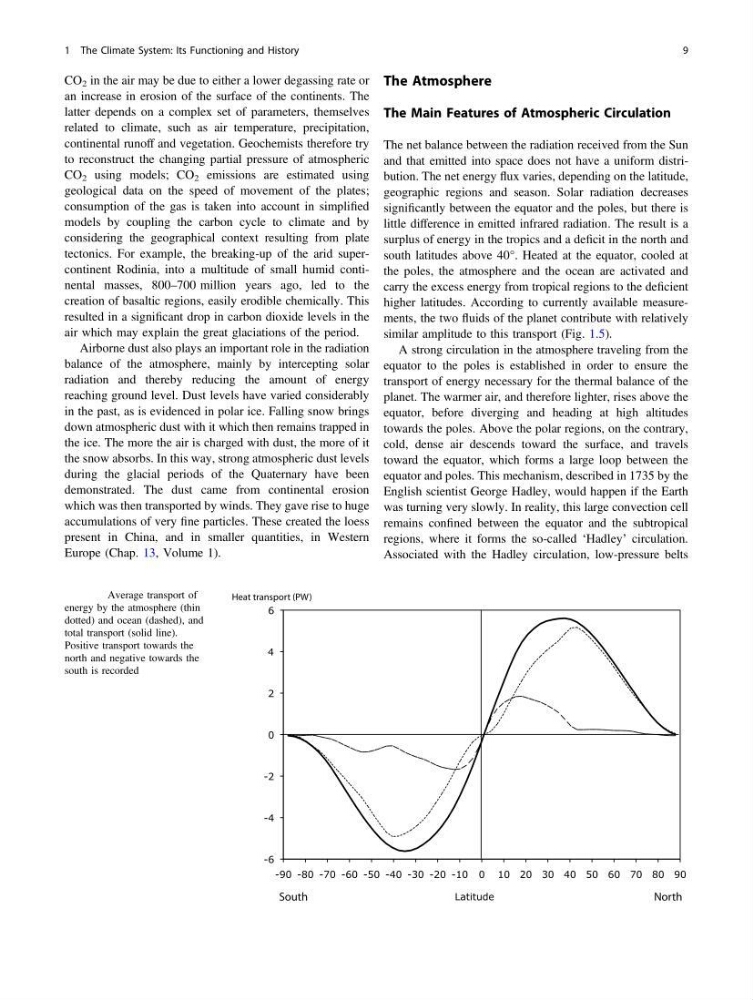
higher latitudes. According to currently available measurements, the two fluids of the planet contribute with relatively
similar amplitude to this transport (Fig. 1.5).
A strong circulation in the atmosphere traveling from the
equator to the poles is established in order to ensure the
transport of energy necessary for the thermal balance of the
planet. The warmer air, and therefore lighter, rises above the
equator, before diverging and heading at high altitudes
towards the poles. Above the polar regions, on the contrary,
cold, dense air descends toward the surface, and travels
toward the equator, which forms a large loop between the
equator and poles. This mechanism, described in 1735 by the
English scientist George Hadley, would happen if the Earth
was turning very slowly. In reality, this large convection cell
remains confined between the equator and the subtropical
regions, where it forms the so-called ‘Hadley’ circulation.
Associated with the Hadley circulation, low-pressure belts
South
North
Heat transport (PW)
Fig. 1.5 Average transport of
energy by the atmosphere (thin
dotted) and ocean (dashed), and
total transport (solid line).
Positive transport towards the
north and negative towards the
south is recorded
1 The Climate System: Its Functioning and History
9
an increase in erosion of the surface of the continents. The
latter depends on a complex set of parameters, themselves
related to climate, such as air temperature, precipitation,
continental runoff and vegetation. Geochemists therefore try
to reconstruct the changing partial pressure of atmospheric
CO 2 using models; CO 2 emissions are estimated using
geological data on the speed of movement of the plates;
consumption of the gas is taken into account in simplified
models by coupling the carbon cycle to climate and by
considering the geographical context resulting from plate
tectonics. For example, the breaking-up of the arid supercontinent Rodinia, into a multitude of small humid continental masses, 800–700 million years ago, led to the
creation of basaltic regions, easily erodible chemically. This
resulted in a significant drop in carbon dioxide levels in the
air which may explain the great glaciations of the period.
Airborne dust also plays an important role in the radiation
balance of the atmosphere, mainly by intercepting solar
radiation and thereby reducing the amount of energy
reaching ground level. Dust levels have varied considerably
in the past, as is evidenced in polar ice. Falling snow brings
down atmospheric dust with it which then remains trapped in
the ice. The more the air is charged with dust, the more of it
the snow absorbs. In this way, strong atmospheric dust levels
during the glacial periods of the Quaternary have been
demonstrated. The dust came from continental erosion
which was then transported by winds. They gave rise to huge
accumulations of very fine particles. These created the loess
present in China, and in smaller quantities, in Western
Europe (Chap. 13, Volume 1).
The Atmosphere
The Main Features of Atmospheric Circulation
The net balance between the radiation received from the Sun
and that emitted into space does not have a uniform distribution. The net energy flux varies, depending on the latitude,
geographic regions and season. Solar radiation decreases
significantly between the equator and the poles, but there is
little difference in emitted infrared radiation. The result is a
surplus of energy in the tropics and a deficit in the north and
south latitudes above 40°. Heated at the equator, cooled at
the poles, the atmosphere and the ocean are activated and
carry the excess energy from tropical regions to the deficient
higher latitudes. According to currently available measurements, the two fluids of the planet contribute with relatively
similar amplitude to this transport (Fig. 1.5).
A strong circulation in the atmosphere traveling from the
equator to the poles is established in order to ensure the
transport of energy necessary for the thermal balance of the
planet. The warmer air, and therefore lighter, rises above the
equator, before diverging and heading at high altitudes
towards the poles. Above the polar regions, on the contrary,
cold, dense air descends toward the surface, and travels
toward the equator, which forms a large loop between the
equator and poles. This mechanism, described in 1735 by the
English scientist George Hadley, would happen if the Earth
was turning very slowly. In reality, this large convection cell
remains confined between the equator and the subtropical
regions, where it forms the so-called ‘Hadley’ circulation.
Associated with the Hadley circulation, low-pressure belts
South
North
Heat transport (PW)
Fig. 1.5 Average transport of
energy by the atmosphere (thin
dotted) and ocean (dashed), and
total transport (solid line).
Positive transport towards the
north and negative towards the
south is recorded
1 The Climate System: Its Functioning and History
9