

in the
13 C/
12 C ratio in specific compounds formed during
photosynthesis, such as in alkenones found in marine cores,
would reflect changes in the CO 2 composition of the surface
waters of the ocean and of the air. However, the relationship
obtained depends on the ratio of surface to volume of cells
performing photosynthesis, which introduces a new uncertainty in the reconstructions. Finally, it is clear that even
isotopic methods, which use accurately measurable
geochemical parameters, produce only rough estimates of
the carbon dioxide composition of the air and its variations.
At long time scales (>10
6 years), the changes in the levels
of CO 2 in the atmosphere are determined by the relative
extent of degassing by volcanoes and mid-ocean ridges on
the one hand, and the consumption of CO 2 by chemical
erosion of silicates on the other. This means that the key role
is played by plate tectonics. Thus, a gradual reduction of
200
300
400
500
600
700
800
900
1000
0
100
200
300
400
500
600
700
800
900
2.5
3
3.5
4
4.5
5
5.5
0
100
200
300
400
500
600
700
800
900
150
200
250
300
350
0
100
200
300
400
500
600
700
800
900
-12
-10
-8
-6
-4
-2
0
2
4
6
0
100
200
300
400
500
600
700
800
900
CH 4 (ppbv)
A
B
C
D
Age (ka)
CO 2 (ppmv)
Anomalie de température par
rapport à l'actuel (°C)
Composition isotopique des
foraminifères benthiques (‰)
Temperature anomaly
with respect to present day (°C)
Isotopic composition
of benthic foraminifera (‰)
Time
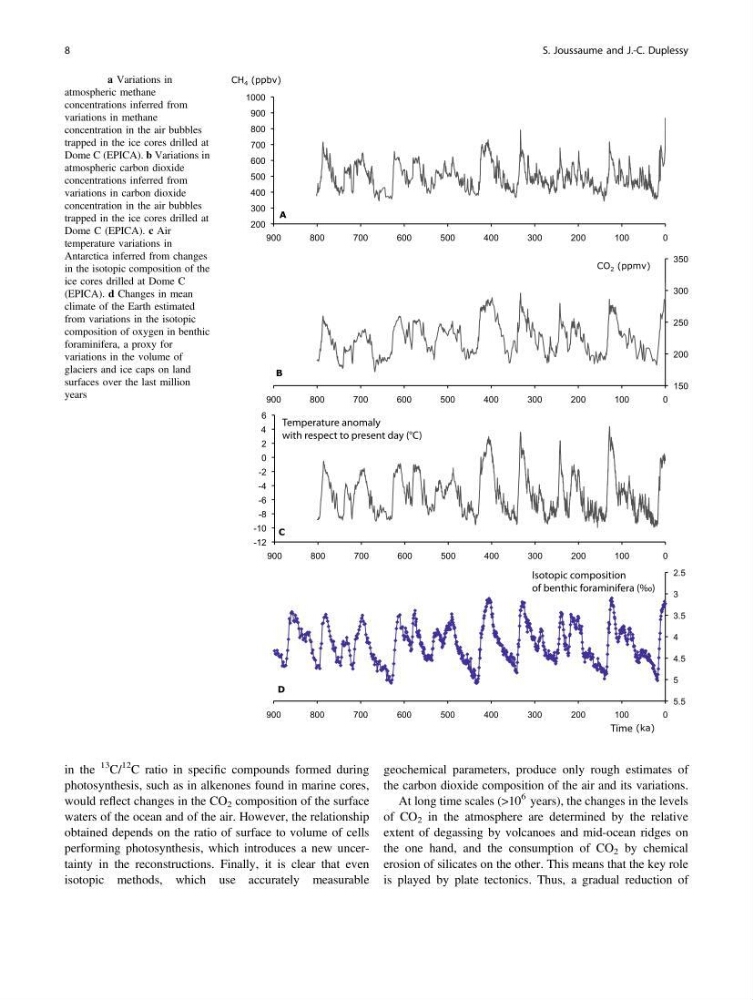
Fig. 1.4 a Variations in
atmospheric methane
concentrations inferred from
variations in methane
concentration in the air bubbles
trapped in the ice cores drilled at
Dome C (EPICA). b Variations in
atmospheric carbon dioxide
concentrations inferred from
variations in carbon dioxide
concentration in the air bubbles
trapped in the ice cores drilled at
Dome C (EPICA). c Air
temperature variations in
Antarctica inferred from changes
in the isotopic composition of the
ice cores drilled at Dome C
(EPICA). d Changes in mean
climate of the Earth estimated
from variations in the isotopic
composition of oxygen in benthic
foraminifera, a proxy for
variations in the volume of
glaciers and ice caps on land
surfaces over the last million
years
8
S. Joussaume and J.-C. Duplessy
13 C/
12 C ratio in specific compounds formed during
photosynthesis, such as in alkenones found in marine cores,
would reflect changes in the CO 2 composition of the surface
waters of the ocean and of the air. However, the relationship
obtained depends on the ratio of surface to volume of cells
performing photosynthesis, which introduces a new uncertainty in the reconstructions. Finally, it is clear that even
isotopic methods, which use accurately measurable
geochemical parameters, produce only rough estimates of
the carbon dioxide composition of the air and its variations.
At long time scales (>10
6 years), the changes in the levels
of CO 2 in the atmosphere are determined by the relative
extent of degassing by volcanoes and mid-ocean ridges on
the one hand, and the consumption of CO 2 by chemical
erosion of silicates on the other. This means that the key role
is played by plate tectonics. Thus, a gradual reduction of
200
300
400
500
600
700
800
900
1000
0
100
200
300
400
500
600
700
800
900
2.5
3
3.5
4
4.5
5
5.5
0
100
200
300
400
500
600
700
800
900
150
200
250
300
350
0
100
200
300
400
500
600
700
800
900
-12
-10
-8
-6
-4
-2
0
2
4
6
0
100
200
300
400
500
600
700
800
900
CH 4 (ppbv)
A
B
C
D
Age (ka)
CO 2 (ppmv)
Anomalie de température par
rapport à l'actuel (°C)
Composition isotopique des
foraminifères benthiques (‰)
Temperature anomaly
with respect to present day (°C)
Isotopic composition
of benthic foraminifera (‰)
Time
Fig. 1.4 a Variations in
atmospheric methane
concentrations inferred from
variations in methane
concentration in the air bubbles
trapped in the ice cores drilled at
Dome C (EPICA). b Variations in
atmospheric carbon dioxide
concentrations inferred from
variations in carbon dioxide
concentration in the air bubbles
trapped in the ice cores drilled at
Dome C (EPICA). c Air
temperature variations in
Antarctica inferred from changes
in the isotopic composition of the
ice cores drilled at Dome C
(EPICA). d Changes in mean
climate of the Earth estimated
from variations in the isotopic
composition of oxygen in benthic
foraminifera, a proxy for
variations in the volume of
glaciers and ice caps on land
surfaces over the last million
years
8
S. Joussaume and J.-C. Duplessy