

Despite recent progress on the developments of new
proxies and the multiplication of the application of such
methods to a growing number of sediment cores, the indications of past ocean oxygenation over the last
glacial-interglacial cycles portrayed by these records stay
very qualitative and mostly apply to the last deglaciation
(Jaccard and Galbraith 2011). Overall, marine sediments
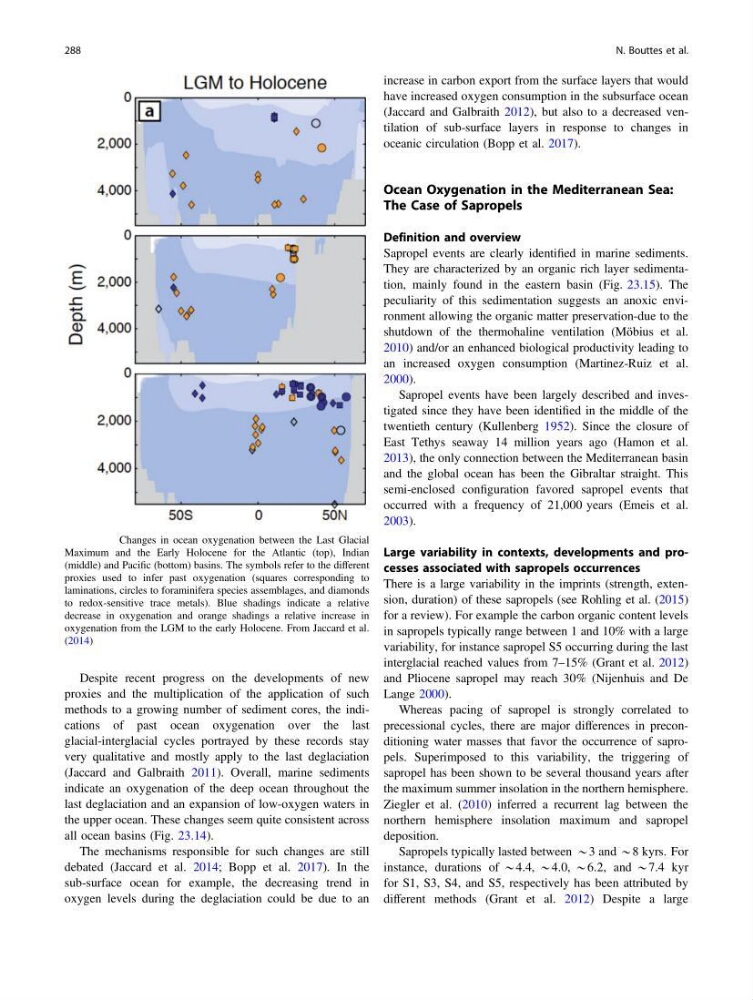
indicate an oxygenation of the deep ocean throughout the
last deglaciation and an expansion of low-oxygen waters in
the upper ocean. These changes seem quite consistent across
all ocean basins (Fig. 23.14).
The mechanisms responsible for such changes are still
debated (Jaccard et al. 2014; Bopp et al. 2017). In the
sub-surface ocean for example, the decreasing trend in
oxygen levels during the deglaciation could be due to an
increase in carbon export from the surface layers that would
have increased oxygen consumption in the subsurface ocean
(Jaccard and Galbraith 2012), but also to a decreased ventilation of sub-surface layers in response to changes in
oceanic circulation (Bopp et al. 2017).
Ocean Oxygenation in the Mediterranean Sea:
The Case of Sapropels
Definition and overview
Sapropel events are clearly identified in marine sediments.
They are characterized by an organic rich layer sedimentation, mainly found in the eastern basin (Fig. 23.15). The
peculiarity of this sedimentation suggests an anoxic environment allowing the organic matter preservation-due to the
shutdown of the thermohaline ventilation (Möbius et al.
2010) and/or an enhanced biological productivity leading to
an increased oxygen consumption (Martinez-Ruiz et al.
2000).
Sapropel events have been largely described and investigated since they have been identified in the middle of the
twentieth century (Kullenberg 1952). Since the closure of
East Tethys seaway 14 million years ago (Hamon et al.
2013), the only connection between the Mediterranean basin
and the global ocean has been the Gibraltar straight. This
semi-enclosed configuration favored sapropel events that
occurred with a frequency of 21,000 years (Emeis et al.
2003).
Large variability in contexts, developments and processes associated with sapropels occurrences
There is a large variability in the imprints (strength, extension, duration) of these sapropels (see Rohling et al. (2015)
for a review). For example the carbon organic content levels
in sapropels typically range between 1 and 10% with a large
variability, for instance sapropel S5 occurring during the last
interglacial reached values from 7–15% (Grant et al. 2012)
and Pliocene sapropel may reach 30% (Nijenhuis and De
Lange 2000).
Whereas pacing of sapropel is strongly correlated to
precessional cycles, there are major differences in preconditioning water masses that favor the occurrence of sapropels. Superimposed to this variability, the triggering of
sapropel has been shown to be several thousand years after
the maximum summer insolation in the northern hemisphere.
Ziegler et al. (2010) inferred a recurrent lag between the
northern hemisphere insolation maximum and sapropel
deposition.
Sapropels typically lasted between *3 and *8 kyrs. For
instance, durations of *4.4, *4.0, *6.2, and *7.4 kyr
for S1, S3, S4, and S5, respectively has been attributed by
different methods (Grant et al. 2012) Despite a large
Fig. 23.14 Changes in ocean oxygenation between the Last Glacial
Maximum and the Early Holocene for the Atlantic (top), Indian
(middle) and Pacific (bottom) basins. The symbols refer to the different
proxies used to infer past oxygenation (squares corresponding to
laminations, circles to foraminifera species assemblages, and diamonds
to redox-sensitive trace metals). Blue shadings indicate a relative
decrease in oxygenation and orange shadings a relative increase in
oxygenation from the LGM to the early Holocene. From Jaccard et al.
(2014)
288
N. Bouttes et al.
proxies and the multiplication of the application of such
methods to a growing number of sediment cores, the indications of past ocean oxygenation over the last
glacial-interglacial cycles portrayed by these records stay
very qualitative and mostly apply to the last deglaciation
(Jaccard and Galbraith 2011). Overall, marine sediments
indicate an oxygenation of the deep ocean throughout the
last deglaciation and an expansion of low-oxygen waters in
the upper ocean. These changes seem quite consistent across
all ocean basins (Fig. 23.14).
The mechanisms responsible for such changes are still
debated (Jaccard et al. 2014; Bopp et al. 2017). In the
sub-surface ocean for example, the decreasing trend in
oxygen levels during the deglaciation could be due to an
increase in carbon export from the surface layers that would
have increased oxygen consumption in the subsurface ocean
(Jaccard and Galbraith 2012), but also to a decreased ventilation of sub-surface layers in response to changes in
oceanic circulation (Bopp et al. 2017).
Ocean Oxygenation in the Mediterranean Sea:
The Case of Sapropels
Definition and overview
Sapropel events are clearly identified in marine sediments.
They are characterized by an organic rich layer sedimentation, mainly found in the eastern basin (Fig. 23.15). The
peculiarity of this sedimentation suggests an anoxic environment allowing the organic matter preservation-due to the
shutdown of the thermohaline ventilation (Möbius et al.
2010) and/or an enhanced biological productivity leading to
an increased oxygen consumption (Martinez-Ruiz et al.
2000).
Sapropel events have been largely described and investigated since they have been identified in the middle of the
twentieth century (Kullenberg 1952). Since the closure of
East Tethys seaway 14 million years ago (Hamon et al.
2013), the only connection between the Mediterranean basin
and the global ocean has been the Gibraltar straight. This
semi-enclosed configuration favored sapropel events that
occurred with a frequency of 21,000 years (Emeis et al.
2003).
Large variability in contexts, developments and processes associated with sapropels occurrences
There is a large variability in the imprints (strength, extension, duration) of these sapropels (see Rohling et al. (2015)
for a review). For example the carbon organic content levels
in sapropels typically range between 1 and 10% with a large
variability, for instance sapropel S5 occurring during the last
interglacial reached values from 7–15% (Grant et al. 2012)
and Pliocene sapropel may reach 30% (Nijenhuis and De
Lange 2000).
Whereas pacing of sapropel is strongly correlated to
precessional cycles, there are major differences in preconditioning water masses that favor the occurrence of sapropels. Superimposed to this variability, the triggering of
sapropel has been shown to be several thousand years after
the maximum summer insolation in the northern hemisphere.
Ziegler et al. (2010) inferred a recurrent lag between the
northern hemisphere insolation maximum and sapropel
deposition.
Sapropels typically lasted between *3 and *8 kyrs. For
instance, durations of *4.4, *4.0, *6.2, and *7.4 kyr
for S1, S3, S4, and S5, respectively has been attributed by
different methods (Grant et al. 2012) Despite a large
Fig. 23.14 Changes in ocean oxygenation between the Last Glacial
Maximum and the Early Holocene for the Atlantic (top), Indian
(middle) and Pacific (bottom) basins. The symbols refer to the different
proxies used to infer past oxygenation (squares corresponding to
laminations, circles to foraminifera species assemblages, and diamonds
to redox-sensitive trace metals). Blue shadings indicate a relative
decrease in oxygenation and orange shadings a relative increase in
oxygenation from the LGM to the early Holocene. From Jaccard et al.
(2014)
288
N. Bouttes et al.