

Many studies have examined the oxygenation of the
Earth’s atmosphere over geological time scales, focusing for
example on the Great Oxidation Event 2.45 billion years ago
(e.g., Holland 1994) or on the variations of atmospheric O 2
over the Phanerozoic (Berner et al. 2003). Over the last
million years, the consensus is that the atmospheric concentration of O 2 has been very stable due to the very long
residence time of O 2 in the atmosphere-ocean system (on the
order of two million years, Catling and Claire 2005).
The oceanic component of the oxygen cycle has been
however much more variable over glacial-interglacial cycles
(Jaccard and Galbraith 2012). This is due to the fact that the
oceanic reservoir of oxygen is much smaller than the
atmospheric one (225 Tmol O 2 in the ocean vs. 3.8 Â 10
7
Tmol of O 2 in the atmosphere), and that dissolved oxygen
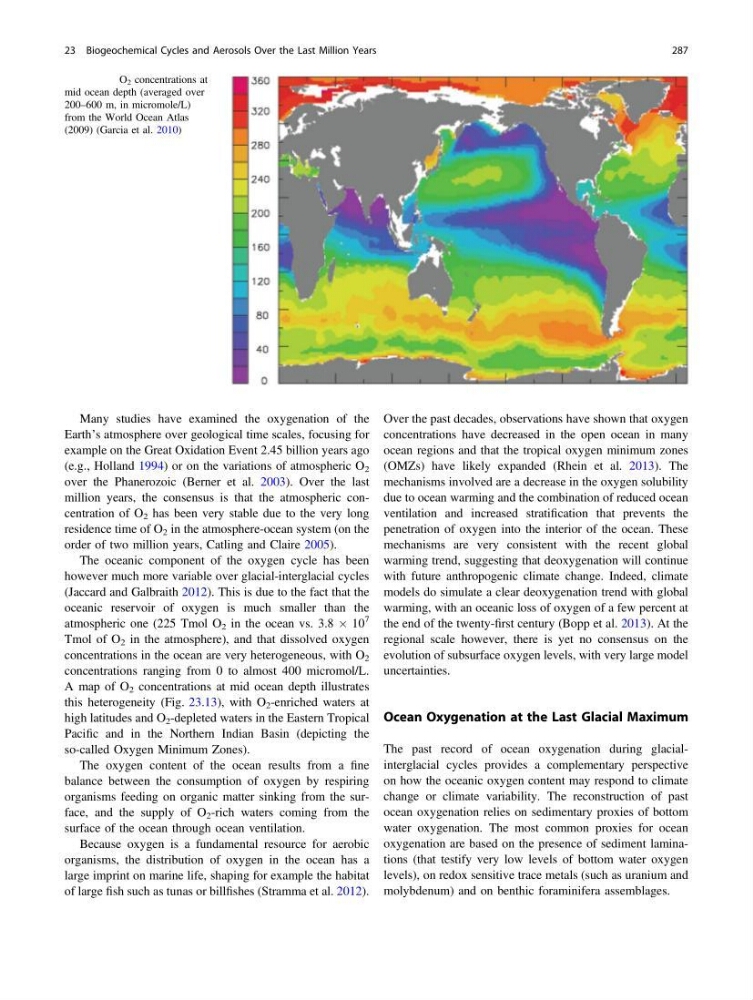
concentrations in the ocean are very heterogeneous, with O 2
concentrations ranging from 0 to almost 400 micromol/L.
A map of O 2 concentrations at mid ocean depth illustrates
this heterogeneity (Fig. 23.13), with O 2 -enriched waters at
high latitudes and O 2 -depleted waters in the Eastern Tropical
Pacific and in the Northern Indian Basin (depicting the
so-called Oxygen Minimum Zones).
The oxygen content of the ocean results from a fine
balance between the consumption of oxygen by respiring
organisms feeding on organic matter sinking from the surface, and the supply of O 2 -rich waters coming from the
surface of the ocean through ocean ventilation.
Because oxygen is a fundamental resource for aerobic
organisms, the distribution of oxygen in the ocean has a
large imprint on marine life, shaping for example the habitat
of large fish such as tunas or billfishes (Stramma et al. 2012).
Over the past decades, observations have shown that oxygen
concentrations have decreased in the open ocean in many
ocean regions and that the tropical oxygen minimum zones
(OMZs) have likely expanded (Rhein et al. 2013). The
mechanisms involved are a decrease in the oxygen solubility
due to ocean warming and the combination of reduced ocean
ventilation and increased stratification that prevents the
penetration of oxygen into the interior of the ocean. These
mechanisms are very consistent with the recent global
warming trend, suggesting that deoxygenation will continue
with future anthropogenic climate change. Indeed, climate
models do simulate a clear deoxygenation trend with global
warming, with an oceanic loss of oxygen of a few percent at
the end of the twenty-first century (Bopp et al. 2013). At the
regional scale however, there is yet no consensus on the
evolution of subsurface oxygen levels, with very large model
uncertainties.
Ocean Oxygenation at the Last Glacial Maximum
The past record of ocean oxygenation during glacialinterglacial cycles provides a complementary perspective
on how the oceanic oxygen content may respond to climate
change or climate variability. The reconstruction of past
ocean oxygenation relies on sedimentary proxies of bottom
water oxygenation. The most common proxies for ocean
oxygenation are based on the presence of sediment laminations (that testify very low levels of bottom water oxygen
levels), on redox sensitive trace metals (such as uranium and
molybdenum) and on benthic foraminifera assemblages.
Fig. 23.13 O 2 concentrations at
mid ocean depth (averaged over
200–600 m, in micromole/L)
from the World Ocean Atlas
(2009) (Garcia et al. 2010)
23 Biogeochemical Cycles and Aerosols Over the Last Million Years
287
Earth’s atmosphere over geological time scales, focusing for
example on the Great Oxidation Event 2.45 billion years ago
(e.g., Holland 1994) or on the variations of atmospheric O 2
over the Phanerozoic (Berner et al. 2003). Over the last
million years, the consensus is that the atmospheric concentration of O 2 has been very stable due to the very long
residence time of O 2 in the atmosphere-ocean system (on the
order of two million years, Catling and Claire 2005).
The oceanic component of the oxygen cycle has been
however much more variable over glacial-interglacial cycles
(Jaccard and Galbraith 2012). This is due to the fact that the
oceanic reservoir of oxygen is much smaller than the
atmospheric one (225 Tmol O 2 in the ocean vs. 3.8 Â 10
7
Tmol of O 2 in the atmosphere), and that dissolved oxygen
concentrations in the ocean are very heterogeneous, with O 2
concentrations ranging from 0 to almost 400 micromol/L.
A map of O 2 concentrations at mid ocean depth illustrates
this heterogeneity (Fig. 23.13), with O 2 -enriched waters at
high latitudes and O 2 -depleted waters in the Eastern Tropical
Pacific and in the Northern Indian Basin (depicting the
so-called Oxygen Minimum Zones).
The oxygen content of the ocean results from a fine
balance between the consumption of oxygen by respiring
organisms feeding on organic matter sinking from the surface, and the supply of O 2 -rich waters coming from the
surface of the ocean through ocean ventilation.
Because oxygen is a fundamental resource for aerobic
organisms, the distribution of oxygen in the ocean has a
large imprint on marine life, shaping for example the habitat
of large fish such as tunas or billfishes (Stramma et al. 2012).
Over the past decades, observations have shown that oxygen
concentrations have decreased in the open ocean in many
ocean regions and that the tropical oxygen minimum zones
(OMZs) have likely expanded (Rhein et al. 2013). The
mechanisms involved are a decrease in the oxygen solubility
due to ocean warming and the combination of reduced ocean
ventilation and increased stratification that prevents the
penetration of oxygen into the interior of the ocean. These
mechanisms are very consistent with the recent global
warming trend, suggesting that deoxygenation will continue
with future anthropogenic climate change. Indeed, climate
models do simulate a clear deoxygenation trend with global
warming, with an oceanic loss of oxygen of a few percent at
the end of the twenty-first century (Bopp et al. 2013). At the
regional scale however, there is yet no consensus on the
evolution of subsurface oxygen levels, with very large model
uncertainties.
Ocean Oxygenation at the Last Glacial Maximum
The past record of ocean oxygenation during glacialinterglacial cycles provides a complementary perspective
on how the oceanic oxygen content may respond to climate
change or climate variability. The reconstruction of past
ocean oxygenation relies on sedimentary proxies of bottom
water oxygenation. The most common proxies for ocean
oxygenation are based on the presence of sediment laminations (that testify very low levels of bottom water oxygen
levels), on redox sensitive trace metals (such as uranium and
molybdenum) and on benthic foraminifera assemblages.
Fig. 23.13 O 2 concentrations at
mid ocean depth (averaged over
200–600 m, in micromole/L)
from the World Ocean Atlas
(2009) (Garcia et al. 2010)
23 Biogeochemical Cycles and Aerosols Over the Last Million Years
287