

which is a powerful GHG. In conditions where O 2 is completely depleted, N 2 O instead of NO 3
− is respired into N 2 .
Ammonification is the production of NH 4
+ by bacteria
and fungi from organic nitrogen originating from dead plants
or animals, or animal waste.
During nitrification and denitrification, N 2 O, a greenhouse gas, is also produced. The sources of N 2 O come from
both ocean and land. The sink of N 2 O is due to photochemical reaction with ozone in the stratosphere.
Changes in the Nitrogen Cycle During Glacial
Interglacial Cycles
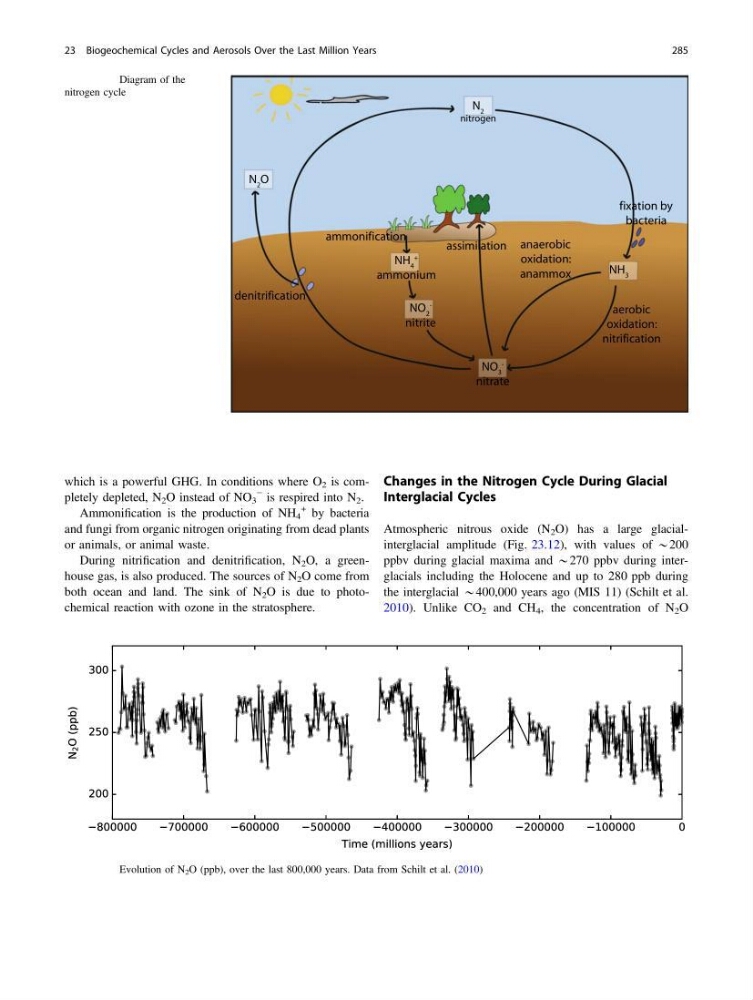
Atmospheric nitrous oxide (N 2 O) has a large glacialinterglacial amplitude (Fig. 23.12), with values of *200
ppbv during glacial maxima and *270 ppbv during interglacials including the Holocene and up to 280 ppb during
the interglacial *400,000 years ago (MIS 11) (Schilt et al.
2010). Unlike CO 2 and CH 4 , the concentration of N 2 O
N 2
nitrogen
fixation by
bacteria
NH 3
NO 3
-
nitrate
aerobic
oxidation:
nitrification
anaerobic
oxidation:
anammox
assimilation
denitrification
ammonification
NH 4
+
ammonium
NO 2
-
nitrite
N 2 O
Fig. 23.11 Diagram of the
nitrogen cycle
Fig. 23.12 Evolution of N 2 O (ppb), over the last 800,000 years. Data from Schilt et al. (2010)
23 Biogeochemical Cycles and Aerosols Over the Last Million Years
285
− is respired into N 2 .
Ammonification is the production of NH 4
+ by bacteria
and fungi from organic nitrogen originating from dead plants
or animals, or animal waste.
During nitrification and denitrification, N 2 O, a greenhouse gas, is also produced. The sources of N 2 O come from
both ocean and land. The sink of N 2 O is due to photochemical reaction with ozone in the stratosphere.
Changes in the Nitrogen Cycle During Glacial
Interglacial Cycles
Atmospheric nitrous oxide (N 2 O) has a large glacialinterglacial amplitude (Fig. 23.12), with values of *200
ppbv during glacial maxima and *270 ppbv during interglacials including the Holocene and up to 280 ppb during
the interglacial *400,000 years ago (MIS 11) (Schilt et al.
2010). Unlike CO 2 and CH 4 , the concentration of N 2 O
N 2
nitrogen
fixation by
bacteria
NH 3
NO 3
-
nitrate
aerobic
oxidation:
nitrification
anaerobic
oxidation:
anammox
assimilation
denitrification
ammonification
NH 4
+
ammonium
NO 2
-
nitrite
N 2 O
Fig. 23.11 Diagram of the
nitrogen cycle
Fig. 23.12 Evolution of N 2 O (ppb), over the last 800,000 years. Data from Schilt et al. (2010)
23 Biogeochemical Cycles and Aerosols Over the Last Million Years
285