

hypotheses to explain the various mechanisms involved.
Fluteau et al. (2001) suggested that high seasonality in
Gondwana was typical at mid and high latitudes due to the
low heat capacity of the continents, and that monsoon-type
atmospheric circulation marked the eastern side of the
supercontinent. Other modeling studies (Kiehl and Shields
2005; Shields and Kiehl 2018) have confirmed these results,
even suggesting that these characteristics continued despite
a high atmospheric concentration of carbon dioxide
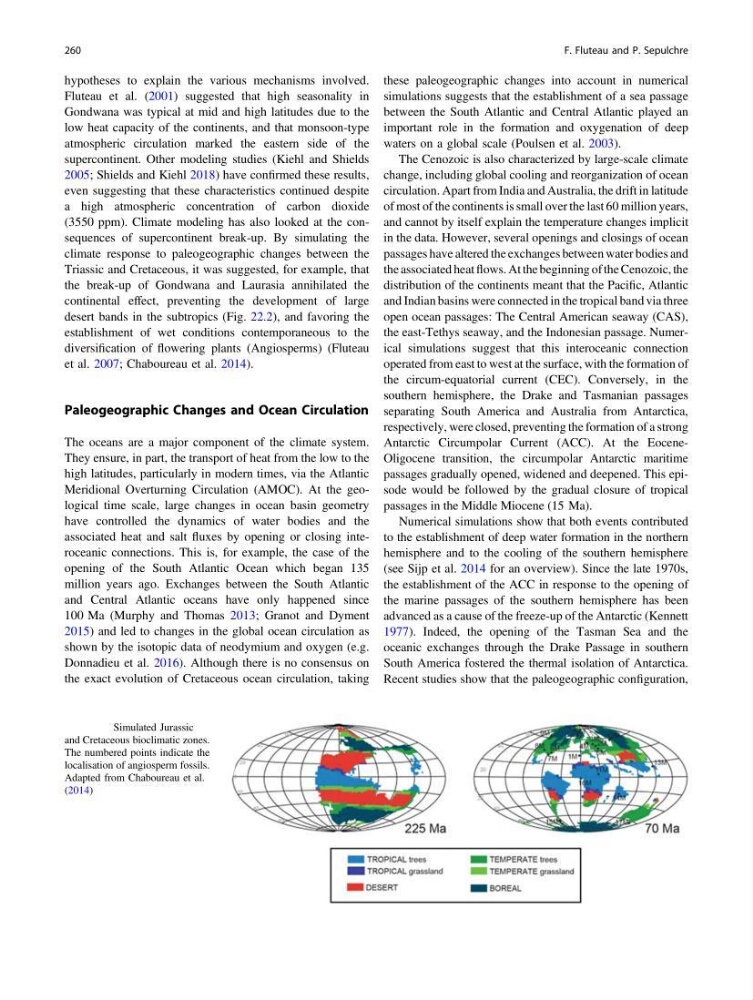
(3550 ppm). Climate modeling has also looked at the consequences of supercontinent break-up. By simulating the
climate response to paleogeographic changes between the
Triassic and Cretaceous, it was suggested, for example, that
the break-up of Gondwana and Laurasia annihilated the
continental effect, preventing the development of large
desert bands in the subtropics (Fig. 22.2), and favoring the
establishment of wet conditions contemporaneous to the
diversification of flowering plants (Angiosperms) (Fluteau
et al. 2007; Chaboureau et al. 2014).
Paleogeographic Changes and Ocean Circulation
The oceans are a major component of the climate system.
They ensure, in part, the transport of heat from the low to the
high latitudes, particularly in modern times, via the Atlantic
Meridional Overturning Circulation (AMOC). At the geological time scale, large changes in ocean basin geometry
have controlled the dynamics of water bodies and the
associated heat and salt fluxes by opening or closing interoceanic connections. This is, for example, the case of the
opening of the South Atlantic Ocean which began 135
million years ago. Exchanges between the South Atlantic
and Central Atlantic oceans have only happened since
100 Ma (Murphy and Thomas 2013; Granot and Dyment
2015) and led to changes in the global ocean circulation as
shown by the isotopic data of neodymium and oxygen (e.g.
Donnadieu et al. 2016). Although there is no consensus on
the exact evolution of Cretaceous ocean circulation, taking
these paleogeographic changes into account in numerical
simulations suggests that the establishment of a sea passage
between the South Atlantic and Central Atlantic played an
important role in the formation and oxygenation of deep
waters on a global scale (Poulsen et al. 2003).
The Cenozoic is also characterized by large-scale climate
change, including global cooling and reorganization of ocean
circulation. Apart from India and Australia, the drift in latitude
of most of the continents is small over the last 60 million years,
and cannot by itself explain the temperature changes implicit
in the data. However, several openings and closings of ocean
passages have altered the exchanges between water bodies and
the associated heat flows. At the beginning of the Cenozoic, the
distribution of the continents meant that the Pacific, Atlantic
and Indian basins were connected in the tropical band via three
open ocean passages: The Central American seaway (CAS),
the east-Tethys seaway, and the Indonesian passage. Numerical simulations suggest that this interoceanic connection
operated from east to west at the surface, with the formation of
the circum-equatorial current (CEC). Conversely, in the
southern hemisphere, the Drake and Tasmanian passages
separating South America and Australia from Antarctica,
respectively, were closed, preventing the formation of a strong
Antarctic Circumpolar Current (ACC). At the EoceneOligocene transition, the circumpolar Antarctic maritime
passages gradually opened, widened and deepened. This episode would be followed by the gradual closure of tropical
passages in the Middle Miocene (15 Ma).
Numerical simulations show that both events contributed
to the establishment of deep water formation in the northern
hemisphere and to the cooling of the southern hemisphere
(see Sijp et al. 2014 for an overview). Since the late 1970s,
the establishment of the ACC in response to the opening of
the marine passages of the southern hemisphere has been
advanced as a cause of the freeze-up of the Antarctic (Kennett
1977). Indeed, the opening of the Tasman Sea and the
oceanic exchanges through the Drake Passage in southern
South America fostered the thermal isolation of Antarctica.
Recent studies show that the paleogeographic configuration,
Fig. 22.2 Simulated Jurassic
and Cretaceous bioclimatic zones.
The numbered points indicate the
localisation of angiosperm fossils.
Adapted from Chaboureau et al.
(2014)
260
F. Fluteau and P. Sepulchre
Fluteau et al. (2001) suggested that high seasonality in
Gondwana was typical at mid and high latitudes due to the
low heat capacity of the continents, and that monsoon-type
atmospheric circulation marked the eastern side of the
supercontinent. Other modeling studies (Kiehl and Shields
2005; Shields and Kiehl 2018) have confirmed these results,
even suggesting that these characteristics continued despite
a high atmospheric concentration of carbon dioxide
(3550 ppm). Climate modeling has also looked at the consequences of supercontinent break-up. By simulating the
climate response to paleogeographic changes between the
Triassic and Cretaceous, it was suggested, for example, that
the break-up of Gondwana and Laurasia annihilated the
continental effect, preventing the development of large
desert bands in the subtropics (Fig. 22.2), and favoring the
establishment of wet conditions contemporaneous to the
diversification of flowering plants (Angiosperms) (Fluteau
et al. 2007; Chaboureau et al. 2014).
Paleogeographic Changes and Ocean Circulation
The oceans are a major component of the climate system.
They ensure, in part, the transport of heat from the low to the
high latitudes, particularly in modern times, via the Atlantic
Meridional Overturning Circulation (AMOC). At the geological time scale, large changes in ocean basin geometry
have controlled the dynamics of water bodies and the
associated heat and salt fluxes by opening or closing interoceanic connections. This is, for example, the case of the
opening of the South Atlantic Ocean which began 135
million years ago. Exchanges between the South Atlantic
and Central Atlantic oceans have only happened since
100 Ma (Murphy and Thomas 2013; Granot and Dyment
2015) and led to changes in the global ocean circulation as
shown by the isotopic data of neodymium and oxygen (e.g.
Donnadieu et al. 2016). Although there is no consensus on
the exact evolution of Cretaceous ocean circulation, taking
these paleogeographic changes into account in numerical
simulations suggests that the establishment of a sea passage
between the South Atlantic and Central Atlantic played an
important role in the formation and oxygenation of deep
waters on a global scale (Poulsen et al. 2003).
The Cenozoic is also characterized by large-scale climate
change, including global cooling and reorganization of ocean
circulation. Apart from India and Australia, the drift in latitude
of most of the continents is small over the last 60 million years,
and cannot by itself explain the temperature changes implicit
in the data. However, several openings and closings of ocean
passages have altered the exchanges between water bodies and
the associated heat flows. At the beginning of the Cenozoic, the
distribution of the continents meant that the Pacific, Atlantic
and Indian basins were connected in the tropical band via three
open ocean passages: The Central American seaway (CAS),
the east-Tethys seaway, and the Indonesian passage. Numerical simulations suggest that this interoceanic connection
operated from east to west at the surface, with the formation of
the circum-equatorial current (CEC). Conversely, in the
southern hemisphere, the Drake and Tasmanian passages
separating South America and Australia from Antarctica,
respectively, were closed, preventing the formation of a strong
Antarctic Circumpolar Current (ACC). At the EoceneOligocene transition, the circumpolar Antarctic maritime
passages gradually opened, widened and deepened. This episode would be followed by the gradual closure of tropical
passages in the Middle Miocene (15 Ma).
Numerical simulations show that both events contributed
to the establishment of deep water formation in the northern
hemisphere and to the cooling of the southern hemisphere
(see Sijp et al. 2014 for an overview). Since the late 1970s,
the establishment of the ACC in response to the opening of
the marine passages of the southern hemisphere has been
advanced as a cause of the freeze-up of the Antarctic (Kennett
1977). Indeed, the opening of the Tasman Sea and the
oceanic exchanges through the Drake Passage in southern
South America fostered the thermal isolation of Antarctica.
Recent studies show that the paleogeographic configuration,
Fig. 22.2 Simulated Jurassic
and Cretaceous bioclimatic zones.
The numbered points indicate the
localisation of angiosperm fossils.
Adapted from Chaboureau et al.
(2014)
260
F. Fluteau and P. Sepulchre