

Reconstructing and understanding changes in the ocean over
the last two millennia is particularly difficult, since oceanographic observations are only available for the last century at
most, and for paleoceanographers this period is recorded in
the uppermost portion of the sediment which is often poorly
consolidated or lost.
Recently, much effort has been put on the gathering of the
best time-series of the last two millennia as part of the Past
Global Changes (PAGES) 2 k network (PAGES 2k Consortium 2013, 2017). Continental-scale temperature reconstructions provide evidence of twentieth century warming over all
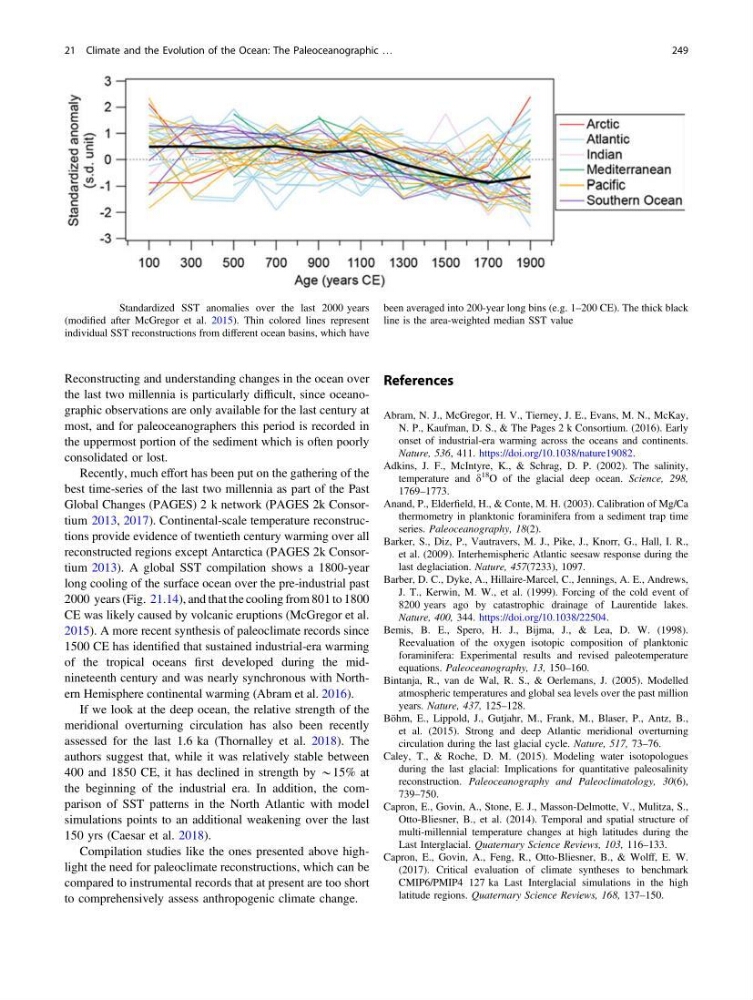
reconstructed regions except Antarctica (PAGES 2k Consortium 2013). A global SST compilation shows a 1800-year
long cooling of the surface ocean over the pre-industrial past
2000 years (Fig. 21.14), and that the cooling from 801 to 1800
CE was likely caused by volcanic eruptions (McGregor et al.
2015). A more recent synthesis of paleoclimate records since
1500 CE has identified that sustained industrial-era warming
of the tropical oceans first developed during the midnineteenth century and was nearly synchronous with Northern Hemisphere continental warming (Abram et al. 2016).
If we look at the deep ocean, the relative strength of the
meridional overturning circulation has also been recently
assessed for the last 1.6 ka (Thornalley et al. 2018). The
authors suggest that, while it was relatively stable between
400 and 1850 CE, it has declined in strength by *15% at
the beginning of the industrial era. In addition, the comparison of SST patterns in the North Atlantic with model
simulations points to an additional weakening over the last
150 yrs (Caesar et al. 2018).
Compilation studies like the ones presented above highlight the need for paleoclimate reconstructions, which can be
compared to instrumental records that at present are too short
to comprehensively assess anthropogenic climate change.
References
Abram, N. J., McGregor, H. V., Tierney, J. E., Evans, M. N., McKay,
N. P., Kaufman, D. S., & The Pages 2 k Consortium. (2016). Early
onset of industrial-era warming across the oceans and continents.
Nature, 536, 411. https://doi.org/10.1038/nature19082.
Adkins, J. F., McIntyre, K., & Schrag, D. P. (2002). The salinity,
temperature and d
18
O of the glacial deep ocean. Science, 298,
1769–1773.
Anand, P., Elderfield, H., & Conte, M. H. (2003). Calibration of Mg/Ca
thermometry in planktonic foraminifera from a sediment trap time
series. Paleoceanography, 18(2).
Barker, S., Diz, P., Vautravers, M. J., Pike, J., Knorr, G., Hall, I. R.,
et al. (2009). Interhemispheric Atlantic seesaw response during the
last deglaciation. Nature, 457(7233), 1097.
Barber, D. C., Dyke, A., Hillaire-Marcel, C., Jennings, A. E., Andrews,
J. T., Kerwin, M. W., et al. (1999). Forcing of the cold event of
8200 years ago by catastrophic drainage of Laurentide lakes.
Nature, 400, 344. https://doi.org/10.1038/22504.
Bemis, B. E., Spero, H. J., Bijma, J., & Lea, D. W. (1998).
Reevaluation of the oxygen isotopic composition of planktonic
foraminifera: Experimental results and revised paleotemperature
equations. Paleoceanography, 13, 150–160.
Bintanja, R., van de Wal, R. S., & Oerlemans, J. (2005). Modelled
atmospheric temperatures and global sea levels over the past million
years. Nature, 437, 125–128.
Böhm, E., Lippold, J., Gutjahr, M., Frank, M., Blaser, P., Antz, B.,
et al. (2015). Strong and deep Atlantic meridional overturning
circulation during the last glacial cycle. Nature, 517, 73–76.
Caley, T., & Roche, D. M. (2015). Modeling water isotopologues
during the last glacial: Implications for quantitative paleosalinity
reconstruction. Paleoceanography and Paleoclimatology, 30(6),
739–750.
Capron, E., Govin, A., Stone, E. J., Masson-Delmotte, V., Mulitza, S.,
Otto-Bliesner, B., et al. (2014). Temporal and spatial structure of
multi-millennial temperature changes at high latitudes during the
Last Interglacial. Quaternary Science Reviews, 103, 116–133.
Capron, E., Govin, A., Feng, R., Otto-Bliesner, B., & Wolff, E. W.
(2017). Critical evaluation of climate syntheses to benchmark
CMIP6/PMIP4 127 ka Last Interglacial simulations in the high
latitude regions. Quaternary Science Reviews, 168, 137–150.
Fig. 21.14 Standardized SST anomalies over the last 2000 years
(modified after McGregor et al. 2015). Thin colored lines represent
individual SST reconstructions from different ocean basins, which have
been averaged into 200-year long bins (e.g. 1–200 CE). The thick black
line is the area-weighted median SST value
21 Climate and the Evolution of the Ocean: The Paleoceanographic …
249
the last two millennia is particularly difficult, since oceanographic observations are only available for the last century at
most, and for paleoceanographers this period is recorded in
the uppermost portion of the sediment which is often poorly
consolidated or lost.
Recently, much effort has been put on the gathering of the
best time-series of the last two millennia as part of the Past
Global Changes (PAGES) 2 k network (PAGES 2k Consortium 2013, 2017). Continental-scale temperature reconstructions provide evidence of twentieth century warming over all
reconstructed regions except Antarctica (PAGES 2k Consortium 2013). A global SST compilation shows a 1800-year
long cooling of the surface ocean over the pre-industrial past
2000 years (Fig. 21.14), and that the cooling from 801 to 1800
CE was likely caused by volcanic eruptions (McGregor et al.
2015). A more recent synthesis of paleoclimate records since
1500 CE has identified that sustained industrial-era warming
of the tropical oceans first developed during the midnineteenth century and was nearly synchronous with Northern Hemisphere continental warming (Abram et al. 2016).
If we look at the deep ocean, the relative strength of the
meridional overturning circulation has also been recently
assessed for the last 1.6 ka (Thornalley et al. 2018). The
authors suggest that, while it was relatively stable between
400 and 1850 CE, it has declined in strength by *15% at
the beginning of the industrial era. In addition, the comparison of SST patterns in the North Atlantic with model
simulations points to an additional weakening over the last
150 yrs (Caesar et al. 2018).
Compilation studies like the ones presented above highlight the need for paleoclimate reconstructions, which can be
compared to instrumental records that at present are too short
to comprehensively assess anthropogenic climate change.
References
Abram, N. J., McGregor, H. V., Tierney, J. E., Evans, M. N., McKay,
N. P., Kaufman, D. S., & The Pages 2 k Consortium. (2016). Early
onset of industrial-era warming across the oceans and continents.
Nature, 536, 411. https://doi.org/10.1038/nature19082.
Adkins, J. F., McIntyre, K., & Schrag, D. P. (2002). The salinity,
temperature and d
18
O of the glacial deep ocean. Science, 298,
1769–1773.
Anand, P., Elderfield, H., & Conte, M. H. (2003). Calibration of Mg/Ca
thermometry in planktonic foraminifera from a sediment trap time
series. Paleoceanography, 18(2).
Barker, S., Diz, P., Vautravers, M. J., Pike, J., Knorr, G., Hall, I. R.,
et al. (2009). Interhemispheric Atlantic seesaw response during the
last deglaciation. Nature, 457(7233), 1097.
Barber, D. C., Dyke, A., Hillaire-Marcel, C., Jennings, A. E., Andrews,
J. T., Kerwin, M. W., et al. (1999). Forcing of the cold event of
8200 years ago by catastrophic drainage of Laurentide lakes.
Nature, 400, 344. https://doi.org/10.1038/22504.
Bemis, B. E., Spero, H. J., Bijma, J., & Lea, D. W. (1998).
Reevaluation of the oxygen isotopic composition of planktonic
foraminifera: Experimental results and revised paleotemperature
equations. Paleoceanography, 13, 150–160.
Bintanja, R., van de Wal, R. S., & Oerlemans, J. (2005). Modelled
atmospheric temperatures and global sea levels over the past million
years. Nature, 437, 125–128.
Böhm, E., Lippold, J., Gutjahr, M., Frank, M., Blaser, P., Antz, B.,
et al. (2015). Strong and deep Atlantic meridional overturning
circulation during the last glacial cycle. Nature, 517, 73–76.
Caley, T., & Roche, D. M. (2015). Modeling water isotopologues
during the last glacial: Implications for quantitative paleosalinity
reconstruction. Paleoceanography and Paleoclimatology, 30(6),
739–750.
Capron, E., Govin, A., Stone, E. J., Masson-Delmotte, V., Mulitza, S.,
Otto-Bliesner, B., et al. (2014). Temporal and spatial structure of
multi-millennial temperature changes at high latitudes during the
Last Interglacial. Quaternary Science Reviews, 103, 116–133.
Capron, E., Govin, A., Feng, R., Otto-Bliesner, B., & Wolff, E. W.
(2017). Critical evaluation of climate syntheses to benchmark
CMIP6/PMIP4 127 ka Last Interglacial simulations in the high
latitude regions. Quaternary Science Reviews, 168, 137–150.
Fig. 21.14 Standardized SST anomalies over the last 2000 years
(modified after McGregor et al. 2015). Thin colored lines represent
individual SST reconstructions from different ocean basins, which have
been averaged into 200-year long bins (e.g. 1–200 CE). The thick black
line is the area-weighted median SST value
21 Climate and the Evolution of the Ocean: The Paleoceanographic …
249