

depleted in
13 C. Consumption of dissolved oxygen and
production of CO 2 , accompanied by a decrease in d
13 C, take
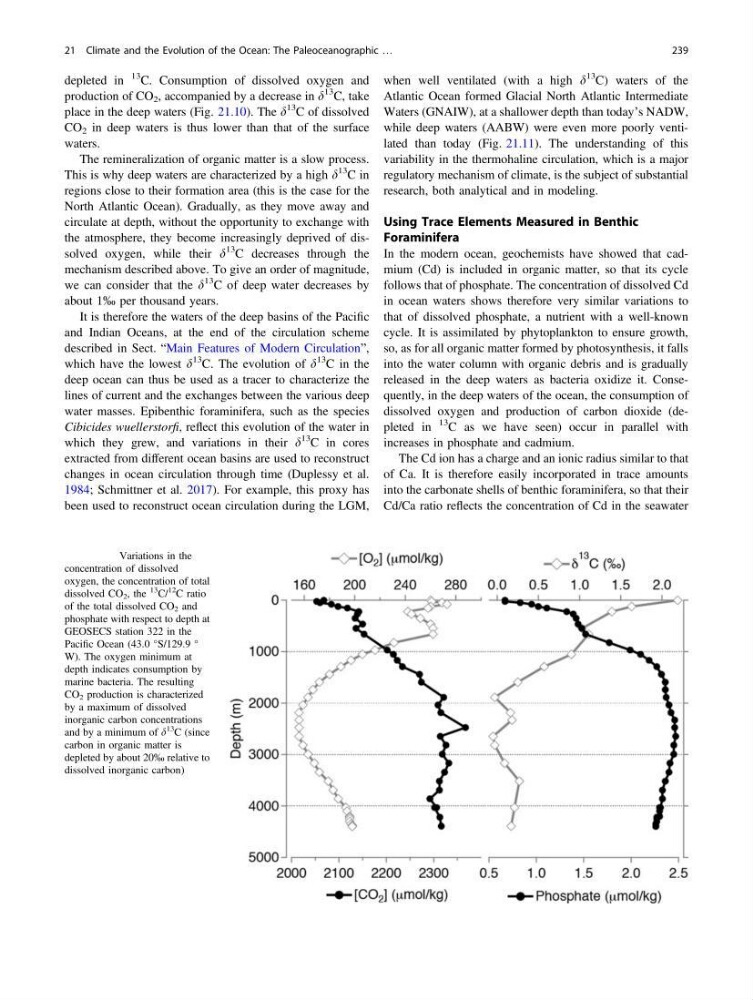
place in the deep waters (Fig. 21.10). The d
13 C of dissolved
CO 2 in deep waters is thus lower than that of the surface
waters.
The remineralization of organic matter is a slow process.
This is why deep waters are characterized by a high d
13
C in
regions close to their formation area (this is the case for the
North Atlantic Ocean). Gradually, as they move away and
circulate at depth, without the opportunity to exchange with
the atmosphere, they become increasingly deprived of dissolved oxygen, while their d
13 C decreases through the
mechanism described above. To give an order of magnitude,
we can consider that the d
13 C of deep water decreases by
about 1‰ per thousand years.
It is therefore the waters of the deep basins of the Pacific
and Indian Oceans, at the end of the circulation scheme
described in Sect. “Main Features of Modern Circulation”,
which have the lowest d
13
C. The evolution of d
13 C in the
deep ocean can thus be used as a tracer to characterize the
lines of current and the exchanges between the various deep
water masses. Epibenthic foraminifera, such as the species
Cibicides wuellerstorfi, reflect this evolution of the water in
which they grew, and variations in their d
13 C in cores
extracted from different ocean basins are used to reconstruct
changes in ocean circulation through time (Duplessy et al.
1984; Schmittner et al. 2017). For example, this proxy has
been used to reconstruct ocean circulation during the LGM,
when well ventilated (with a high d
13 C) waters of the
Atlantic Ocean formed Glacial North Atlantic Intermediate
Waters (GNAIW), at a shallower depth than today’s NADW,
while deep waters (AABW) were even more poorly ventilated than today (Fig. 21.11). The understanding of this
variability in the thermohaline circulation, which is a major
regulatory mechanism of climate, is the subject of substantial
research, both analytical and in modeling.
Using Trace Elements Measured in Benthic
Foraminifera
In the modern ocean, geochemists have showed that cadmium (Cd) is included in organic matter, so that its cycle
follows that of phosphate. The concentration of dissolved Cd
in ocean waters shows therefore very similar variations to
that of dissolved phosphate, a nutrient with a well-known
cycle. It is assimilated by phytoplankton to ensure growth,
so, as for all organic matter formed by photosynthesis, it falls
into the water column with organic debris and is gradually
released in the deep waters as bacteria oxidize it. Consequently, in the deep waters of the ocean, the consumption of
dissolved oxygen and production of carbon dioxide (depleted in
13 C as we have seen) occur in parallel with
increases in phosphate and cadmium.
The Cd ion has a charge and an ionic radius similar to that
of Ca. It is therefore easily incorporated in trace amounts
into the carbonate shells of benthic foraminifera, so that their
Cd/Ca ratio reflects the concentration of Cd in the seawater
Fig. 21.10 Variations in the
concentration of dissolved
oxygen, the concentration of total
dissolved CO 2 , the
13 C/
12
C ratio
of the total dissolved CO 2 and
phosphate with respect to depth at
GEOSECS station 322 in the
Pacific Ocean (43.0 °S/129.9 °
W). The oxygen minimum at
depth indicates consumption by
marine bacteria. The resulting
CO 2 production is characterized
by a maximum of dissolved
inorganic carbon concentrations
and by a minimum of d
13
C (since
carbon in organic matter is
depleted by about 20‰ relative to
dissolved inorganic carbon)
21 Climate and the Evolution of the Ocean: The Paleoceanographic …
239
13 C. Consumption of dissolved oxygen and
production of CO 2 , accompanied by a decrease in d
13 C, take
place in the deep waters (Fig. 21.10). The d
13 C of dissolved
CO 2 in deep waters is thus lower than that of the surface
waters.
The remineralization of organic matter is a slow process.
This is why deep waters are characterized by a high d
13
C in
regions close to their formation area (this is the case for the
North Atlantic Ocean). Gradually, as they move away and
circulate at depth, without the opportunity to exchange with
the atmosphere, they become increasingly deprived of dissolved oxygen, while their d
13 C decreases through the
mechanism described above. To give an order of magnitude,
we can consider that the d
13 C of deep water decreases by
about 1‰ per thousand years.
It is therefore the waters of the deep basins of the Pacific
and Indian Oceans, at the end of the circulation scheme
described in Sect. “Main Features of Modern Circulation”,
which have the lowest d
13
C. The evolution of d
13 C in the
deep ocean can thus be used as a tracer to characterize the
lines of current and the exchanges between the various deep
water masses. Epibenthic foraminifera, such as the species
Cibicides wuellerstorfi, reflect this evolution of the water in
which they grew, and variations in their d
13 C in cores
extracted from different ocean basins are used to reconstruct
changes in ocean circulation through time (Duplessy et al.
1984; Schmittner et al. 2017). For example, this proxy has
been used to reconstruct ocean circulation during the LGM,
when well ventilated (with a high d
13 C) waters of the
Atlantic Ocean formed Glacial North Atlantic Intermediate
Waters (GNAIW), at a shallower depth than today’s NADW,
while deep waters (AABW) were even more poorly ventilated than today (Fig. 21.11). The understanding of this
variability in the thermohaline circulation, which is a major
regulatory mechanism of climate, is the subject of substantial
research, both analytical and in modeling.
Using Trace Elements Measured in Benthic
Foraminifera
In the modern ocean, geochemists have showed that cadmium (Cd) is included in organic matter, so that its cycle
follows that of phosphate. The concentration of dissolved Cd
in ocean waters shows therefore very similar variations to
that of dissolved phosphate, a nutrient with a well-known
cycle. It is assimilated by phytoplankton to ensure growth,
so, as for all organic matter formed by photosynthesis, it falls
into the water column with organic debris and is gradually
released in the deep waters as bacteria oxidize it. Consequently, in the deep waters of the ocean, the consumption of
dissolved oxygen and production of carbon dioxide (depleted in
13 C as we have seen) occur in parallel with
increases in phosphate and cadmium.
The Cd ion has a charge and an ionic radius similar to that
of Ca. It is therefore easily incorporated in trace amounts
into the carbonate shells of benthic foraminifera, so that their
Cd/Ca ratio reflects the concentration of Cd in the seawater
Fig. 21.10 Variations in the
concentration of dissolved
oxygen, the concentration of total
dissolved CO 2 , the
13 C/
12
C ratio
of the total dissolved CO 2 and
phosphate with respect to depth at
GEOSECS station 322 in the
Pacific Ocean (43.0 °S/129.9 °
W). The oxygen minimum at
depth indicates consumption by
marine bacteria. The resulting
CO 2 production is characterized
by a maximum of dissolved
inorganic carbon concentrations
and by a minimum of d
13
C (since
carbon in organic matter is
depleted by about 20‰ relative to
dissolved inorganic carbon)
21 Climate and the Evolution of the Ocean: The Paleoceanographic …
239