

range of 0.8–1.8 psu (Schmidt 1999). In addition, the
spatial and temporal evolution of the slope of the d w -
salinity relationship, tested in isotope-enabled numerical climate models, can lead to very large errors
(Legrande and Schmidt 2011), up to 25 psu in certain
regions for the LGM (Caley and Roche 2015).
To reduce these very large errors on past SSS
reconstructions, model-derived temporal slopes of the
d w -salinity relationship can be used directly in the
calculation. This approach has been tested with success for the LGM on a marine sediment record located
in Gulf of Guinea and influenced by West African
monsoon hydrology (Caley and Roche 2015). However, allowing model-derived regional d w -salinity
relationships to vary through time can lead to significant uncertainties related to the shortcomings of the
models, so complementary approaches should also be
developed.
Paleosalinities from Stable Hydrogen Isotopes
(d
2
H)
Another method uses hydrogen isotope changes to reconstruct paleosalinities. Culture experiments have found a
constant offset between the hydrogen isotopic composition
of water and the hydrogen isotopic composition of alkenones
synthesized in that water (Paul 2002; Englebrecht and Sachs
2005). Schouten et al. (2006) demonstrated that this offset
was dependent on salinity via biological fractionation processes. Reconstructing salinity by using the biological fractionation factor that is linked to it requires information on the
past hydrogen isotope ratio of seawater (d
2 H w ).
Isotope-enabled climate model results indicate a rather
stable dependence between d
2 H and surface d w in the past
(Caley and Roche 2015). As d w can be reconstructed (see
Sect. “Chemical Methods”) this suggest that d
2 H w can also
be obtained. An estimation of paleosalinities based on d
2 H
measurements in alkenones might therefore be possible if the
slope and the intercept of the regression between the biological fractionation factor and salinity can be sufficiently
constrained. The impact of species composition and growth
phase on the use of alkenone d
2 H to reconstruct paleosalinity
currently requires further investigations (Wolhowe et al.
2009; Chivall et al. 2014; M’Boule et al. 2014).
Pairing information from water isotopes, d
18 O and d
2 H
(isotopologues), could yield better estimates for paleosalinity
(Rohling 2007; Leduc et al. 2013). Numerical modeling
experiments for the Holocene and the LGM periods have
demonstrated that this combination of water isotopologues
may indeed allow for a better estimation of paleosalinity
variability (Legrande and Schmidt 2011; Caley and Roche
2015). Nonetheless, ecological biases introduced by combining proxies based on two different organisms
(foraminifera are zooplankton and coccoliths are phytoplankton) could emerge, together with differences in dissolution and bioturbation in a sediment core.
Chemical Methods
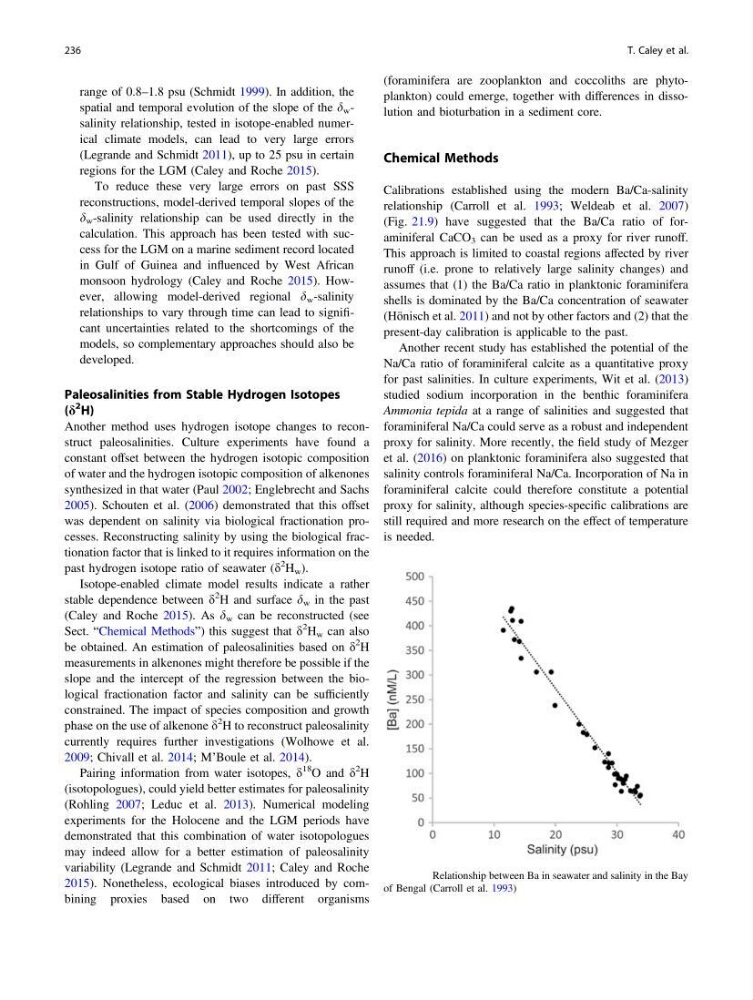
Calibrations established using the modern Ba/Ca-salinity
relationship (Carroll et al. 1993; Weldeab et al. 2007)
(Fig. 21.9) have suggested that the Ba/Ca ratio of foraminiferal CaCO 3 can be used as a proxy for river runoff.
This approach is limited to coastal regions affected by river
runoff (i.e. prone to relatively large salinity changes) and
assumes that (1) the Ba/Ca ratio in planktonic foraminifera
shells is dominated by the Ba/Ca concentration of seawater
(Hönisch et al. 2011) and not by other factors and (2) that the
present-day calibration is applicable to the past.
Another recent study has established the potential of the
Na/Ca ratio of foraminiferal calcite as a quantitative proxy
for past salinities. In culture experiments, Wit et al. (2013)
studied sodium incorporation in the benthic foraminifera
Ammonia tepida at a range of salinities and suggested that
foraminiferal Na/Ca could serve as a robust and independent
proxy for salinity. More recently, the field study of Mezger
et al. (2016) on planktonic foraminifera also suggested that
salinity controls foraminiferal Na/Ca. Incorporation of Na in
foraminiferal calcite could therefore constitute a potential
proxy for salinity, although species-specific calibrations are
still required and more research on the effect of temperature
is needed.
Fig. 21.9 Relationship between Ba in seawater and salinity in the Bay
of Bengal (Carroll et al. 1993)
236
T. Caley et al.
spatial and temporal evolution of the slope of the d w -
salinity relationship, tested in isotope-enabled numerical climate models, can lead to very large errors
(Legrande and Schmidt 2011), up to 25 psu in certain
regions for the LGM (Caley and Roche 2015).
To reduce these very large errors on past SSS
reconstructions, model-derived temporal slopes of the
d w -salinity relationship can be used directly in the
calculation. This approach has been tested with success for the LGM on a marine sediment record located
in Gulf of Guinea and influenced by West African
monsoon hydrology (Caley and Roche 2015). However, allowing model-derived regional d w -salinity
relationships to vary through time can lead to significant uncertainties related to the shortcomings of the
models, so complementary approaches should also be
developed.
Paleosalinities from Stable Hydrogen Isotopes
(d
2
H)
Another method uses hydrogen isotope changes to reconstruct paleosalinities. Culture experiments have found a
constant offset between the hydrogen isotopic composition
of water and the hydrogen isotopic composition of alkenones
synthesized in that water (Paul 2002; Englebrecht and Sachs
2005). Schouten et al. (2006) demonstrated that this offset
was dependent on salinity via biological fractionation processes. Reconstructing salinity by using the biological fractionation factor that is linked to it requires information on the
past hydrogen isotope ratio of seawater (d
2 H w ).
Isotope-enabled climate model results indicate a rather
stable dependence between d
2 H and surface d w in the past
(Caley and Roche 2015). As d w can be reconstructed (see
Sect. “Chemical Methods”) this suggest that d
2 H w can also
be obtained. An estimation of paleosalinities based on d
2 H
measurements in alkenones might therefore be possible if the
slope and the intercept of the regression between the biological fractionation factor and salinity can be sufficiently
constrained. The impact of species composition and growth
phase on the use of alkenone d
2 H to reconstruct paleosalinity
currently requires further investigations (Wolhowe et al.
2009; Chivall et al. 2014; M’Boule et al. 2014).
Pairing information from water isotopes, d
18 O and d
2 H
(isotopologues), could yield better estimates for paleosalinity
(Rohling 2007; Leduc et al. 2013). Numerical modeling
experiments for the Holocene and the LGM periods have
demonstrated that this combination of water isotopologues
may indeed allow for a better estimation of paleosalinity
variability (Legrande and Schmidt 2011; Caley and Roche
2015). Nonetheless, ecological biases introduced by combining proxies based on two different organisms
(foraminifera are zooplankton and coccoliths are phytoplankton) could emerge, together with differences in dissolution and bioturbation in a sediment core.
Chemical Methods
Calibrations established using the modern Ba/Ca-salinity
relationship (Carroll et al. 1993; Weldeab et al. 2007)
(Fig. 21.9) have suggested that the Ba/Ca ratio of foraminiferal CaCO 3 can be used as a proxy for river runoff.
This approach is limited to coastal regions affected by river
runoff (i.e. prone to relatively large salinity changes) and
assumes that (1) the Ba/Ca ratio in planktonic foraminifera
shells is dominated by the Ba/Ca concentration of seawater
(Hönisch et al. 2011) and not by other factors and (2) that the
present-day calibration is applicable to the past.
Another recent study has established the potential of the
Na/Ca ratio of foraminiferal calcite as a quantitative proxy
for past salinities. In culture experiments, Wit et al. (2013)
studied sodium incorporation in the benthic foraminifera
Ammonia tepida at a range of salinities and suggested that
foraminiferal Na/Ca could serve as a robust and independent
proxy for salinity. More recently, the field study of Mezger
et al. (2016) on planktonic foraminifera also suggested that
salinity controls foraminiferal Na/Ca. Incorporation of Na in
foraminiferal calcite could therefore constitute a potential
proxy for salinity, although species-specific calibrations are
still required and more research on the effect of temperature
is needed.
Fig. 21.9 Relationship between Ba in seawater and salinity in the Bay
of Bengal (Carroll et al. 1993)
236
T. Caley et al.