

D47 ¼ R47/R47 Ã À1
ð
Þ ÀR46/R46 Ã À1
ð
Þ
½
À R45/R45 Ã À1
ð
Þ Â 1000
where R45, R46 and R47 are the abundance ratios of masses
45/44, 46/44 and 47/44, respectively, in the CO 2 , and where
R 45*, R 46* and R 47* denote these ratios for a gas with
the same overall composition but in ‘stochastic’ state (Ghosh
et al. 2006).
The main advantage of this method (called the D47
method) is that the thermodynamic-measured value reflects
an internal balance of the crystal lattice and requires no
knowledge of the composition of the original water. This
method is based on properties obeying thermodynamical
principles, so it can be applied to a variety of environments
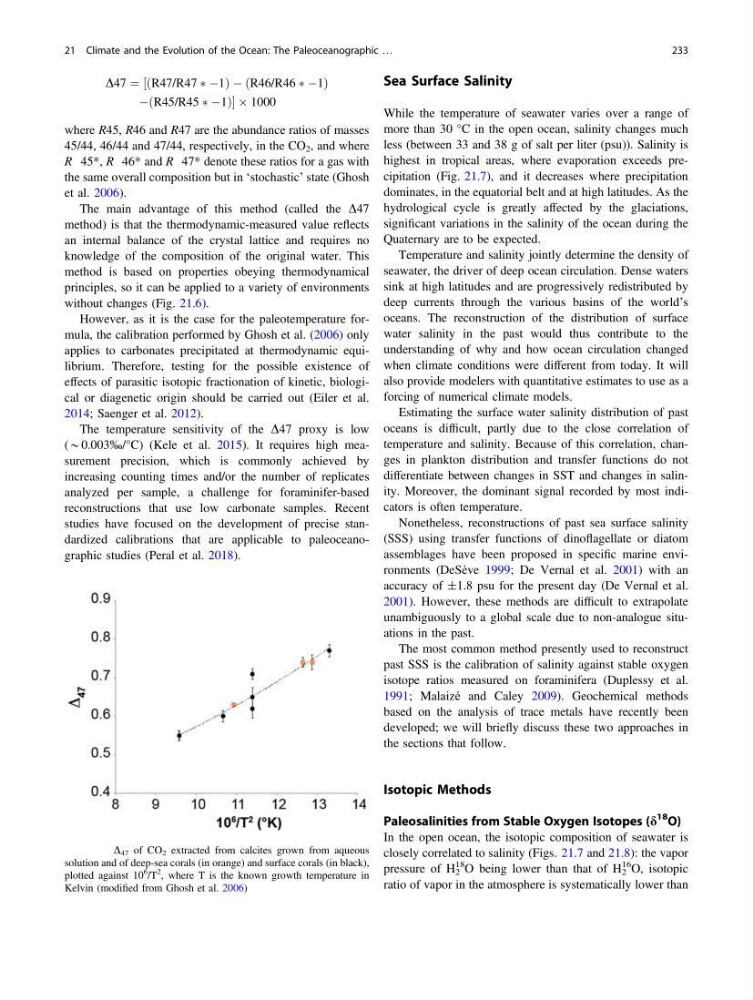
without changes (Fig. 21.6).
However, as it is the case for the paleotemperature formula, the calibration performed by Ghosh et al. (2006) only
applies to carbonates precipitated at thermodynamic equilibrium. Therefore, testing for the possible existence of
effects of parasitic isotopic fractionation of kinetic, biological or diagenetic origin should be carried out (Eiler et al.
2014; Saenger et al. 2012).
The temperature sensitivity of the D47 proxy is low
(*0.003‰/°C) (Kele et al. 2015). It requires high measurement precision, which is commonly achieved by
increasing counting times and/or the number of replicates
analyzed per sample, a challenge for foraminifer-based
reconstructions that use low carbonate samples. Recent
studies have focused on the development of precise standardized calibrations that are applicable to paleoceanographic studies (Peral et al. 2018).
Sea Surface Salinity
While the temperature of seawater varies over a range of
more than 30 °C in the open ocean, salinity changes much
less (between 33 and 38 g of salt per liter (psu)). Salinity is
highest in tropical areas, where evaporation exceeds precipitation (Fig. 21.7), and it decreases where precipitation
dominates, in the equatorial belt and at high latitudes. As the
hydrological cycle is greatly affected by the glaciations,
significant variations in the salinity of the ocean during the
Quaternary are to be expected.
Temperature and salinity jointly determine the density of
seawater, the driver of deep ocean circulation. Dense waters
sink at high latitudes and are progressively redistributed by
deep currents through the various basins of the world’s
oceans. The reconstruction of the distribution of surface
water salinity in the past would thus contribute to the
understanding of why and how ocean circulation changed
when climate conditions were different from today. It will
also provide modelers with quantitative estimates to use as a
forcing of numerical climate models.
Estimating the surface water salinity distribution of past
oceans is difficult, partly due to the close correlation of
temperature and salinity. Because of this correlation, changes in plankton distribution and transfer functions do not
differentiate between changes in SST and changes in salinity. Moreover, the dominant signal recorded by most indicators is often temperature.
Nonetheless, reconstructions of past sea surface salinity
(SSS) using transfer functions of dinoflagellate or diatom
assemblages have been proposed in specific marine environments (DeSève 1999; De Vernal et al. 2001) with an
accuracy of ±1.8 psu for the present day (De Vernal et al.
2001). However, these methods are difficult to extrapolate
unambiguously to a global scale due to non-analogue situations in the past.
The most common method presently used to reconstruct
past SSS is the calibration of salinity against stable oxygen
isotope ratios measured on foraminifera (Duplessy et al.
1991; Malaizé and Caley 2009). Geochemical methods
based on the analysis of trace metals have recently been
developed; we will briefly discuss these two approaches in
the sections that follow.
Isotopic Methods
Paleosalinities from Stable Oxygen Isotopes (d
18 O)
In the open ocean, the isotopic composition of seawater is
closely correlated to salinity (Figs. 21.7 and 21.8): the vapor
pressure of H 2
18
O being lower than that of H 2
16 O, isotopic
ratio of vapor in the atmosphere is systematically lower than
Fig. 21.6 D 47 of CO 2 extracted from calcites grown from aqueous
solution and of deep-sea corals (in orange) and surface corals (in black),
plotted against 10
6
/T
2
, where T is the known growth temperature in
Kelvin (modified from Ghosh et al. 2006)
21 Climate and the Evolution of the Ocean: The Paleoceanographic …
233
ð
Þ ÀR46/R46 Ã À1
ð
Þ
½
À R45/R45 Ã À1
ð
Þ Â 1000
where R45, R46 and R47 are the abundance ratios of masses
45/44, 46/44 and 47/44, respectively, in the CO 2 , and where
R 45*, R 46* and R 47* denote these ratios for a gas with
the same overall composition but in ‘stochastic’ state (Ghosh
et al. 2006).
The main advantage of this method (called the D47
method) is that the thermodynamic-measured value reflects
an internal balance of the crystal lattice and requires no
knowledge of the composition of the original water. This
method is based on properties obeying thermodynamical
principles, so it can be applied to a variety of environments
without changes (Fig. 21.6).
However, as it is the case for the paleotemperature formula, the calibration performed by Ghosh et al. (2006) only
applies to carbonates precipitated at thermodynamic equilibrium. Therefore, testing for the possible existence of
effects of parasitic isotopic fractionation of kinetic, biological or diagenetic origin should be carried out (Eiler et al.
2014; Saenger et al. 2012).
The temperature sensitivity of the D47 proxy is low
(*0.003‰/°C) (Kele et al. 2015). It requires high measurement precision, which is commonly achieved by
increasing counting times and/or the number of replicates
analyzed per sample, a challenge for foraminifer-based
reconstructions that use low carbonate samples. Recent
studies have focused on the development of precise standardized calibrations that are applicable to paleoceanographic studies (Peral et al. 2018).
Sea Surface Salinity
While the temperature of seawater varies over a range of
more than 30 °C in the open ocean, salinity changes much
less (between 33 and 38 g of salt per liter (psu)). Salinity is
highest in tropical areas, where evaporation exceeds precipitation (Fig. 21.7), and it decreases where precipitation
dominates, in the equatorial belt and at high latitudes. As the
hydrological cycle is greatly affected by the glaciations,
significant variations in the salinity of the ocean during the
Quaternary are to be expected.
Temperature and salinity jointly determine the density of
seawater, the driver of deep ocean circulation. Dense waters
sink at high latitudes and are progressively redistributed by
deep currents through the various basins of the world’s
oceans. The reconstruction of the distribution of surface
water salinity in the past would thus contribute to the
understanding of why and how ocean circulation changed
when climate conditions were different from today. It will
also provide modelers with quantitative estimates to use as a
forcing of numerical climate models.
Estimating the surface water salinity distribution of past
oceans is difficult, partly due to the close correlation of
temperature and salinity. Because of this correlation, changes in plankton distribution and transfer functions do not
differentiate between changes in SST and changes in salinity. Moreover, the dominant signal recorded by most indicators is often temperature.
Nonetheless, reconstructions of past sea surface salinity
(SSS) using transfer functions of dinoflagellate or diatom
assemblages have been proposed in specific marine environments (DeSève 1999; De Vernal et al. 2001) with an
accuracy of ±1.8 psu for the present day (De Vernal et al.
2001). However, these methods are difficult to extrapolate
unambiguously to a global scale due to non-analogue situations in the past.
The most common method presently used to reconstruct
past SSS is the calibration of salinity against stable oxygen
isotope ratios measured on foraminifera (Duplessy et al.
1991; Malaizé and Caley 2009). Geochemical methods
based on the analysis of trace metals have recently been
developed; we will briefly discuss these two approaches in
the sections that follow.
Isotopic Methods
Paleosalinities from Stable Oxygen Isotopes (d
18 O)
In the open ocean, the isotopic composition of seawater is
closely correlated to salinity (Figs. 21.7 and 21.8): the vapor
pressure of H 2
18
O being lower than that of H 2
16 O, isotopic
ratio of vapor in the atmosphere is systematically lower than
Fig. 21.6 D 47 of CO 2 extracted from calcites grown from aqueous
solution and of deep-sea corals (in orange) and surface corals (in black),
plotted against 10
6
/T
2
, where T is the known growth temperature in
Kelvin (modified from Ghosh et al. 2006)
21 Climate and the Evolution of the Ocean: The Paleoceanographic …
233