

Climate Mechanisms
The Sun is the major driver of climate. Received solar
energy plays a key role in establishing climate conditions on
the surface of our planet. But these depend critically on the
composition of the atmosphere and energy exchanges
between the surface of the planet and the atmosphere that
surrounds it. The Earth radiation balance compares, for each
point on the Earth’s surface, the energy received from the
Sun and that which is emitted back into space. Significant
geographical differences drive wind and ocean currents
which redistribute energy, influenced by the shape of the
ocean basins and the relief of the land.
The Radiation Balance of the Earth
The Greenhouse Effect
A disk with a surface area of 1 m
2 , located equidistant
between the Earth and the Sun and intercepting solar radiation at a perpendicular angle, would receive an energy flow
of 1368 W at the top of the Atmosphere (TOA). However,
the Earth is a sphere whose surface area is four times greater
than that of a disk with the same diameter. This is why, on
average and over the course of a year, the solar flux intercepted by a unit area is four times lower. It corresponds to a
power of 340 W/m
2 TOA with a known accuracy of roughly
1 W/m
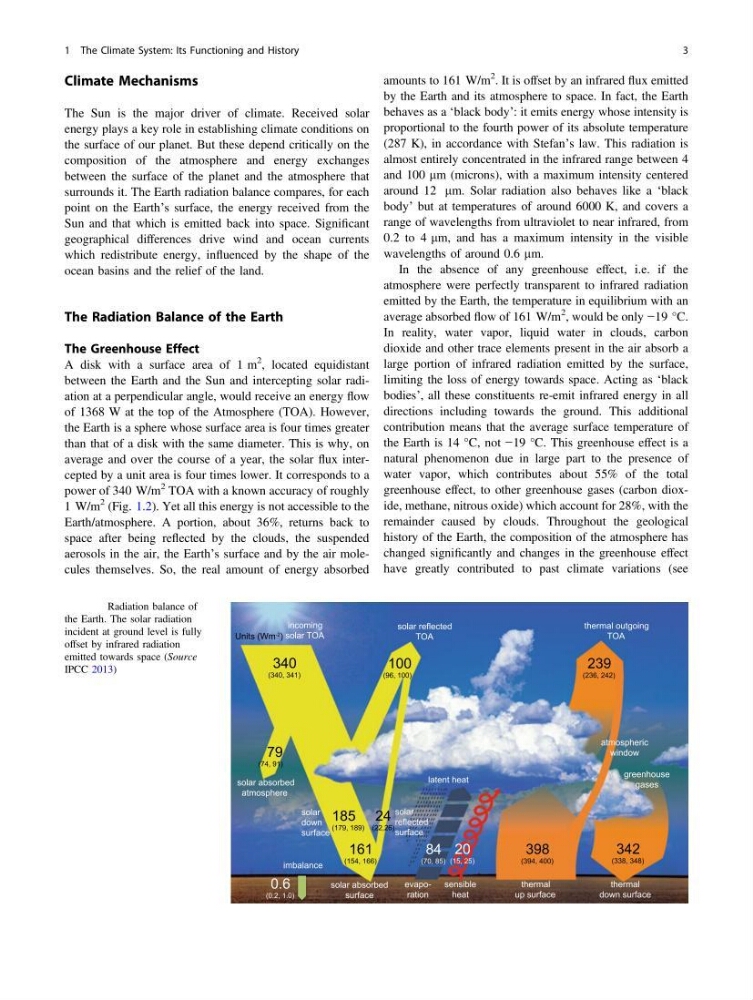
2 (Fig. 1.2). Yet all this energy is not accessible to the
Earth/atmosphere. A portion, about 36%, returns back to
space after being reflected by the clouds, the suspended
aerosols in the air, the Earth’s surface and by the air molecules themselves. So, the real amount of energy absorbed
amounts to 161 W/m
2 . It is offset by an infrared flux emitted
by the Earth and its atmosphere to space. In fact, the Earth
behaves as a ‘black body’: it emits energy whose intensity is
proportional to the fourth power of its absolute temperature
(287 K), in accordance with Stefan’s law. This radiation is
almost entirely concentrated in the infrared range between 4
and 100 lm (microns), with a maximum intensity centered
around 12 lm. Solar radiation also behaves like a ‘black
body’ but at temperatures of around 6000 K, and covers a
range of wavelengths from ultraviolet to near infrared, from
0.2 to 4 lm, and has a maximum intensity in the visible
wavelengths of around 0.6 lm.
In the absence of any greenhouse effect, i.e. if the
atmosphere were perfectly transparent to infrared radiation
emitted by the Earth, the temperature in equilibrium with an
average absorbed flow of 161 W/m
2
, would be only −19 °C.
In reality, water vapor, liquid water in clouds, carbon
dioxide and other trace elements present in the air absorb a
large portion of infrared radiation emitted by the surface,
limiting the loss of energy towards space. Acting as ‘black
bodies’, all these constituents re-emit infrared energy in all
directions including towards the ground. This additional
contribution means that the average surface temperature of
the Earth is 14 °C, not −19 °C. This greenhouse effect is a
natural phenomenon due in large part to the presence of
water vapor, which contributes about 55% of the total
greenhouse effect, to other greenhouse gases (carbon dioxide, methane, nitrous oxide) which account for 28%, with the
remainder caused by clouds. Throughout the geological
history of the Earth, the composition of the atmosphere has
changed significantly and changes in the greenhouse effect
have greatly contributed to past climate variations (see
Fig. 1.2 Radiation balance of
the Earth. The solar radiation
incident at ground level is fully
offset by infrared radiation
emitted towards space (Source
IPCC 2013)
1 The Climate System: Its Functioning and History
3
The Sun is the major driver of climate. Received solar
energy plays a key role in establishing climate conditions on
the surface of our planet. But these depend critically on the
composition of the atmosphere and energy exchanges
between the surface of the planet and the atmosphere that
surrounds it. The Earth radiation balance compares, for each
point on the Earth’s surface, the energy received from the
Sun and that which is emitted back into space. Significant
geographical differences drive wind and ocean currents
which redistribute energy, influenced by the shape of the
ocean basins and the relief of the land.
The Radiation Balance of the Earth
The Greenhouse Effect
A disk with a surface area of 1 m
2 , located equidistant
between the Earth and the Sun and intercepting solar radiation at a perpendicular angle, would receive an energy flow
of 1368 W at the top of the Atmosphere (TOA). However,
the Earth is a sphere whose surface area is four times greater
than that of a disk with the same diameter. This is why, on
average and over the course of a year, the solar flux intercepted by a unit area is four times lower. It corresponds to a
power of 340 W/m
2 TOA with a known accuracy of roughly
1 W/m
2 (Fig. 1.2). Yet all this energy is not accessible to the
Earth/atmosphere. A portion, about 36%, returns back to
space after being reflected by the clouds, the suspended
aerosols in the air, the Earth’s surface and by the air molecules themselves. So, the real amount of energy absorbed
amounts to 161 W/m
2 . It is offset by an infrared flux emitted
by the Earth and its atmosphere to space. In fact, the Earth
behaves as a ‘black body’: it emits energy whose intensity is
proportional to the fourth power of its absolute temperature
(287 K), in accordance with Stefan’s law. This radiation is
almost entirely concentrated in the infrared range between 4
and 100 lm (microns), with a maximum intensity centered
around 12 lm. Solar radiation also behaves like a ‘black
body’ but at temperatures of around 6000 K, and covers a
range of wavelengths from ultraviolet to near infrared, from
0.2 to 4 lm, and has a maximum intensity in the visible
wavelengths of around 0.6 lm.
In the absence of any greenhouse effect, i.e. if the
atmosphere were perfectly transparent to infrared radiation
emitted by the Earth, the temperature in equilibrium with an
average absorbed flow of 161 W/m
2
, would be only −19 °C.
In reality, water vapor, liquid water in clouds, carbon
dioxide and other trace elements present in the air absorb a
large portion of infrared radiation emitted by the surface,
limiting the loss of energy towards space. Acting as ‘black
bodies’, all these constituents re-emit infrared energy in all
directions including towards the ground. This additional
contribution means that the average surface temperature of
the Earth is 14 °C, not −19 °C. This greenhouse effect is a
natural phenomenon due in large part to the presence of
water vapor, which contributes about 55% of the total
greenhouse effect, to other greenhouse gases (carbon dioxide, methane, nitrous oxide) which account for 28%, with the
remainder caused by clouds. Throughout the geological
history of the Earth, the composition of the atmosphere has
changed significantly and changes in the greenhouse effect
have greatly contributed to past climate variations (see
Fig. 1.2 Radiation balance of
the Earth. The solar radiation
incident at ground level is fully
offset by infrared radiation
emitted towards space (Source
IPCC 2013)
1 The Climate System: Its Functioning and History
3