

seasons over the past 1500 years) show sequences of high
(the seventeenth and eighteenth centuries and in the twentieth century) and low (the nineteenth century) accumulations (Thompson et al. 2006).
As in polar ice, it is possible to measure the temperature
in the borehole. This method does not allow past temperature
changes to be reconstructed with a high temporal resolution,
but it does offer the possibility of measuring slow fluctuations. In high altitude glaciers, this profile depends on the
energy balance at the surface and on the flow of geothermal
heat in the depths. The proximity of the ice to the bedrock
does not allow these profiles to be applied to the second half
of the cores although the surface profiles can be interpreted.
In the cores where these profiles are available, an increase in
temperature is observed for recent decades (Vimeux et al.
2009), reaching 1.1 °C in the twentieth century.
The measurement of the isotopic composition (d
18 O and
dD) of tropical ice provides information on rainfall patterns
caused by the air mass along its trajectory. The linear relationship between the isotopic composition of snow and
surface air temperature, well established for the polar
regions, does not hold true in the tropics. This relationship is
mainly due to the fact that, in the middle and high latitudes,
the amount of precipitation formed and air temperature are
closely linked as per the Clausius-Clapeyron law. This is not
the case in the tropics, where the majority of precipitation is
convective and where the water cycle is complex (recycling
of water vapor from the surface). The coupling of
observations, through rainfall collection network systems,
and modeling of atmospheric cycling of stable isotopes of
water with a hierarchy of models (general circulation
atmospheric model, mesoscale model correctly representing
the topography and one dimension convection model) has
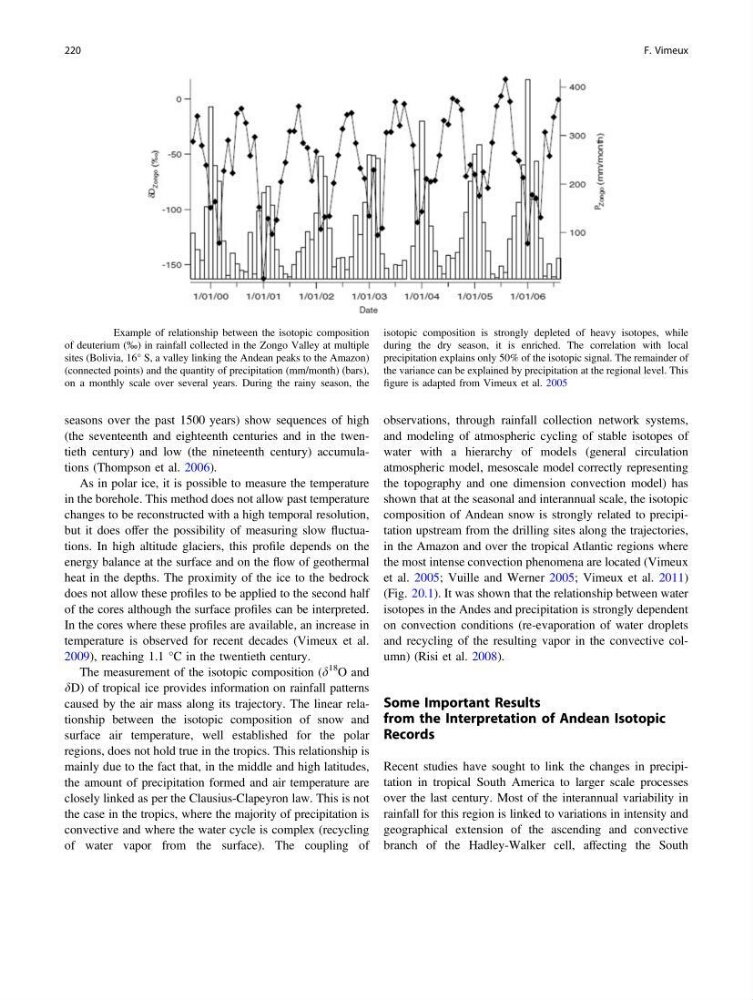
shown that at the seasonal and interannual scale, the isotopic
composition of Andean snow is strongly related to precipitation upstream from the drilling sites along the trajectories,
in the Amazon and over the tropical Atlantic regions where
the most intense convection phenomena are located (Vimeux
et al. 2005; Vuille and Werner 2005; Vimeux et al. 2011)
(Fig. 20.1). It was shown that the relationship between water
isotopes in the Andes and precipitation is strongly dependent
on convection conditions (re-evaporation of water droplets
and recycling of the resulting vapor in the convective column) (Risi et al. 2008).
Some Important Results
from the Interpretation of Andean Isotopic
Records
Recent studies have sought to link the changes in precipitation in tropical South America to larger scale processes
over the last century. Most of the interannual variability in
rainfall for this region is linked to variations in intensity and
geographical extension of the ascending and convective
branch of the Hadley-Walker cell, affecting the South
Fig. 20.1 Example of relationship between the isotopic composition
of deuterium (‰) in rainfall collected in the Zongo Valley at multiple
sites (Bolivia, 16° S, a valley linking the Andean peaks to the Amazon)
(connected points) and the quantity of precipitation (mm/month) (bars),
on a monthly scale over several years. During the rainy season, the
isotopic composition is strongly depleted of heavy isotopes, while
during the dry season, it is enriched. The correlation with local
precipitation explains only 50% of the isotopic signal. The remainder of
the variance can be explained by precipitation at the regional level. This
figure is adapted from Vimeux et al. 2005
220
F. Vimeux
(the seventeenth and eighteenth centuries and in the twentieth century) and low (the nineteenth century) accumulations (Thompson et al. 2006).
As in polar ice, it is possible to measure the temperature
in the borehole. This method does not allow past temperature
changes to be reconstructed with a high temporal resolution,
but it does offer the possibility of measuring slow fluctuations. In high altitude glaciers, this profile depends on the
energy balance at the surface and on the flow of geothermal
heat in the depths. The proximity of the ice to the bedrock
does not allow these profiles to be applied to the second half
of the cores although the surface profiles can be interpreted.
In the cores where these profiles are available, an increase in
temperature is observed for recent decades (Vimeux et al.
2009), reaching 1.1 °C in the twentieth century.
The measurement of the isotopic composition (d
18 O and
dD) of tropical ice provides information on rainfall patterns
caused by the air mass along its trajectory. The linear relationship between the isotopic composition of snow and
surface air temperature, well established for the polar
regions, does not hold true in the tropics. This relationship is
mainly due to the fact that, in the middle and high latitudes,
the amount of precipitation formed and air temperature are
closely linked as per the Clausius-Clapeyron law. This is not
the case in the tropics, where the majority of precipitation is
convective and where the water cycle is complex (recycling
of water vapor from the surface). The coupling of
observations, through rainfall collection network systems,
and modeling of atmospheric cycling of stable isotopes of
water with a hierarchy of models (general circulation
atmospheric model, mesoscale model correctly representing
the topography and one dimension convection model) has
shown that at the seasonal and interannual scale, the isotopic
composition of Andean snow is strongly related to precipitation upstream from the drilling sites along the trajectories,
in the Amazon and over the tropical Atlantic regions where
the most intense convection phenomena are located (Vimeux
et al. 2005; Vuille and Werner 2005; Vimeux et al. 2011)
(Fig. 20.1). It was shown that the relationship between water
isotopes in the Andes and precipitation is strongly dependent
on convection conditions (re-evaporation of water droplets
and recycling of the resulting vapor in the convective column) (Risi et al. 2008).
Some Important Results
from the Interpretation of Andean Isotopic
Records
Recent studies have sought to link the changes in precipitation in tropical South America to larger scale processes
over the last century. Most of the interannual variability in
rainfall for this region is linked to variations in intensity and
geographical extension of the ascending and convective
branch of the Hadley-Walker cell, affecting the South
Fig. 20.1 Example of relationship between the isotopic composition
of deuterium (‰) in rainfall collected in the Zongo Valley at multiple
sites (Bolivia, 16° S, a valley linking the Andean peaks to the Amazon)
(connected points) and the quantity of precipitation (mm/month) (bars),
on a monthly scale over several years. During the rainy season, the
isotopic composition is strongly depleted of heavy isotopes, while
during the dry season, it is enriched. The correlation with local
precipitation explains only 50% of the isotopic signal. The remainder of
the variance can be explained by precipitation at the regional level. This
figure is adapted from Vimeux et al. 2005
220
F. Vimeux