

inside the cave can cause rapid degassing of CO 2 , and thus
lead to a kinetic effect causing a thermodynamic disequilibrium. There are several equations linking the isotopic compositions of calcite and of water with temperature, allowing
this equilibrium to be checked (Kim and O’Neil 1997; Tremaine et al. 2011). However, the study of deposits of modern
calcite shows that many of them are not deposited at isotopic
equilibrium, but rather reflect a kinetic effect (Genty 2008;
Mickler et al. 2006). In this case, calculation of the temperature is not valid (the d
18 O c measured from calcite is generally
too high, causing the calculated temperature to be too low).
There is a recent, promising method to reconstruct paleotemperatures using only isotopes from the mineral phase of
the calcite, thus overcoming the difficulty of extracting water
from the fluid inclusions (Daeron et al. 2008, 2011). It
involves the clumped isotopes of the CO
2À
3 molecules and is
based on the thermo-dependence of the isotopic exchanges
between these different molecules:
13 C
16 O
2À
3 þ
12 C
18 O
16 O
2
2 \ ¼ [
13 C
18 O
16 O
2À
2 þ
12 C
16 þ
12 C
16 O
2
3
Called the Delta 47 method, this method reflects the
statistical overabundance of mass 47 clumped isotopes in
CO 2 (
13 C
18 O
16 O) produced by acidc attack of carbonate
minerals. When applied to speleothems which were deposited at thermodynamic equilibrium, precipitation temperatures can be reconstructed independently of the previous
method which uses the d
18 O of the calcite and of the fluid
inclusions. However, tests on modern deposits from caves in
the South of France and in vitro experiments show the
existence of a kinetic effect during precipitation (Daeron
et al. 2011, 2008). In this case, the temperature can only be
calculated by using both the Delta 47 measurement and the
measurement of the d
18 O in calcite and fluid inclusions. The
value of this is twofold: in addition to calculating the precipitation temperature, this method quantifies the state of
thermodynamic disequilibrium, often difficult to detect, and
which is also a reflection of the conditions of the
paleoenvironment.
Another way of quantifying climate parameters is by
calibrating proxies from the growth laminae of fast-growing
modern stalagmites (Baker et al. 2007; Domínguez-Villar
et al. 2018). The method consists of finding the best correlation between the signal measured on the stalagmite
(e.g. the thickness of the annual growth laminae) and the
climate signal from instrumental measurements outside
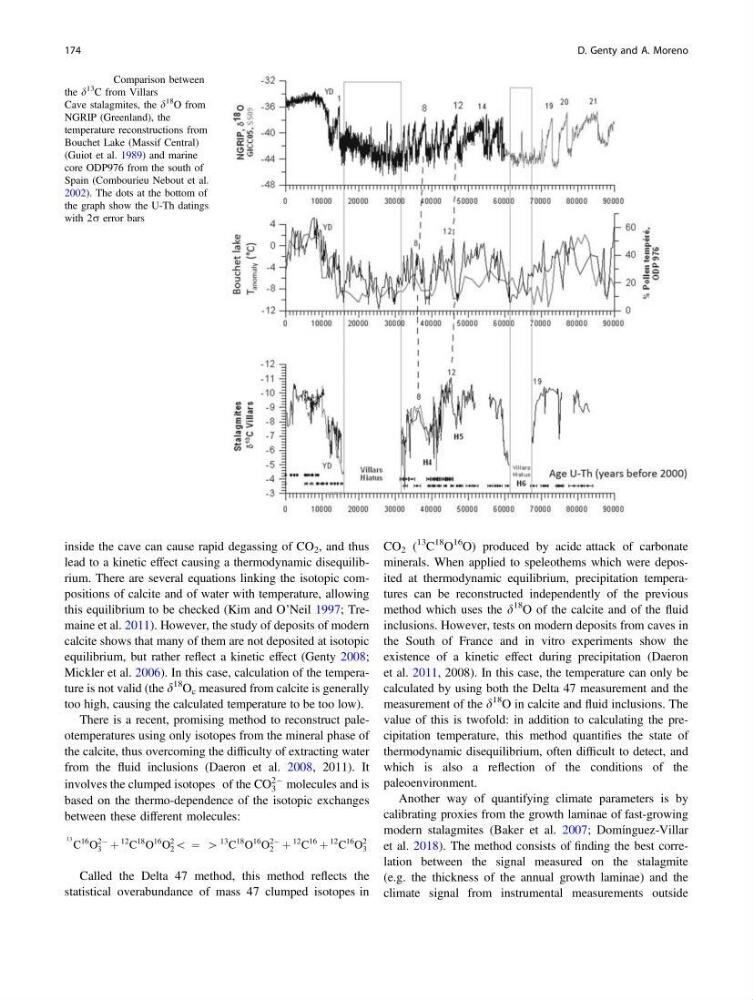
Fig. 14.3 Comparison between
the d
13
C from Villars
Cave stalagmites, the d
18
O from
NGRIP (Greenland), the
temperature reconstructions from
Bouchet Lake (Massif Central)
(Guiot et al. 1989) and marine
core ODP976 from the south of
Spain (Combourieu Nebout et al.
2002). The dots at the bottom of
the graph show the U-Th datings
with 2r error bars
174
D. Genty and A. Moreno
lead to a kinetic effect causing a thermodynamic disequilibrium. There are several equations linking the isotopic compositions of calcite and of water with temperature, allowing
this equilibrium to be checked (Kim and O’Neil 1997; Tremaine et al. 2011). However, the study of deposits of modern
calcite shows that many of them are not deposited at isotopic
equilibrium, but rather reflect a kinetic effect (Genty 2008;
Mickler et al. 2006). In this case, calculation of the temperature is not valid (the d
18 O c measured from calcite is generally
too high, causing the calculated temperature to be too low).
There is a recent, promising method to reconstruct paleotemperatures using only isotopes from the mineral phase of
the calcite, thus overcoming the difficulty of extracting water
from the fluid inclusions (Daeron et al. 2008, 2011). It
involves the clumped isotopes of the CO
2À
3 molecules and is
based on the thermo-dependence of the isotopic exchanges
between these different molecules:
13 C
16 O
2À
3 þ
12 C
18 O
16 O
2
2 \ ¼ [
13 C
18 O
16 O
2À
2 þ
12 C
16 þ
12 C
16 O
2
3
Called the Delta 47 method, this method reflects the
statistical overabundance of mass 47 clumped isotopes in
CO 2 (
13 C
18 O
16 O) produced by acidc attack of carbonate
minerals. When applied to speleothems which were deposited at thermodynamic equilibrium, precipitation temperatures can be reconstructed independently of the previous
method which uses the d
18 O of the calcite and of the fluid
inclusions. However, tests on modern deposits from caves in
the South of France and in vitro experiments show the
existence of a kinetic effect during precipitation (Daeron
et al. 2011, 2008). In this case, the temperature can only be
calculated by using both the Delta 47 measurement and the
measurement of the d
18 O in calcite and fluid inclusions. The
value of this is twofold: in addition to calculating the precipitation temperature, this method quantifies the state of
thermodynamic disequilibrium, often difficult to detect, and
which is also a reflection of the conditions of the
paleoenvironment.
Another way of quantifying climate parameters is by
calibrating proxies from the growth laminae of fast-growing
modern stalagmites (Baker et al. 2007; Domínguez-Villar
et al. 2018). The method consists of finding the best correlation between the signal measured on the stalagmite
(e.g. the thickness of the annual growth laminae) and the
climate signal from instrumental measurements outside
Fig. 14.3 Comparison between
the d
13
C from Villars
Cave stalagmites, the d
18
O from
NGRIP (Greenland), the
temperature reconstructions from
Bouchet Lake (Massif Central)
(Guiot et al. 1989) and marine
core ODP976 from the south of
Spain (Combourieu Nebout et al.
2002). The dots at the bottom of
the graph show the U-Th datings
with 2r error bars
174
D. Genty and A. Moreno