

the correction for detritus, and to the uranium concentration
in the speleothem (varying from *30 ppb to *1 ppm).
This is, on average, between less than 1% and 5% for the last
three climate cycles, as far back as *500 ka. The most
common current technique to measure these isotopes is by
MC-ICP-MS; this requires between a few milligrams to tens
of milligrams of calcite to make a measurement. Moreover,
thanks to the technical progress in ICP-MS equipment and
an improved understanding of half-life constants of
radioactive isotopes in recent years, the error in U-Th dates
can be even lower (Cheng et al. 2013). Other methods are
used incidentally, such as
14 C, whose concentration at the
moment of deposition of the calcite depends on the proportions of atmospheric CO 2 and of CO 2 without
14 C,
coming from the dissolution of limestone (Genty et al.
1999),
226 Ra for recent millennia (Ghaleb et al. 2004), and
the U-Pb method which can trace back more than a million
years (Woodhead et al. 2006).
Paleoclimate Reconstruction: A Qualitative
Approach
The proxies used in speleothems to reconstruct past climates
are isotopes of calcite (d
18 O c , d
13 C c ), isotopes of fluid
inclusions trapped in the calcite (dD, d
18 O), trace elements
(Sr, Ba, Mg, U), organic matter (lipids, amino acids), petrography and the growth rate.
The most common crystalline fabrics (layout and shape
of the calcite crystals) in stalagmites is the palisading
columnar one: large elongated crystals perpendicular to the
growth laminae. However, the addition of detrital components, variations in humidity, in temperature or in pCO 2 over
the course of climate variations can produce a variety of
crystalline fabrics (dendritic, fibrous, microcrystalline, etc.).
Even if we could establish links between crystal structures
and environmental conditions through the study of modern
calcite deposits (Frisia et al. 2000), this type of relationship
is complex and should be examined with caution. Recently,
a new approach to stalagmite characterization consists of
precisely describing the petrography and categorizing the
stalagmites and their bounding surfaces into six different
classes (from individual crystallites to major nonconformities) (Martín-Chivelet et al. 2017).
Speleothem calcite contains, either in its crystalline
defects, or by substitution of Ca in the crystal lattice, minor
or trace elements, which provide information on the paleoenvironment (Fairchild et al. 2000). Interpretation of this is
complex because it involves several factors: composition of
the soil and of the surrounding limestone, the intensity of
dissolution and the precipitation conditions of the calcite
(temperature, supersaturation, growth rate, etc.). At the
annual level, analysis of these trace elements contributes to
an understanding of the dynamics of infiltration, especially
when the elements measured are linked to the residence time
of the infiltrating water. A new model called I-Stal was
recently developed to investigate the factors involved in the
interpretation of trace elements in speleothems (Stoll et al.
2012). To measure these elements, precise techniques are
used to analyze points of a few micrometers in diameter on a
polished section of stalagmite (LA-ICP-MS, XRF, X
fluorescence by synchrotron, ionic microprobe). During the
transfer of these trace elements, organic colloids play a
major role. The sensitivity of each one to environmental
conditions is different; for example, Ba, Na and Sr may be
sensitive to the speleothem growth rate while Mg and U may
reflect paleohydrology. Some, such as P, Zn and Cu, are
related to the vegetation above ground. Trace elements are
also chronological markers: when the annual laminae are not
visible in the calcite structure, then the analysis of trace
elements can reveal seasonal variations, thereby providing a
relative or absolute chronology accurate to the nearest year.
This type of analysis is used to determine the duration of a
rapid climate event or of a transition (Bourdin et al. 2011).
The stable isotopes of calcite are the most commonly
used to reconstruct climate variations, even though interpreting them into temperature and precipitation terms is not
easy. The d
18 O c of the calcite, when it precipitates at isotopic
equilibrium (see below), depends on the temperature of the
precipitation of calcite (temperature in the cave and therefore
the average annual exterior temperature) and on the d
18 O w of
the infiltrating water. The latter is linked to the exterior
temperature above the site, to the amount of water extracted
from the cloud masses between the source of evaporation
and the site and to the isotopic composition of the source,
usually the ocean (isotope distillation process). During the
precipitation of calcite, there is an inverse relationship
between d
18 O c and temperature (*−0.24‰/°C), whereas
the relationship is direct between the rainfall d
18 O and outside temperature of (e.g. 0.3–0.7‰/°C). In summary:
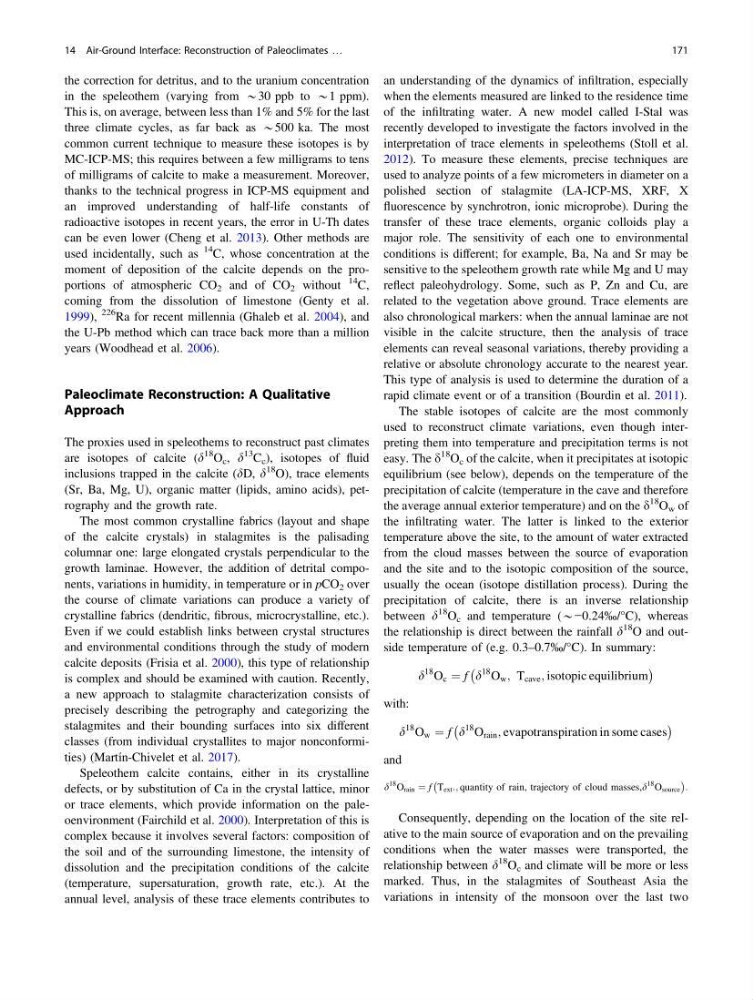
d
18
O c ¼ f d
18
O w ; T cave ; isotopic equilibrium
À
Á
with:
d
18
O w ¼ f d
18
O rain ; evapotranspiration in some cases
À
Á
and
d
18 O rain ¼ f T ext :; quantity of rain, trajectory of cloud masses,d
18 O source
À
Á :
Consequently, depending on the location of the site relative to the main source of evaporation and on the prevailing
conditions when the water masses were transported, the
relationship between d
18 O c and climate will be more or less
marked. Thus, in the stalagmites of Southeast Asia the
variations in intensity of the monsoon over the last two
14 Air-Ground Interface: Reconstruction of Paleoclimates …
171
in the speleothem (varying from *30 ppb to *1 ppm).
This is, on average, between less than 1% and 5% for the last
three climate cycles, as far back as *500 ka. The most
common current technique to measure these isotopes is by
MC-ICP-MS; this requires between a few milligrams to tens
of milligrams of calcite to make a measurement. Moreover,
thanks to the technical progress in ICP-MS equipment and
an improved understanding of half-life constants of
radioactive isotopes in recent years, the error in U-Th dates
can be even lower (Cheng et al. 2013). Other methods are
used incidentally, such as
14 C, whose concentration at the
moment of deposition of the calcite depends on the proportions of atmospheric CO 2 and of CO 2 without
14 C,
coming from the dissolution of limestone (Genty et al.
1999),
226 Ra for recent millennia (Ghaleb et al. 2004), and
the U-Pb method which can trace back more than a million
years (Woodhead et al. 2006).
Paleoclimate Reconstruction: A Qualitative
Approach
The proxies used in speleothems to reconstruct past climates
are isotopes of calcite (d
18 O c , d
13 C c ), isotopes of fluid
inclusions trapped in the calcite (dD, d
18 O), trace elements
(Sr, Ba, Mg, U), organic matter (lipids, amino acids), petrography and the growth rate.
The most common crystalline fabrics (layout and shape
of the calcite crystals) in stalagmites is the palisading
columnar one: large elongated crystals perpendicular to the
growth laminae. However, the addition of detrital components, variations in humidity, in temperature or in pCO 2 over
the course of climate variations can produce a variety of
crystalline fabrics (dendritic, fibrous, microcrystalline, etc.).
Even if we could establish links between crystal structures
and environmental conditions through the study of modern
calcite deposits (Frisia et al. 2000), this type of relationship
is complex and should be examined with caution. Recently,
a new approach to stalagmite characterization consists of
precisely describing the petrography and categorizing the
stalagmites and their bounding surfaces into six different
classes (from individual crystallites to major nonconformities) (Martín-Chivelet et al. 2017).
Speleothem calcite contains, either in its crystalline
defects, or by substitution of Ca in the crystal lattice, minor
or trace elements, which provide information on the paleoenvironment (Fairchild et al. 2000). Interpretation of this is
complex because it involves several factors: composition of
the soil and of the surrounding limestone, the intensity of
dissolution and the precipitation conditions of the calcite
(temperature, supersaturation, growth rate, etc.). At the
annual level, analysis of these trace elements contributes to
an understanding of the dynamics of infiltration, especially
when the elements measured are linked to the residence time
of the infiltrating water. A new model called I-Stal was
recently developed to investigate the factors involved in the
interpretation of trace elements in speleothems (Stoll et al.
2012). To measure these elements, precise techniques are
used to analyze points of a few micrometers in diameter on a
polished section of stalagmite (LA-ICP-MS, XRF, X
fluorescence by synchrotron, ionic microprobe). During the
transfer of these trace elements, organic colloids play a
major role. The sensitivity of each one to environmental
conditions is different; for example, Ba, Na and Sr may be
sensitive to the speleothem growth rate while Mg and U may
reflect paleohydrology. Some, such as P, Zn and Cu, are
related to the vegetation above ground. Trace elements are
also chronological markers: when the annual laminae are not
visible in the calcite structure, then the analysis of trace
elements can reveal seasonal variations, thereby providing a
relative or absolute chronology accurate to the nearest year.
This type of analysis is used to determine the duration of a
rapid climate event or of a transition (Bourdin et al. 2011).
The stable isotopes of calcite are the most commonly
used to reconstruct climate variations, even though interpreting them into temperature and precipitation terms is not
easy. The d
18 O c of the calcite, when it precipitates at isotopic
equilibrium (see below), depends on the temperature of the
precipitation of calcite (temperature in the cave and therefore
the average annual exterior temperature) and on the d
18 O w of
the infiltrating water. The latter is linked to the exterior
temperature above the site, to the amount of water extracted
from the cloud masses between the source of evaporation
and the site and to the isotopic composition of the source,
usually the ocean (isotope distillation process). During the
precipitation of calcite, there is an inverse relationship
between d
18 O c and temperature (*−0.24‰/°C), whereas
the relationship is direct between the rainfall d
18 O and outside temperature of (e.g. 0.3–0.7‰/°C). In summary:
d
18
O c ¼ f d
18
O w ; T cave ; isotopic equilibrium
À
Á
with:
d
18
O w ¼ f d
18
O rain ; evapotranspiration in some cases
À
Á
and
d
18 O rain ¼ f T ext :; quantity of rain, trajectory of cloud masses,d
18 O source
À
Á :
Consequently, depending on the location of the site relative to the main source of evaporation and on the prevailing
conditions when the water masses were transported, the
relationship between d
18 O c and climate will be more or less
marked. Thus, in the stalagmites of Southeast Asia the
variations in intensity of the monsoon over the last two
14 Air-Ground Interface: Reconstruction of Paleoclimates …
171