

1988). This model was verified by comparing the theoretical
growth rates with the actual growth rates measured on
modern calcite deposits at various latitudes. In a cold and
humid climate (Scotland), the average vertical growth of a
stalagmite is only 20 microns/year, while it can reach
1 mm/year in the caves of southern France (Baker et al.
1998). The sensitivity of the growth rate to environmental
conditions provides an indicator of paleoclimatic conditions:
more speleothems with a faster growth rate are produced in
warm and humid periods than in cold, dry periods. It appears
that below a certain rainfall threshold, the growth of speleothems may slow down due to under-saturation of the
infiltration water.
The temperature of a cave is generally stable throughout
the year and is close to the average annual exterior temperature. Depending on the depth of the cave, the exterior
thermal wave which determines the cave temperature may
take between several months and several years to travel
through the thickness of the rock. However, there are
marked seasonal variations in the water infiltration rate and
in the concentrations of the different chemical elements
(Ca, Sr, Mg, U, MO, etc.) even if the average infiltration
time can be several years (Genty and Deflandre 1998; Genty
et al. 2014). These have resulted in a seasonal variation in
the growth rate and are probably responsible for the formation of visible or luminescent annual growth laminae
(Genty and Quinif 1996). When such laminae are present,
their identification (a clear and dark lamina is deposited each
year) can provide a precise timeline and allows the study of
the evolution of an isotopic or geochemical parameter to the
nearest year. But annual lamination of stalagmites is not
systematic and is often broken; examples rarely go back
further than 1000 years (Baker et al. 2015).
The most common way to date speleothems is to measure
the isotope series of uranium:
234 U,
238 U,
230 Th (See
Chap. 6). Uranium, which is soluble, enters the karst system,
while thorium, insoluble, remains above ground. The
230 Th
measured in the stalagmites is therefore, theoretically, the
result of the disintegration of
234 U. Sometimes, thorium is
also brought by infiltrated water, often along with some
detrital clay; a correction must then be made to take account
of
232 Th (linked to detrital contamination) in the light of the
initial
230 Th/
232
Th ratio (Hellstrom 2006). Finally, uncertainty on the age of a calcite fragment is linked to the size of
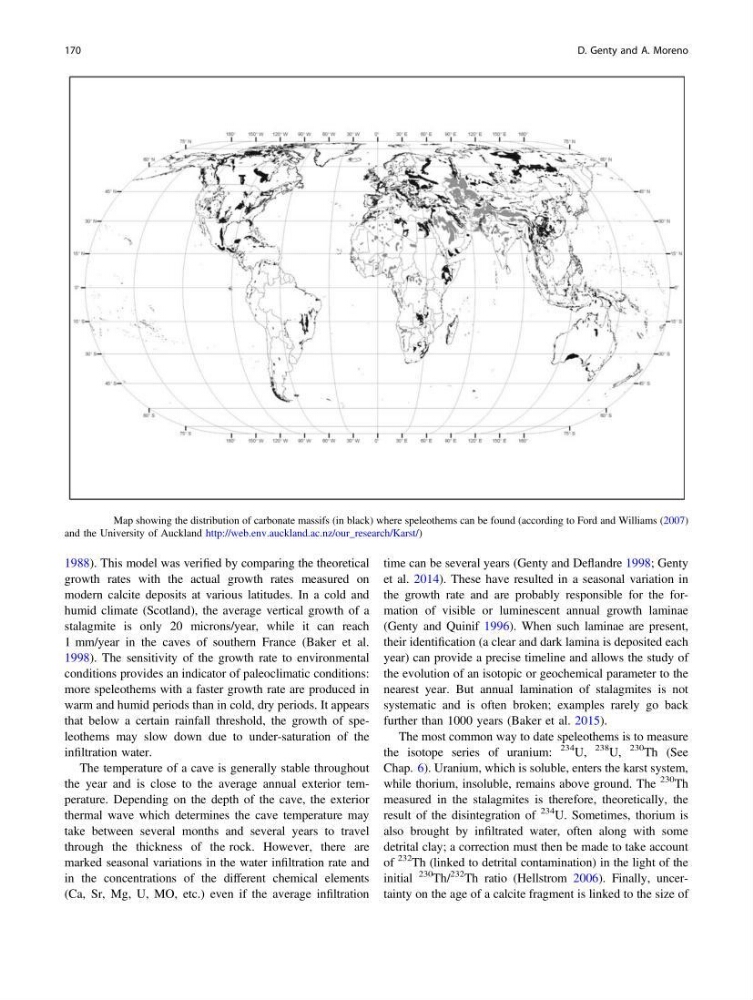
Fig. 14.1 Map showing the distribution of carbonate massifs (in black) where speleothems can be found (according to Ford and Williams (2007)
and the University of Auckland http://web.env.auckland.ac.nz/our_research/Karst/)
170
D. Genty and A. Moreno
growth rates with the actual growth rates measured on
modern calcite deposits at various latitudes. In a cold and
humid climate (Scotland), the average vertical growth of a
stalagmite is only 20 microns/year, while it can reach
1 mm/year in the caves of southern France (Baker et al.
1998). The sensitivity of the growth rate to environmental
conditions provides an indicator of paleoclimatic conditions:
more speleothems with a faster growth rate are produced in
warm and humid periods than in cold, dry periods. It appears
that below a certain rainfall threshold, the growth of speleothems may slow down due to under-saturation of the
infiltration water.
The temperature of a cave is generally stable throughout
the year and is close to the average annual exterior temperature. Depending on the depth of the cave, the exterior
thermal wave which determines the cave temperature may
take between several months and several years to travel
through the thickness of the rock. However, there are
marked seasonal variations in the water infiltration rate and
in the concentrations of the different chemical elements
(Ca, Sr, Mg, U, MO, etc.) even if the average infiltration
time can be several years (Genty and Deflandre 1998; Genty
et al. 2014). These have resulted in a seasonal variation in
the growth rate and are probably responsible for the formation of visible or luminescent annual growth laminae
(Genty and Quinif 1996). When such laminae are present,
their identification (a clear and dark lamina is deposited each
year) can provide a precise timeline and allows the study of
the evolution of an isotopic or geochemical parameter to the
nearest year. But annual lamination of stalagmites is not
systematic and is often broken; examples rarely go back
further than 1000 years (Baker et al. 2015).
The most common way to date speleothems is to measure
the isotope series of uranium:
234 U,
238 U,
230 Th (See
Chap. 6). Uranium, which is soluble, enters the karst system,
while thorium, insoluble, remains above ground. The
230 Th
measured in the stalagmites is therefore, theoretically, the
result of the disintegration of
234 U. Sometimes, thorium is
also brought by infiltrated water, often along with some
detrital clay; a correction must then be made to take account
of
232 Th (linked to detrital contamination) in the light of the
initial
230 Th/
232
Th ratio (Hellstrom 2006). Finally, uncertainty on the age of a calcite fragment is linked to the size of
Fig. 14.1 Map showing the distribution of carbonate massifs (in black) where speleothems can be found (according to Ford and Williams (2007)
and the University of Auckland http://web.env.auckland.ac.nz/our_research/Karst/)
170
D. Genty and A. Moreno