

Paleoclimate Indicators
Different paleoenvironmental indicators can be identified for
this type of material, deposited at medium and high latitudes
with climate conditions unfavorable for biological development (glacial periods). These parameters allow their interpretation in term of atmospheric circulation. Four major
categories are presented below.
Sedimentological Indicators
The conceptual view
Even the observation of a loess sequence is instructive.
Indeed, when a record is of one or more climate cycles, this
is never made up of a single stratigraphic unit.
While loess sediment is characteristic of cold and quite
arid periods, other warmer periods are marked by paleosols.
Thus, if at low resolution, the loess-paleosol sequence corresponds to one or more climatic cycles; at higher resolution,
the identification of more precise events is achieved by
observing the sequence of soils or a particular hierarchy of
pedo-sedimentary units. (Kukla and An (1989)). In Europe, a
leached brown paleosol (Bt), at the base of a brown soil,
indicates an interglacial level, while a humus-rich forest soil
or a tundra gley (hydromorphic soil) are indicative of more
temperate interstadial intervals (Antoine (2009)).
Since they present detailed records of past climate,
reproducing the same pedostratigraphic and sedimentological units with the same succession of these units, the
pedosedimentary record of loess sequences can be used as a
powerful tool for chronostratigraphical correlation (Antoine,
et al, (1999); Rousseau et al. (2007a, b)).
The grain size index
The study of the grain size, calculated through determination
of the dominant classes, their mode distribution and relationships between them, can characterize the relative
strengths of the winds that created the deposits (Rousseau
et al. (2007a, b)). These wind dynamics are linked to
changes in the general atmospheric circulation (Fig. 13.3).
On a finer scale, Nussloch shows a progressive coarsening
of the loess deposits between ca 30 and 22 ka (Rousseau
et al. (2007b)). This coarsening trend ends with a short but
major decrease in grain size, followed by an increase to a
new maximum at 20 ± 2 ka (‘‘W’’ shape). Correlation
between the loess grain-size index and the Greenland
ice-core dust records suggests a global connection between
North Atlantic and Western European global atmospheric
circulation and wind regimes (Antoine (2009); Rousseau
et al. (2007b)).
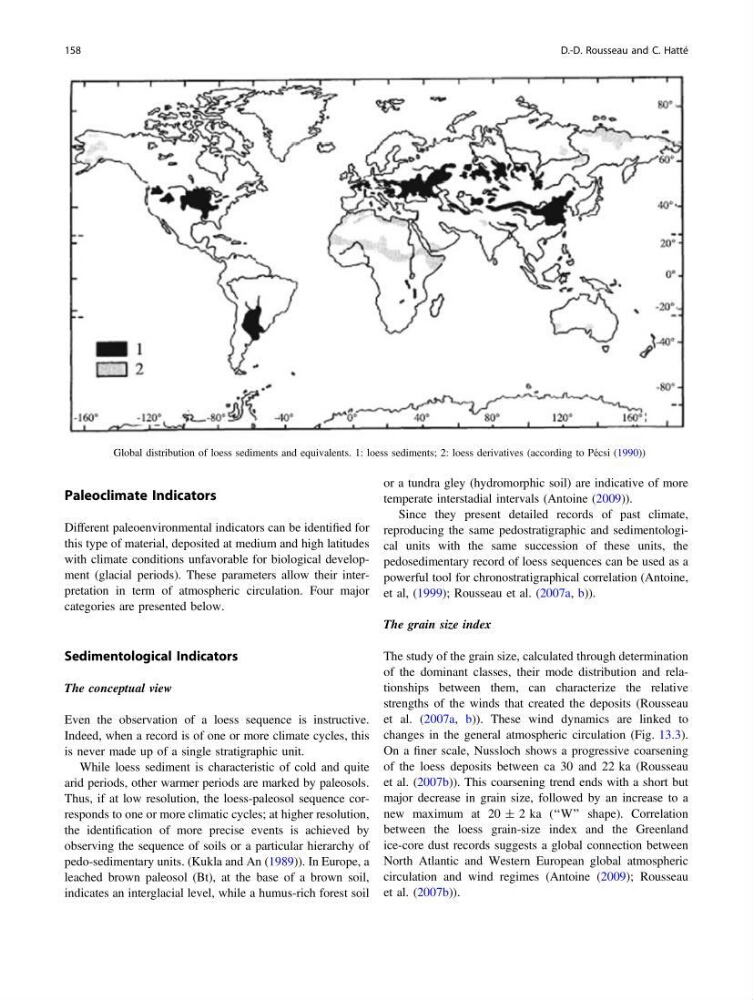
Fig. 13.1 Global distribution of loess sediments and equivalents. 1: loess sediments; 2: loess derivatives (according to Pécsi (1990))
158
D.-D. Rousseau and C. Hatté
Different paleoenvironmental indicators can be identified for
this type of material, deposited at medium and high latitudes
with climate conditions unfavorable for biological development (glacial periods). These parameters allow their interpretation in term of atmospheric circulation. Four major
categories are presented below.
Sedimentological Indicators
The conceptual view
Even the observation of a loess sequence is instructive.
Indeed, when a record is of one or more climate cycles, this
is never made up of a single stratigraphic unit.
While loess sediment is characteristic of cold and quite
arid periods, other warmer periods are marked by paleosols.
Thus, if at low resolution, the loess-paleosol sequence corresponds to one or more climatic cycles; at higher resolution,
the identification of more precise events is achieved by
observing the sequence of soils or a particular hierarchy of
pedo-sedimentary units. (Kukla and An (1989)). In Europe, a
leached brown paleosol (Bt), at the base of a brown soil,
indicates an interglacial level, while a humus-rich forest soil
or a tundra gley (hydromorphic soil) are indicative of more
temperate interstadial intervals (Antoine (2009)).
Since they present detailed records of past climate,
reproducing the same pedostratigraphic and sedimentological units with the same succession of these units, the
pedosedimentary record of loess sequences can be used as a
powerful tool for chronostratigraphical correlation (Antoine,
et al, (1999); Rousseau et al. (2007a, b)).
The grain size index
The study of the grain size, calculated through determination
of the dominant classes, their mode distribution and relationships between them, can characterize the relative
strengths of the winds that created the deposits (Rousseau
et al. (2007a, b)). These wind dynamics are linked to
changes in the general atmospheric circulation (Fig. 13.3).
On a finer scale, Nussloch shows a progressive coarsening
of the loess deposits between ca 30 and 22 ka (Rousseau
et al. (2007b)). This coarsening trend ends with a short but
major decrease in grain size, followed by an increase to a
new maximum at 20 ± 2 ka (‘‘W’’ shape). Correlation
between the loess grain-size index and the Greenland
ice-core dust records suggests a global connection between
North Atlantic and Western European global atmospheric
circulation and wind regimes (Antoine (2009); Rousseau
et al. (2007b)).
Fig. 13.1 Global distribution of loess sediments and equivalents. 1: loess sediments; 2: loess derivatives (according to Pécsi (1990))
158
D.-D. Rousseau and C. Hatté