

ages, changes in the seasonality of precipitation, in the
altitude of condensation, in the trajectory and origin of
precipitation, can all have significant effects on the relationship between isotopic composition and local surface
temperature. Isotopic distillation models and atmospheric
general circulation models, equipped with an explicit representation of stable water isotopes allow the impact of these
factors to be estimated through sensitivity studies. A set of
simulations conducted using the ECHAM-iso model,
(Werner et al. 2001; Jouzel et al. 2007a; Werner et al. 2017)
has helped to highlight the stability of the temperatureisotope relationship for the Antarctic central plateau,
between the glacial and current climates, and to show that
the temporal slope is very similar to the spatial slope. This
supports the ‘isotopic thermometer’ approach for sites on the
Antarctic plateau with an accuracy of between −10 and
+30%, according to Jouzel et al. (2003).
However, this approach is debatable for climates warmer
than the present. Sime et al. (2008) examined a scenario
showing an increase in atmospheric concentration of CO 2
with the HadAM3-iso model. This simulation suggests a
reduction in the isotope-temperature relationship in the
Dome C region of Antarctica, in the context of a warmer
global climate. This result remains difficult to apply to
measurements from ice cores, because of a lack of analogy
between climate changes caused by modifications in the
Earth’s orbit (‘warm’ interglacial periods) and those caused
by an increase in the greenhouse effect.
Similarly, climate-isotope modeling and the comparison
of isotopic analysis with other paleothermometry methods
suggest that in central Greenland, the two slopes differ significantly, by up to a factor of 2 (Dahl-Jensen et al. 1998;
Masson-Delmotte et al. 2005); the conventional approach
underestimates variations in temperature by this amount.
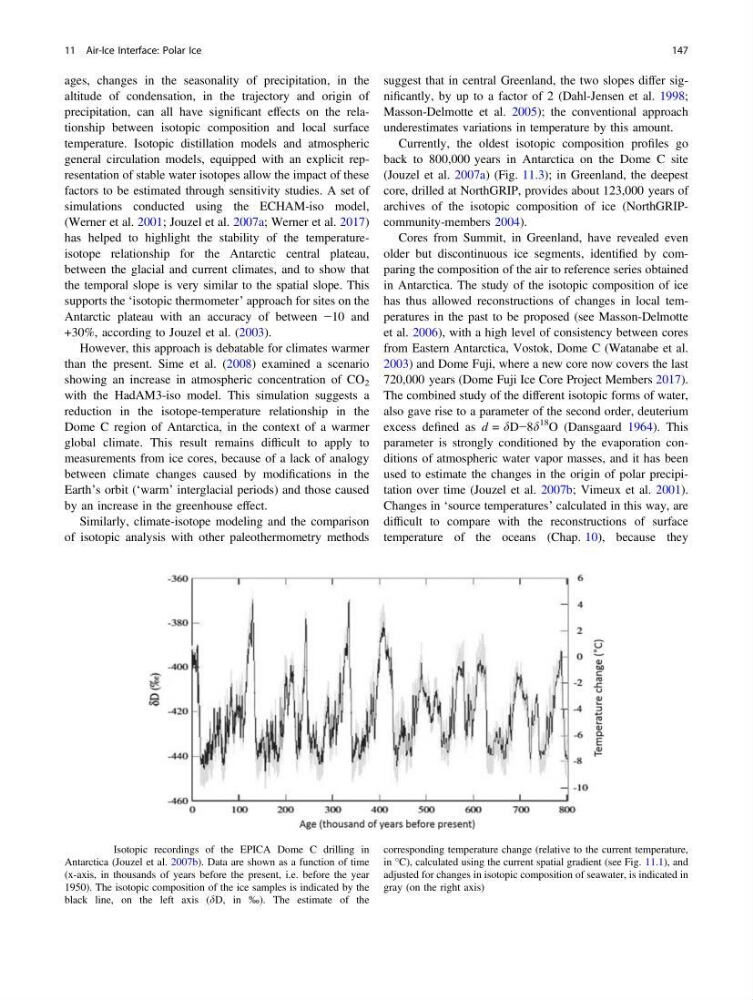
Currently, the oldest isotopic composition profiles go
back to 800,000 years in Antarctica on the Dome C site
(Jouzel et al. 2007a) (Fig. 11.3); in Greenland, the deepest
core, drilled at NorthGRIP, provides about 123,000 years of
archives of the isotopic composition of ice (NorthGRIPcommunity-members 2004).
Cores from Summit, in Greenland, have revealed even
older but discontinuous ice segments, identified by comparing the composition of the air to reference series obtained
in Antarctica. The study of the isotopic composition of ice
has thus allowed reconstructions of changes in local temperatures in the past to be proposed (see Masson-Delmotte
et al. 2006), with a high level of consistency between cores
from Eastern Antarctica, Vostok, Dome C (Watanabe et al.
2003) and Dome Fuji, where a new core now covers the last
720,000 years (Dome Fuji Ice Core Project Members 2017).
The combined study of the different isotopic forms of water,
also gave rise to a parameter of the second order, deuterium
excess defined as d = dD−8d
18 O (Dansgaard 1964). This
parameter is strongly conditioned by the evaporation conditions of atmospheric water vapor masses, and it has been
used to estimate the changes in the origin of polar precipitation over time (Jouzel et al. 2007b; Vimeux et al. 2001).
Changes in ‘source temperatures’ calculated in this way, are
difficult to compare with the reconstructions of surface
temperature of the oceans (Chap. 10), because they
Fig. 11.3 Isotopic recordings of the EPICA Dome C drilling in
Antarctica (Jouzel et al. 2007b). Data are shown as a function of time
(x-axis, in thousands of years before the present, i.e. before the year
1950). The isotopic composition of the ice samples is indicated by the
black line, on the left axis (dD, in ‰). The estimate of the
corresponding temperature change (relative to the current temperature,
in °C), calculated using the current spatial gradient (see Fig. 11.1), and
adjusted for changes in isotopic composition of seawater, is indicated in
gray (on the right axis)
11 Air-Ice Interface: Polar Ice
147
altitude of condensation, in the trajectory and origin of
precipitation, can all have significant effects on the relationship between isotopic composition and local surface
temperature. Isotopic distillation models and atmospheric
general circulation models, equipped with an explicit representation of stable water isotopes allow the impact of these
factors to be estimated through sensitivity studies. A set of
simulations conducted using the ECHAM-iso model,
(Werner et al. 2001; Jouzel et al. 2007a; Werner et al. 2017)
has helped to highlight the stability of the temperatureisotope relationship for the Antarctic central plateau,
between the glacial and current climates, and to show that
the temporal slope is very similar to the spatial slope. This
supports the ‘isotopic thermometer’ approach for sites on the
Antarctic plateau with an accuracy of between −10 and
+30%, according to Jouzel et al. (2003).
However, this approach is debatable for climates warmer
than the present. Sime et al. (2008) examined a scenario
showing an increase in atmospheric concentration of CO 2
with the HadAM3-iso model. This simulation suggests a
reduction in the isotope-temperature relationship in the
Dome C region of Antarctica, in the context of a warmer
global climate. This result remains difficult to apply to
measurements from ice cores, because of a lack of analogy
between climate changes caused by modifications in the
Earth’s orbit (‘warm’ interglacial periods) and those caused
by an increase in the greenhouse effect.
Similarly, climate-isotope modeling and the comparison
of isotopic analysis with other paleothermometry methods
suggest that in central Greenland, the two slopes differ significantly, by up to a factor of 2 (Dahl-Jensen et al. 1998;
Masson-Delmotte et al. 2005); the conventional approach
underestimates variations in temperature by this amount.
Currently, the oldest isotopic composition profiles go
back to 800,000 years in Antarctica on the Dome C site
(Jouzel et al. 2007a) (Fig. 11.3); in Greenland, the deepest
core, drilled at NorthGRIP, provides about 123,000 years of
archives of the isotopic composition of ice (NorthGRIPcommunity-members 2004).
Cores from Summit, in Greenland, have revealed even
older but discontinuous ice segments, identified by comparing the composition of the air to reference series obtained
in Antarctica. The study of the isotopic composition of ice
has thus allowed reconstructions of changes in local temperatures in the past to be proposed (see Masson-Delmotte
et al. 2006), with a high level of consistency between cores
from Eastern Antarctica, Vostok, Dome C (Watanabe et al.
2003) and Dome Fuji, where a new core now covers the last
720,000 years (Dome Fuji Ice Core Project Members 2017).
The combined study of the different isotopic forms of water,
also gave rise to a parameter of the second order, deuterium
excess defined as d = dD−8d
18 O (Dansgaard 1964). This
parameter is strongly conditioned by the evaporation conditions of atmospheric water vapor masses, and it has been
used to estimate the changes in the origin of polar precipitation over time (Jouzel et al. 2007b; Vimeux et al. 2001).
Changes in ‘source temperatures’ calculated in this way, are
difficult to compare with the reconstructions of surface
temperature of the oceans (Chap. 10), because they
Fig. 11.3 Isotopic recordings of the EPICA Dome C drilling in
Antarctica (Jouzel et al. 2007b). Data are shown as a function of time
(x-axis, in thousands of years before the present, i.e. before the year
1950). The isotopic composition of the ice samples is indicated by the
black line, on the left axis (dD, in ‰). The estimate of the
corresponding temperature change (relative to the current temperature,
in °C), calculated using the current spatial gradient (see Fig. 11.1), and
adjusted for changes in isotopic composition of seawater, is indicated in
gray (on the right axis)
11 Air-Ice Interface: Polar Ice
147