

isotopic composition associated with different air mass
trajectories. The exact effect of these uncertainties on
temperature reconstructions remains difficult to quantify;
• uncertainty concerning the stability over time of the
relationships between the isotopic abundances in precipitations and weather factors: even with an almost perfect
archive of the isotopic composition of precipitations, how
does this translate in terms of climate? Although
condensation temperature is the key factor governing the
isotopic distillation of an air mass, certain factors like the
evaporation conditions, changes in the source of moisture
or the vapor trajectory (including convective processes or
not), continental recycling (precipitation/evaporation
ratio), can affect the isotopic composition of the precipitations. Several critical aspects, such as the seasonality of
the precipitations or the relationship between the
-60
-50
-40
-30
-20
-10
0
δ
18
O (
o
/
oo )
-50
-40
-30
-20
-10
0
10
20
Surface air temperature (°C)
Slope: 0.795±0.015
Slope: 0.580±0.015
GNIP
Antarctica
a
b
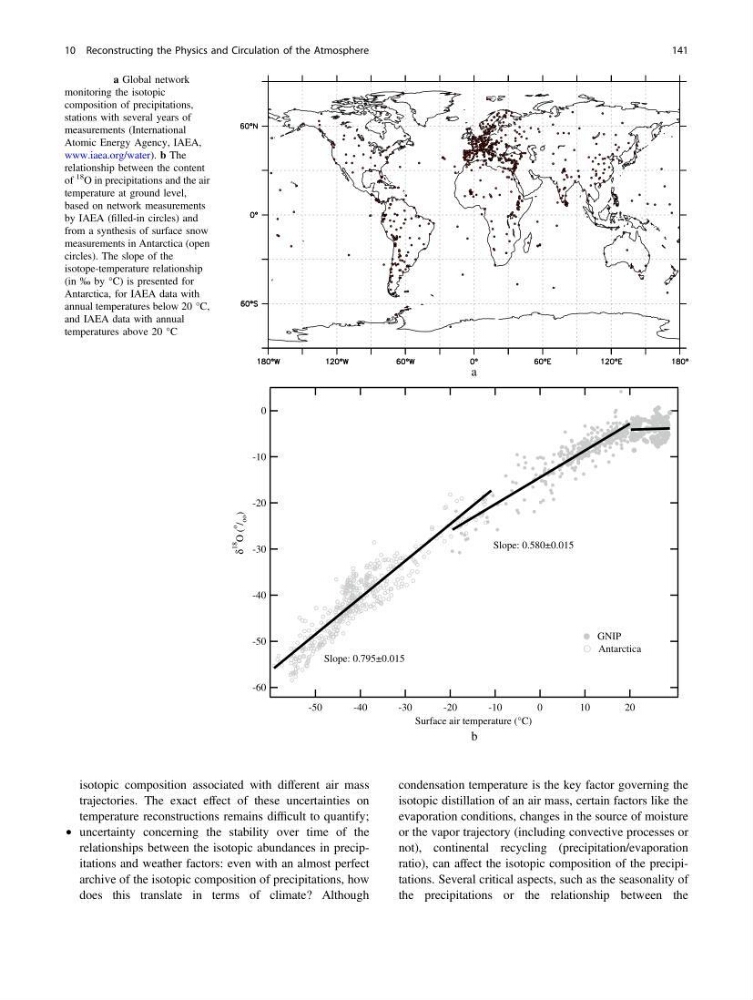
Fig. 10.2 a Global network
monitoring the isotopic
composition of precipitations,
stations with several years of
measurements (International
Atomic Energy Agency, IAEA,
www.iaea.org/water). b The
relationship between the content
of
18
O in precipitations and the air
temperature at ground level,
based on network measurements
by IAEA (filled-in circles) and
from a synthesis of surface snow
measurements in Antarctica (open
circles). The slope of the
isotope-temperature relationship
(in ‰ by °C) is presented for
Antarctica, for IAEA data with
annual temperatures below 20 °C,
and IAEA data with annual
temperatures above 20 °C
10 Reconstructing the Physics and Circulation of the Atmosphere
141
trajectories. The exact effect of these uncertainties on
temperature reconstructions remains difficult to quantify;
• uncertainty concerning the stability over time of the
relationships between the isotopic abundances in precipitations and weather factors: even with an almost perfect
archive of the isotopic composition of precipitations, how
does this translate in terms of climate? Although
condensation temperature is the key factor governing the
isotopic distillation of an air mass, certain factors like the
evaporation conditions, changes in the source of moisture
or the vapor trajectory (including convective processes or
not), continental recycling (precipitation/evaporation
ratio), can affect the isotopic composition of the precipitations. Several critical aspects, such as the seasonality of
the precipitations or the relationship between the
-60
-50
-40
-30
-20
-10
0
δ
18
O (
o
/
oo )
-50
-40
-30
-20
-10
0
10
20
Surface air temperature (°C)
Slope: 0.795±0.015
Slope: 0.580±0.015
GNIP
Antarctica
a
b
Fig. 10.2 a Global network
monitoring the isotopic
composition of precipitations,
stations with several years of
measurements (International
Atomic Energy Agency, IAEA,
www.iaea.org/water). b The
relationship between the content
of
18
O in precipitations and the air
temperature at ground level,
based on network measurements
by IAEA (filled-in circles) and
from a synthesis of surface snow
measurements in Antarctica (open
circles). The slope of the
isotope-temperature relationship
(in ‰ by °C) is presented for
Antarctica, for IAEA data with
annual temperatures below 20 °C,
and IAEA data with annual
temperatures above 20 °C
10 Reconstructing the Physics and Circulation of the Atmosphere
141