

• uncertainty in the measurement of the isotopic content;
this is generally low, with an impact of around a tenth of
degree on estimates of temperatures;
• uncertainty in the processes able to modify the relationship between the isotopic composition of precipitations
and the isotopic composition of the archive (ice, calcite,
cellulose…). The physicochemical and biological processes controlling the transfer of information between the
precipitation and the archive must be understood and
quantified in order to assess the uncertainty in the
reconstruction of the initial isotopic composition of the
precipitation. Each archive has specific biases described
in the following sections, which are not necessarily
constant over time: these uncertainties can only be estimated through proper understanding and modeling of
transfer processes between the water from precipitation
and that of the archive (hydro-isotopic models of the
functioning of trees, and of lake systems). Recent work
has, for instance, shown that the isotopic composition of
Greenland or Antarctic surface snow can evolve between
snowfall events, possibly due to the interplay of snow
metamorphism with changes in surface water vapor
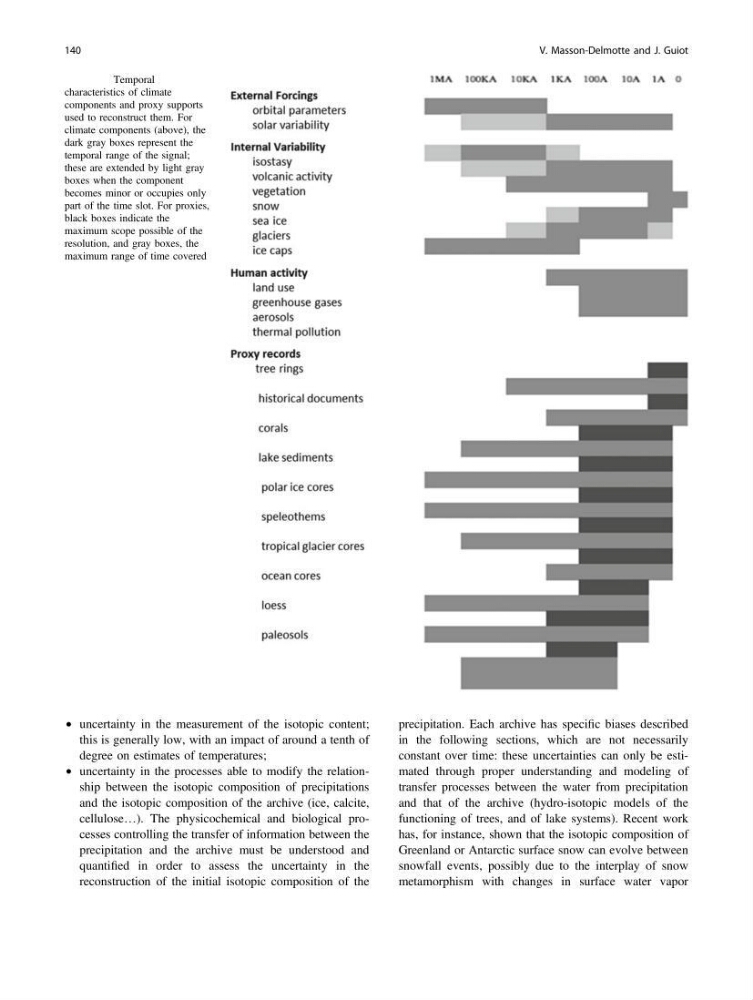
Fig. 10.1 Temporal
characteristics of climate
components and proxy supports
used to reconstruct them. For
climate components (above), the
dark gray boxes represent the
temporal range of the signal;
these are extended by light gray
boxes when the component
becomes minor or occupies only
part of the time slot. For proxies,
black boxes indicate the
maximum scope possible of the
resolution, and gray boxes, the
maximum range of time covered
140
V. Masson-Delmotte and J. Guiot
this is generally low, with an impact of around a tenth of
degree on estimates of temperatures;
• uncertainty in the processes able to modify the relationship between the isotopic composition of precipitations
and the isotopic composition of the archive (ice, calcite,
cellulose…). The physicochemical and biological processes controlling the transfer of information between the
precipitation and the archive must be understood and
quantified in order to assess the uncertainty in the
reconstruction of the initial isotopic composition of the
precipitation. Each archive has specific biases described
in the following sections, which are not necessarily
constant over time: these uncertainties can only be estimated through proper understanding and modeling of
transfer processes between the water from precipitation
and that of the archive (hydro-isotopic models of the
functioning of trees, and of lake systems). Recent work
has, for instance, shown that the isotopic composition of
Greenland or Antarctic surface snow can evolve between
snowfall events, possibly due to the interplay of snow
metamorphism with changes in surface water vapor
Fig. 10.1 Temporal
characteristics of climate
components and proxy supports
used to reconstruct them. For
climate components (above), the
dark gray boxes represent the
temporal range of the signal;
these are extended by light gray
boxes when the component
becomes minor or occupies only
part of the time slot. For proxies,
black boxes indicate the
maximum scope possible of the
resolution, and gray boxes, the
maximum range of time covered
140
V. Masson-Delmotte and J. Guiot