

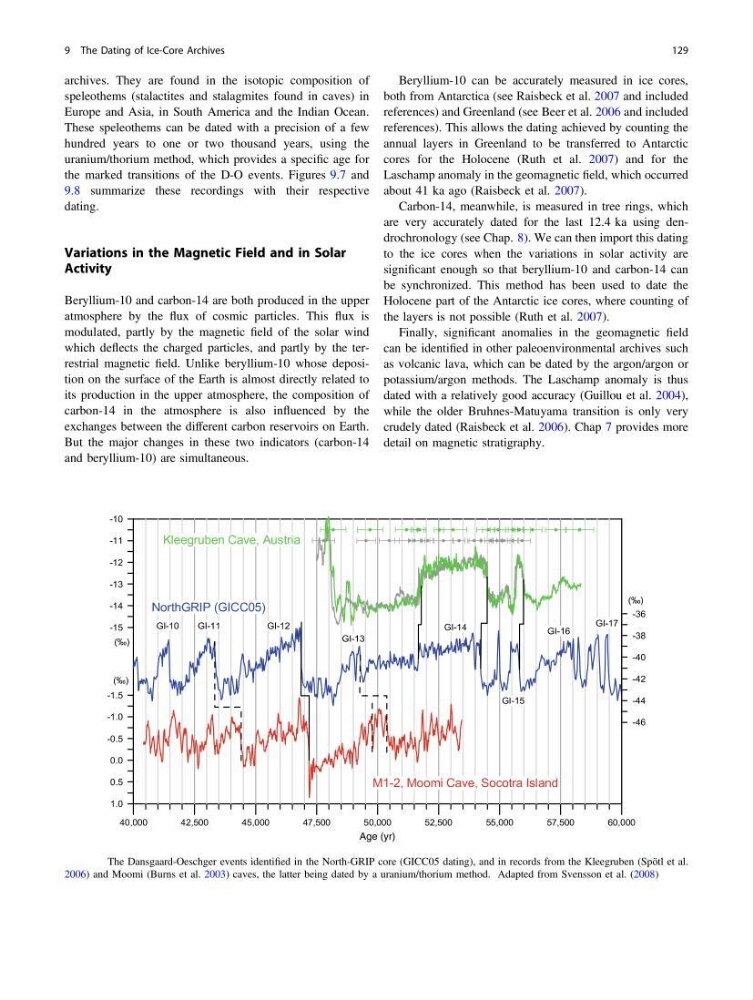
archives. They are found in the isotopic composition of
speleothems (stalactites and stalagmites found in caves) in
Europe and Asia, in South America and the Indian Ocean.
These speleothems can be dated with a precision of a few
hundred years to one or two thousand years, using the
uranium/thorium method, which provides a specific age for
the marked transitions of the D-O events. Figures 9.7 and
9.8 summarize these recordings with their respective
dating.
Variations in the Magnetic Field and in Solar
Activity
Beryllium-10 and carbon-14 are both produced in the upper
atmosphere by the flux of cosmic particles. This flux is
modulated, partly by the magnetic field of the solar wind
which deflects the charged particles, and partly by the terrestrial magnetic field. Unlike beryllium-10 whose deposition on the surface of the Earth is almost directly related to
its production in the upper atmosphere, the composition of
carbon-14 in the atmosphere is also influenced by the
exchanges between the different carbon reservoirs on Earth.
But the major changes in these two indicators (carbon-14
and beryllium-10) are simultaneous.
Beryllium-10 can be accurately measured in ice cores,
both from Antarctica (see Raisbeck et al. 2007 and included
references) and Greenland (see Beer et al. 2006 and included
references). This allows the dating achieved by counting the
annual layers in Greenland to be transferred to Antarctic
cores for the Holocene (Ruth et al. 2007) and for the
Laschamp anomaly in the geomagnetic field, which occurred
about 41 ka ago (Raisbeck et al. 2007).
Carbon-14, meanwhile, is measured in tree rings, which
are very accurately dated for the last 12.4 ka using dendrochronology (see Chap. 8). We can then import this dating
to the ice cores when the variations in solar activity are
significant enough so that beryllium-10 and carbon-14 can
be synchronized. This method has been used to date the
Holocene part of the Antarctic ice cores, where counting of
the layers is not possible (Ruth et al. 2007).
Finally, significant anomalies in the geomagnetic field
can be identified in other paleoenvironmental archives such
as volcanic lava, which can be dated by the argon/argon or
potassium/argon methods. The Laschamp anomaly is thus
dated with a relatively good accuracy (Guillou et al. 2004),
while the older Bruhnes-Matuyama transition is only very
crudely dated (Raisbeck et al. 2006). Chap 7 provides more
detail on magnetic stratigraphy.
Age (yr)
Fig. 9.7 The Dansgaard-Oeschger events identified in the North-GRIP core (GICC05 dating), and in records from the Kleegruben (Spötl et al.
2006) and Moomi (Burns et al. 2003) caves, the latter being dated by a uranium/thorium method. Adapted from Svensson et al. (2008)
9 The Dating of Ice-Core Archives
129
speleothems (stalactites and stalagmites found in caves) in
Europe and Asia, in South America and the Indian Ocean.
These speleothems can be dated with a precision of a few
hundred years to one or two thousand years, using the
uranium/thorium method, which provides a specific age for
the marked transitions of the D-O events. Figures 9.7 and
9.8 summarize these recordings with their respective
dating.
Variations in the Magnetic Field and in Solar
Activity
Beryllium-10 and carbon-14 are both produced in the upper
atmosphere by the flux of cosmic particles. This flux is
modulated, partly by the magnetic field of the solar wind
which deflects the charged particles, and partly by the terrestrial magnetic field. Unlike beryllium-10 whose deposition on the surface of the Earth is almost directly related to
its production in the upper atmosphere, the composition of
carbon-14 in the atmosphere is also influenced by the
exchanges between the different carbon reservoirs on Earth.
But the major changes in these two indicators (carbon-14
and beryllium-10) are simultaneous.
Beryllium-10 can be accurately measured in ice cores,
both from Antarctica (see Raisbeck et al. 2007 and included
references) and Greenland (see Beer et al. 2006 and included
references). This allows the dating achieved by counting the
annual layers in Greenland to be transferred to Antarctic
cores for the Holocene (Ruth et al. 2007) and for the
Laschamp anomaly in the geomagnetic field, which occurred
about 41 ka ago (Raisbeck et al. 2007).
Carbon-14, meanwhile, is measured in tree rings, which
are very accurately dated for the last 12.4 ka using dendrochronology (see Chap. 8). We can then import this dating
to the ice cores when the variations in solar activity are
significant enough so that beryllium-10 and carbon-14 can
be synchronized. This method has been used to date the
Holocene part of the Antarctic ice cores, where counting of
the layers is not possible (Ruth et al. 2007).
Finally, significant anomalies in the geomagnetic field
can be identified in other paleoenvironmental archives such
as volcanic lava, which can be dated by the argon/argon or
potassium/argon methods. The Laschamp anomaly is thus
dated with a relatively good accuracy (Guillou et al. 2004),
while the older Bruhnes-Matuyama transition is only very
crudely dated (Raisbeck et al. 2006). Chap 7 provides more
detail on magnetic stratigraphy.
Age (yr)
Fig. 9.7 The Dansgaard-Oeschger events identified in the North-GRIP core (GICC05 dating), and in records from the Kleegruben (Spötl et al.
2006) and Moomi (Burns et al. 2003) caves, the latter being dated by a uranium/thorium method. Adapted from Svensson et al. (2008)
9 The Dating of Ice-Core Archives
129