

Application of the
15
N and
40
Ar Isotopes
in the Bubbles
Nitrogen and argon have isotopic compositions (in
15 N and
40 Ar) in the atmosphere almost constant over the timescales
studied in ice cores. But the isotopic composition of the air
bubbles varies due to a process occurring in the firn.
Because of the mixing, no fractionation occurs in the
convective zone. In the diffusive zone, two types of fractionation take place:
• Gravitational fractionation, under the influence of gravity, draws the heavy isotopes towards the bottom of the
firn, according to the equation:
d g ¼
T
T 0
exp
Dmgz
RT
À 1
 1000
ð9:1Þ
where Dm is the difference in mass between the two isotopes, g is the gravitational acceleration, z is the height of the
diffusive column, R is the constant of perfect gases and T is
the temperature, expressed in Kelvin. This fractionation will
therefore depend primarily on the height of the diffusive
column, and to a lesser extent, on the temperature of the firn.
All things being equal, the gravitational fractionation is
proportional to the difference in mass between the two isotopes under consideration. So, it is four times higher for
argon (
40 Ar and
36 Ar) than it is for nitrogen (
15 N and
14 N).
• Thermal fractionation draws the heaviest types towards
the cold extremity. Thermal fractionation in equilibrium
may be written as:
d g ¼
T
T 0
a
À1
 1000
ð9:2Þ
where T and T 0 are the temperatures at either end of the
diffusive column and a is the thermal diffusion coefficient,
which depends in a complex way on the temperature.
Nitrogen-15 and argon-40 can thus be used in two different ways to constrain the age differences between ice and
gas.
Firstly, abrupt changes in temperature can be identified in
both the ice (where it is recorded in the variations in the
isotopic composition of oxygen and of hydrogen in the H 2 O
molecule, see §11.3, Chap. 11), and in the air (in the isotopic
composition anomaly due to thermal fractionation). Thus, an
estimate of Ddepth may be deduced. This method was used
to validate firn models in Greenland during major rapid
changes in temperature, called Dansgaard-Oeschger events.
In Antarctica, temperature variations are less abrupt, and so
detection of the temperature anomaly remains ambiguous.
Secondly, assuming that the convective column is known
and that no fractionation takes place during the pore closing
process, we can calculate the thickness of the diffusive
column. This technique also served to validate the firn
models in Greenland. For sites on the Antarctic plateau, the
situation is more complex, because nitrogen-15 and
argon-40 suggest a decrease in the diffusive column during
the glacial periods, although the firn models calculate an
increase in the thickness of the firn (Landais et al. 2006).
Three hypotheses may explain this discrepancy: (1) the
height of the convective zone increased during glacial
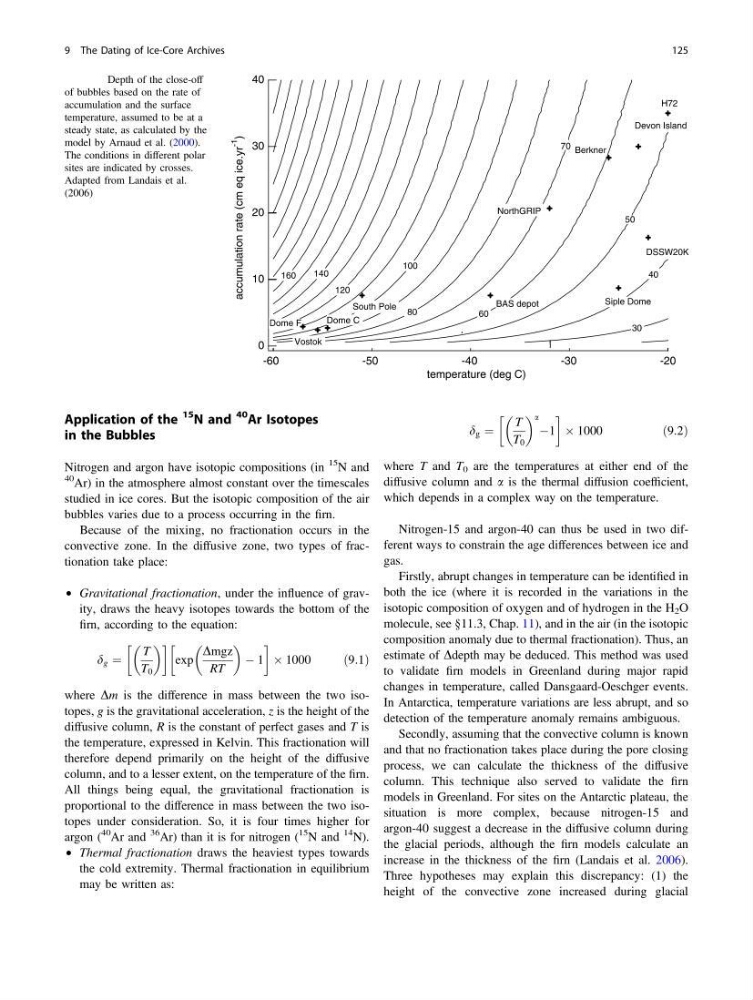
Fig. 9.2 Depth of the close-off
of bubbles based on the rate of
accumulation and the surface
temperature, assumed to be at a
steady state, as calculated by the
model by Arnaud et al. (2000).
The conditions in different polar
sites are indicated by crosses.
Adapted from Landais et al.
(2006)
9 The Dating of Ice-Core Archives
125
15
N and
40
Ar Isotopes
in the Bubbles
Nitrogen and argon have isotopic compositions (in
15 N and
40 Ar) in the atmosphere almost constant over the timescales
studied in ice cores. But the isotopic composition of the air
bubbles varies due to a process occurring in the firn.
Because of the mixing, no fractionation occurs in the
convective zone. In the diffusive zone, two types of fractionation take place:
• Gravitational fractionation, under the influence of gravity, draws the heavy isotopes towards the bottom of the
firn, according to the equation:
d g ¼
T
T 0
exp
Dmgz
RT
À 1
 1000
ð9:1Þ
where Dm is the difference in mass between the two isotopes, g is the gravitational acceleration, z is the height of the
diffusive column, R is the constant of perfect gases and T is
the temperature, expressed in Kelvin. This fractionation will
therefore depend primarily on the height of the diffusive
column, and to a lesser extent, on the temperature of the firn.
All things being equal, the gravitational fractionation is
proportional to the difference in mass between the two isotopes under consideration. So, it is four times higher for
argon (
40 Ar and
36 Ar) than it is for nitrogen (
15 N and
14 N).
• Thermal fractionation draws the heaviest types towards
the cold extremity. Thermal fractionation in equilibrium
may be written as:
d g ¼
T
T 0
a
À1
 1000
ð9:2Þ
where T and T 0 are the temperatures at either end of the
diffusive column and a is the thermal diffusion coefficient,
which depends in a complex way on the temperature.
Nitrogen-15 and argon-40 can thus be used in two different ways to constrain the age differences between ice and
gas.
Firstly, abrupt changes in temperature can be identified in
both the ice (where it is recorded in the variations in the
isotopic composition of oxygen and of hydrogen in the H 2 O
molecule, see §11.3, Chap. 11), and in the air (in the isotopic
composition anomaly due to thermal fractionation). Thus, an
estimate of Ddepth may be deduced. This method was used
to validate firn models in Greenland during major rapid
changes in temperature, called Dansgaard-Oeschger events.
In Antarctica, temperature variations are less abrupt, and so
detection of the temperature anomaly remains ambiguous.
Secondly, assuming that the convective column is known
and that no fractionation takes place during the pore closing
process, we can calculate the thickness of the diffusive
column. This technique also served to validate the firn
models in Greenland. For sites on the Antarctic plateau, the
situation is more complex, because nitrogen-15 and
argon-40 suggest a decrease in the diffusive column during
the glacial periods, although the firn models calculate an
increase in the thickness of the firn (Landais et al. 2006).
Three hypotheses may explain this discrepancy: (1) the
height of the convective zone increased during glacial
Fig. 9.2 Depth of the close-off
of bubbles based on the rate of
accumulation and the surface
temperature, assumed to be at a
steady state, as calculated by the
model by Arnaud et al. (2000).
The conditions in different polar
sites are indicated by crosses.
Adapted from Landais et al.
(2006)
9 The Dating of Ice-Core Archives
125