

The dating of samples from trees which died at an
unknown date requires synchronization between the analyzed series and a chronology of previously dated ring
widths, called a master chronology. This master chronology
must be composed of several series of rings from the same
tree species as the one to be dated and from trees exposed to
the same climatic factors, i.e. geographically close. Building
a master chronology involves assembling several mean
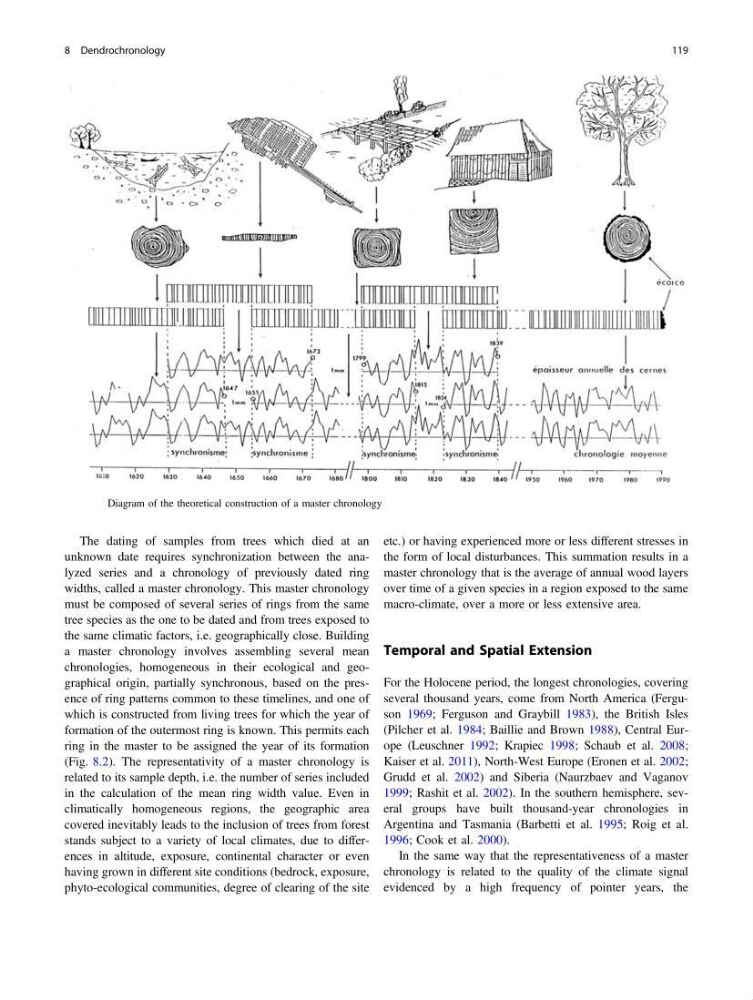
chronologies, homogeneous in their ecological and geographical origin, partially synchronous, based on the presence of ring patterns common to these timelines, and one of
which is constructed from living trees for which the year of
formation of the outermost ring is known. This permits each
ring in the master to be assigned the year of its formation
(Fig. 8.2). The representativity of a master chronology is
related to its sample depth, i.e. the number of series included
in the calculation of the mean ring width value. Even in
climatically homogeneous regions, the geographic area
covered inevitably leads to the inclusion of trees from forest
stands subject to a variety of local climates, due to differences in altitude, exposure, continental character or even
having grown in different site conditions (bedrock, exposure,
phyto-ecological communities, degree of clearing of the site
etc.) or having experienced more or less different stresses in
the form of local disturbances. This summation results in a
master chronology that is the average of annual wood layers
over time of a given species in a region exposed to the same
macro-climate, over a more or less extensive area.
Temporal and Spatial Extension
For the Holocene period, the longest chronologies, covering
several thousand years, come from North America (Ferguson 1969; Ferguson and Graybill 1983), the British Isles
(Pilcher et al. 1984; Baillie and Brown 1988), Central Europe (Leuschner 1992; Krapiec 1998; Schaub et al. 2008;
Kaiser et al. 2011), North-West Europe (Eronen et al. 2002;
Grudd et al. 2002) and Siberia (Naurzbaev and Vaganov
1999; Rashit et al. 2002). In the southern hemisphere, several groups have built thousand-year chronologies in
Argentina and Tasmania (Barbetti et al. 1995; Roig et al.
1996; Cook et al. 2000).
In the same way that the representativeness of a master
chronology is related to the quality of the climate signal
evidenced by a high frequency of pointer years, the
Fig. 8.2 Diagram of the theoretical construction of a master chronology
8 Dendrochronology
119
unknown date requires synchronization between the analyzed series and a chronology of previously dated ring
widths, called a master chronology. This master chronology
must be composed of several series of rings from the same
tree species as the one to be dated and from trees exposed to
the same climatic factors, i.e. geographically close. Building
a master chronology involves assembling several mean
chronologies, homogeneous in their ecological and geographical origin, partially synchronous, based on the presence of ring patterns common to these timelines, and one of
which is constructed from living trees for which the year of
formation of the outermost ring is known. This permits each
ring in the master to be assigned the year of its formation
(Fig. 8.2). The representativity of a master chronology is
related to its sample depth, i.e. the number of series included
in the calculation of the mean ring width value. Even in
climatically homogeneous regions, the geographic area
covered inevitably leads to the inclusion of trees from forest
stands subject to a variety of local climates, due to differences in altitude, exposure, continental character or even
having grown in different site conditions (bedrock, exposure,
phyto-ecological communities, degree of clearing of the site
etc.) or having experienced more or less different stresses in
the form of local disturbances. This summation results in a
master chronology that is the average of annual wood layers
over time of a given species in a region exposed to the same
macro-climate, over a more or less extensive area.
Temporal and Spatial Extension
For the Holocene period, the longest chronologies, covering
several thousand years, come from North America (Ferguson 1969; Ferguson and Graybill 1983), the British Isles
(Pilcher et al. 1984; Baillie and Brown 1988), Central Europe (Leuschner 1992; Krapiec 1998; Schaub et al. 2008;
Kaiser et al. 2011), North-West Europe (Eronen et al. 2002;
Grudd et al. 2002) and Siberia (Naurzbaev and Vaganov
1999; Rashit et al. 2002). In the southern hemisphere, several groups have built thousand-year chronologies in
Argentina and Tasmania (Barbetti et al. 1995; Roig et al.
1996; Cook et al. 2000).
In the same way that the representativeness of a master
chronology is related to the quality of the climate signal
evidenced by a high frequency of pointer years, the
Fig. 8.2 Diagram of the theoretical construction of a master chronology
8 Dendrochronology
119