

dendrochronology (dendron: tree, chronos: time, logos:
study). Dendrochronology remained fairly discreet until it
gained in notoriety about 1929, when Douglass succeeded
for the first time in dating beams from ruins of Indian
buildings in the US state of New Mexico, qualifying it as a
dating method with an annual resolution (Robinson 1976).
Despite this, it was not until the arrival of the computer in
the 1960s, that dendrochronology truly took off, with a
proliferation of research laboratories.
In the regions where the first dendrochronological studies
were conducted (semi-arid regions of the southwestern USA
and cold regions), the existence of a single limiting climate
factor (rainfall in semi-arid regions, summer temperatures in
cold regions) was instrumental in creating a series of rings
whose width varied from one year to the next. However, in
regions with a temperate climate, where growth depends on
several factors, one factor can compensate for another, and the
annual ring width series are less variable, making dendrochronological studies more complicated. In fact, if weather
conditions are adequate, year after year, to meet the ecological
requirements of the tree, the rings form a temporal series of
constant width, and do not provide any chronological information, since it is extreme variations that serve as landmarks.
Dating with dendrochronology is based on a fundamental
stage, called crossdating, which is relative dating assuring
the proper placement in time of each ring. Crossdating is
established by intercomparison of different pieces of wood
on which sequences exhibiting similar ring patterns are
identified. For this, similar sequences of coinciding narrow
and wide rings, that is, separated by the same number of
rings, need to be identified. This is possible only with two
conditions. Firstly, the limiting factors for radial growth
must vary in intensity from one year to another, with an
unrepeatable series over time, so that the succession of ring
widths are also variable in such a way as to be irreproducible. Secondly, the limiting factors must act in a similar
way on trees with the same environmental requirements and
over a wide enough geographical area to cause ring widths to
vary the same way in many trees. This principle is important
because ring widths can be crossdated only if one environmental factor becomes critically limiting.
Crossdating, or synchronization, is essential to check the
accuracy of the ring count and the presence of any growth
abnormalities. Abnormalities may appear as double rings
(false rings) in the same calendar year or as missing rings.
Indeed, some years, after a cold winter, possibly followed by a
late spring or preceded by severe defoliation in the previous
year, the ring may be partially or totally absent. In other years,
as a result of the early onset of a summer drought (as in the
Mediterranean region), the cambium may develop latewood
elements and, then, thanks to improved weather conditions
through the summer, may start producing earlywood elements
again before producing latewood at the end of the normal
growing season. In this case, the “first” ring is identified as
supernumerary or false. Crossdating remains largely subjective and various methods have been developed to describe the
observed similarities more objectively (McCarthy 2004).
In living trees of the same species, with a confirmed
contemporaneity between the samples, synchronization is
established by identifying sequences of similar rings over
several series under a microscope (in cores or cross sections
of trunk), firstly from the same tree, and then, between series
from different trees. The operator compares the series from
the bark inwards, records the rings and counts the sequences
of narrow rings or ones with a distinguishing feature (color
or width of the final wood, presence of any traumatic scars or
ducts etc.). This stage allows the identification of each ring
in terms of its vintage, after any anatomical abnormalities
such as missing rings or double rings have been detected.
After synchronization of the series has been established, ring
width series are measured (1/100–1/1 000 mm).
On samples of unknown date, i.e. samples of wood from
trees felled at an unknown date, the measurement of ring
width series allows the establishment of digitized series from
which graphs are drawn to compare the temporal variations
in ring widths. The graphs are then compared in pairs and
sequences of similar ring patterns are sought; maximum
similarity between two curves is obtained when contemporary years are superimposed: maximum values, minimum
values and the number of times two series show the same
upward or downward trend in relation to the preceding year.
This analysis allows us to date the year of formation of
each ring and identifies the felling date of the tree. The
felling date of the tree is ensured when the outermost ring is
still present; for species where the anatomical difference
between sapwood (functional wood nearest the bark) and
heartwood persists over time (oak, ash, elm, larch, etc.), the
felling date of the tree is estimated based on the date
assigned to the last ring.
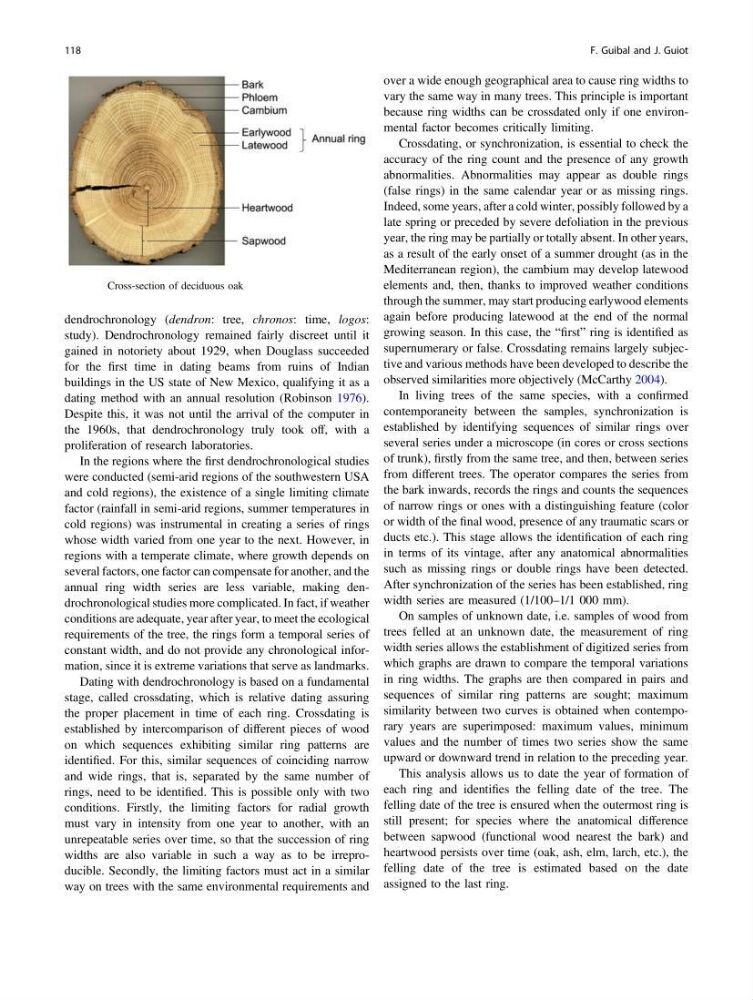
Fig. 8.1 Cross-section of deciduous oak
118
F. Guibal and J. Guiot
study). Dendrochronology remained fairly discreet until it
gained in notoriety about 1929, when Douglass succeeded
for the first time in dating beams from ruins of Indian
buildings in the US state of New Mexico, qualifying it as a
dating method with an annual resolution (Robinson 1976).
Despite this, it was not until the arrival of the computer in
the 1960s, that dendrochronology truly took off, with a
proliferation of research laboratories.
In the regions where the first dendrochronological studies
were conducted (semi-arid regions of the southwestern USA
and cold regions), the existence of a single limiting climate
factor (rainfall in semi-arid regions, summer temperatures in
cold regions) was instrumental in creating a series of rings
whose width varied from one year to the next. However, in
regions with a temperate climate, where growth depends on
several factors, one factor can compensate for another, and the
annual ring width series are less variable, making dendrochronological studies more complicated. In fact, if weather
conditions are adequate, year after year, to meet the ecological
requirements of the tree, the rings form a temporal series of
constant width, and do not provide any chronological information, since it is extreme variations that serve as landmarks.
Dating with dendrochronology is based on a fundamental
stage, called crossdating, which is relative dating assuring
the proper placement in time of each ring. Crossdating is
established by intercomparison of different pieces of wood
on which sequences exhibiting similar ring patterns are
identified. For this, similar sequences of coinciding narrow
and wide rings, that is, separated by the same number of
rings, need to be identified. This is possible only with two
conditions. Firstly, the limiting factors for radial growth
must vary in intensity from one year to another, with an
unrepeatable series over time, so that the succession of ring
widths are also variable in such a way as to be irreproducible. Secondly, the limiting factors must act in a similar
way on trees with the same environmental requirements and
over a wide enough geographical area to cause ring widths to
vary the same way in many trees. This principle is important
because ring widths can be crossdated only if one environmental factor becomes critically limiting.
Crossdating, or synchronization, is essential to check the
accuracy of the ring count and the presence of any growth
abnormalities. Abnormalities may appear as double rings
(false rings) in the same calendar year or as missing rings.
Indeed, some years, after a cold winter, possibly followed by a
late spring or preceded by severe defoliation in the previous
year, the ring may be partially or totally absent. In other years,
as a result of the early onset of a summer drought (as in the
Mediterranean region), the cambium may develop latewood
elements and, then, thanks to improved weather conditions
through the summer, may start producing earlywood elements
again before producing latewood at the end of the normal
growing season. In this case, the “first” ring is identified as
supernumerary or false. Crossdating remains largely subjective and various methods have been developed to describe the
observed similarities more objectively (McCarthy 2004).
In living trees of the same species, with a confirmed
contemporaneity between the samples, synchronization is
established by identifying sequences of similar rings over
several series under a microscope (in cores or cross sections
of trunk), firstly from the same tree, and then, between series
from different trees. The operator compares the series from
the bark inwards, records the rings and counts the sequences
of narrow rings or ones with a distinguishing feature (color
or width of the final wood, presence of any traumatic scars or
ducts etc.). This stage allows the identification of each ring
in terms of its vintage, after any anatomical abnormalities
such as missing rings or double rings have been detected.
After synchronization of the series has been established, ring
width series are measured (1/100–1/1 000 mm).
On samples of unknown date, i.e. samples of wood from
trees felled at an unknown date, the measurement of ring
width series allows the establishment of digitized series from
which graphs are drawn to compare the temporal variations
in ring widths. The graphs are then compared in pairs and
sequences of similar ring patterns are sought; maximum
similarity between two curves is obtained when contemporary years are superimposed: maximum values, minimum
values and the number of times two series show the same
upward or downward trend in relation to the preceding year.
This analysis allows us to date the year of formation of
each ring and identifies the felling date of the tree. The
felling date of the tree is ensured when the outermost ring is
still present; for species where the anatomical difference
between sapwood (functional wood nearest the bark) and
heartwood persists over time (oak, ash, elm, larch, etc.), the
felling date of the tree is estimated based on the date
assigned to the last ring.
Fig. 8.1 Cross-section of deciduous oak
118
F. Guibal and J. Guiot