

et al. 1993; Bond et al. 1993). The role of ocean circulation
in these rapid climate changes remained to be defined.
Consequently, the evolution of the deep North Atlantic water
mass was investigated, in particular by the study of the
magnetic properties of a number of sediment cores collected
along the path of the Nort Atlantic Deep Water (NADW)
(Kissel et al. 2008).
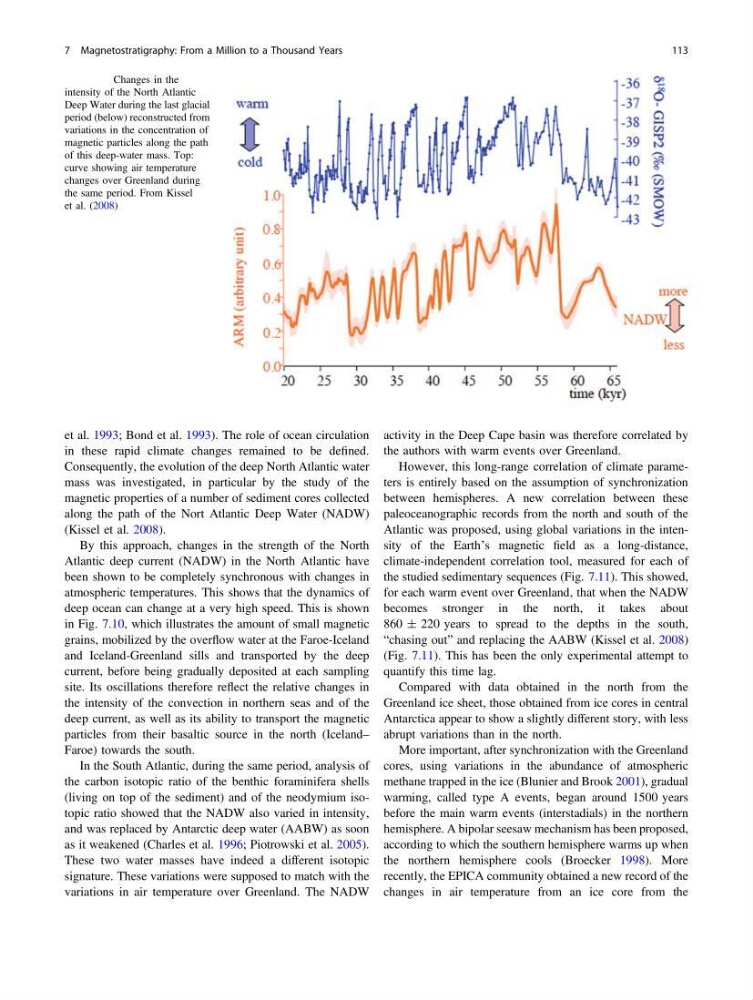
By this approach, changes in the strength of the North
Atlantic deep current (NADW) in the North Atlantic have
been shown to be completely synchronous with changes in
atmospheric temperatures. This shows that the dynamics of
deep ocean can change at a very high speed. This is shown
in Fig. 7.10, which illustrates the amount of small magnetic
grains, mobilized by the overflow water at the Faroe-Iceland
and Iceland-Greenland sills and transported by the deep
current, before being gradually deposited at each sampling
site. Its oscillations therefore reflect the relative changes in
the intensity of the convection in northern seas and of the
deep current, as well as its ability to transport the magnetic
particles from their basaltic source in the north (Iceland–
Faroe) towards the south.
In the South Atlantic, during the same period, analysis of
the carbon isotopic ratio of the benthic foraminifera shells
(living on top of the sediment) and of the neodymium isotopic ratio showed that the NADW also varied in intensity,
and was replaced by Antarctic deep water (AABW) as soon
as it weakened (Charles et al. 1996; Piotrowski et al. 2005).
These two water masses have indeed a different isotopic
signature. These variations were supposed to match with the
variations in air temperature over Greenland. The NADW
activity in the Deep Cape basin was therefore correlated by
the authors with warm events over Greenland.
However, this long-range correlation of climate parameters is entirely based on the assumption of synchronization
between hemispheres. A new correlation between these
paleoceanographic records from the north and south of the
Atlantic was proposed, using global variations in the intensity of the Earth’s magnetic field as a long-distance,
climate-independent correlation tool, measured for each of
the studied sedimentary sequences (Fig. 7.11). This showed,
for each warm event over Greenland, that when the NADW
becomes stronger in the north, it takes about
860 ± 220 years to spread to the depths in the south,
“chasing out” and replacing the AABW (Kissel et al. 2008)
(Fig. 7.11). This has been the only experimental attempt to
quantify this time lag.
Compared with data obtained in the north from the
Greenland ice sheet, those obtained from ice cores in central
Antarctica appear to show a slightly different story, with less
abrupt variations than in the north.
More important, after synchronization with the Greenland
cores, using variations in the abundance of atmospheric
methane trapped in the ice (Blunier and Brook 2001), gradual
warming, called type A events, began around 1500 years
before the main warm events (interstadials) in the northern
hemisphere. A bipolar seesaw mechanism has been proposed,
according to which the southern hemisphere warms up when
the northern hemisphere cools (Broecker 1998). More
recently, the EPICA community obtained a new record of the
changes in air temperature from an ice core from the
Fig. 7.10 Changes in the
intensity of the North Atlantic
Deep Water during the last glacial
period (below) reconstructed from
variations in the concentration of
magnetic particles along the path
of this deep-water mass. Top:
curve showing air temperature
changes over Greenland during
the same period. From Kissel
et al. (2008)
7 Magnetostratigraphy: From a Million to a Thousand Years
113
in these rapid climate changes remained to be defined.
Consequently, the evolution of the deep North Atlantic water
mass was investigated, in particular by the study of the
magnetic properties of a number of sediment cores collected
along the path of the Nort Atlantic Deep Water (NADW)
(Kissel et al. 2008).
By this approach, changes in the strength of the North
Atlantic deep current (NADW) in the North Atlantic have
been shown to be completely synchronous with changes in
atmospheric temperatures. This shows that the dynamics of
deep ocean can change at a very high speed. This is shown
in Fig. 7.10, which illustrates the amount of small magnetic
grains, mobilized by the overflow water at the Faroe-Iceland
and Iceland-Greenland sills and transported by the deep
current, before being gradually deposited at each sampling
site. Its oscillations therefore reflect the relative changes in
the intensity of the convection in northern seas and of the
deep current, as well as its ability to transport the magnetic
particles from their basaltic source in the north (Iceland–
Faroe) towards the south.
In the South Atlantic, during the same period, analysis of
the carbon isotopic ratio of the benthic foraminifera shells
(living on top of the sediment) and of the neodymium isotopic ratio showed that the NADW also varied in intensity,
and was replaced by Antarctic deep water (AABW) as soon
as it weakened (Charles et al. 1996; Piotrowski et al. 2005).
These two water masses have indeed a different isotopic
signature. These variations were supposed to match with the
variations in air temperature over Greenland. The NADW
activity in the Deep Cape basin was therefore correlated by
the authors with warm events over Greenland.
However, this long-range correlation of climate parameters is entirely based on the assumption of synchronization
between hemispheres. A new correlation between these
paleoceanographic records from the north and south of the
Atlantic was proposed, using global variations in the intensity of the Earth’s magnetic field as a long-distance,
climate-independent correlation tool, measured for each of
the studied sedimentary sequences (Fig. 7.11). This showed,
for each warm event over Greenland, that when the NADW
becomes stronger in the north, it takes about
860 ± 220 years to spread to the depths in the south,
“chasing out” and replacing the AABW (Kissel et al. 2008)
(Fig. 7.11). This has been the only experimental attempt to
quantify this time lag.
Compared with data obtained in the north from the
Greenland ice sheet, those obtained from ice cores in central
Antarctica appear to show a slightly different story, with less
abrupt variations than in the north.
More important, after synchronization with the Greenland
cores, using variations in the abundance of atmospheric
methane trapped in the ice (Blunier and Brook 2001), gradual
warming, called type A events, began around 1500 years
before the main warm events (interstadials) in the northern
hemisphere. A bipolar seesaw mechanism has been proposed,
according to which the southern hemisphere warms up when
the northern hemisphere cools (Broecker 1998). More
recently, the EPICA community obtained a new record of the
changes in air temperature from an ice core from the
Fig. 7.10 Changes in the
intensity of the North Atlantic
Deep Water during the last glacial
period (below) reconstructed from
variations in the concentration of
magnetic particles along the path
of this deep-water mass. Top:
curve showing air temperature
changes over Greenland during
the same period. From Kissel
et al. (2008)
7 Magnetostratigraphy: From a Million to a Thousand Years
113