

proved to be very precise: in the thirty years since, studies
have shown it to be out by only 5 Ma at 70 Ma!
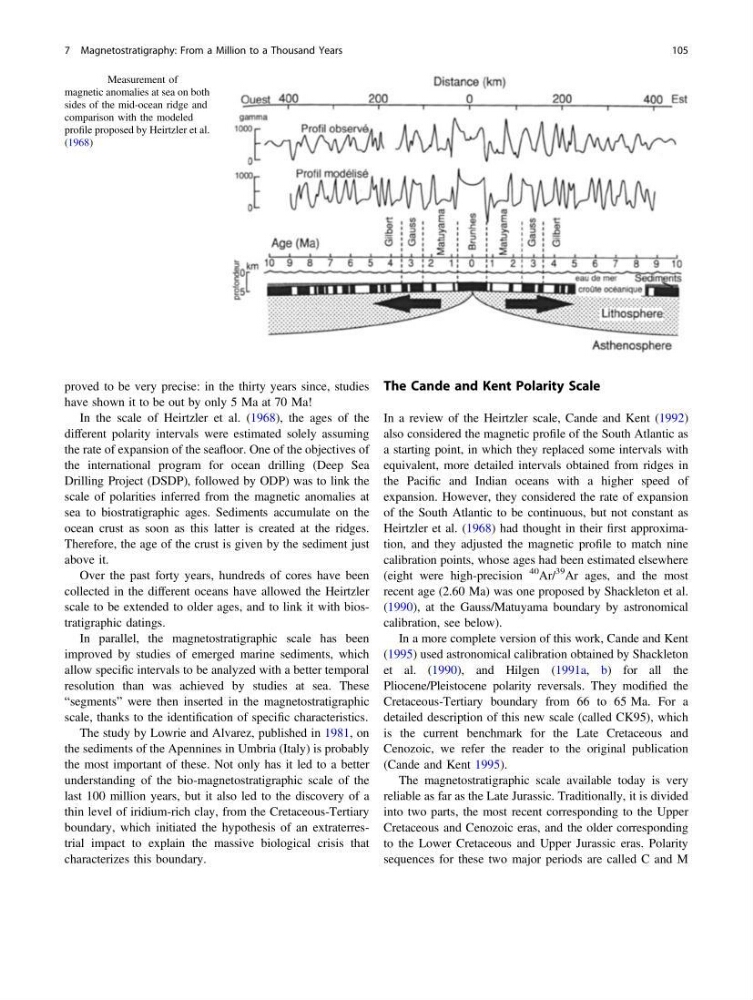
In the scale of Heirtzler et al. (1968), the ages of the
different polarity intervals were estimated solely assuming
the rate of expansion of the seafloor. One of the objectives of
the international program for ocean drilling (Deep Sea
Drilling Project (DSDP), followed by ODP) was to link the
scale of polarities inferred from the magnetic anomalies at
sea to biostratigraphic ages. Sediments accumulate on the
ocean crust as soon as this latter is created at the ridges.
Therefore, the age of the crust is given by the sediment just
above it.
Over the past forty years, hundreds of cores have been
collected in the different oceans have allowed the Heirtzler
scale to be extended to older ages, and to link it with biostratigraphic datings.
In parallel, the magnetostratigraphic scale has been
improved by studies of emerged marine sediments, which
allow specific intervals to be analyzed with a better temporal
resolution than was achieved by studies at sea. These
“segments” were then inserted in the magnetostratigraphic
scale, thanks to the identification of specific characteristics.
The study by Lowrie and Alvarez, published in 1981, on
the sediments of the Apennines in Umbria (Italy) is probably
the most important of these. Not only has it led to a better
understanding of the bio-magnetostratigraphic scale of the
last 100 million years, but it also led to the discovery of a
thin level of iridium-rich clay, from the Cretaceous-Tertiary
boundary, which initiated the hypothesis of an extraterrestrial impact to explain the massive biological crisis that
characterizes this boundary.
The Cande and Kent Polarity Scale
In a review of the Heirtzler scale, Cande and Kent (1992)
also considered the magnetic profile of the South Atlantic as
a starting point, in which they replaced some intervals with
equivalent, more detailed intervals obtained from ridges in
the Pacific and Indian oceans with a higher speed of
expansion. However, they considered the rate of expansion
of the South Atlantic to be continuous, but not constant as
Heirtzler et al. (1968) had thought in their first approximation, and they adjusted the magnetic profile to match nine
calibration points, whose ages had been estimated elsewhere
(eight were high-precision
40 Ar/
39 Ar ages, and the most
recent age (2.60 Ma) was one proposed by Shackleton et al.
(1990), at the Gauss/Matuyama boundary by astronomical
calibration, see below).
In a more complete version of this work, Cande and Kent
(1995) used astronomical calibration obtained by Shackleton
et al. (1990), and Hilgen (1991a, b) for all the
Pliocene/Pleistocene polarity reversals. They modified the
Cretaceous-Tertiary boundary from 66 to 65 Ma. For a
detailed description of this new scale (called CK95), which
is the current benchmark for the Late Cretaceous and
Cenozoic, we refer the reader to the original publication
(Cande and Kent 1995).
The magnetostratigraphic scale available today is very
reliable as far as the Late Jurassic. Traditionally, it is divided
into two parts, the most recent corresponding to the Upper
Cretaceous and Cenozoic eras, and the older corresponding
to the Lower Cretaceous and Upper Jurassic eras. Polarity
sequences for these two major periods are called C and M
Fig. 7.5 Measurement of
magnetic anomalies at sea on both
sides of the mid-ocean ridge and
comparison with the modeled
profile proposed by Heirtzler et al.
(1968)
7 Magnetostratigraphy: From a Million to a Thousand Years
105
have shown it to be out by only 5 Ma at 70 Ma!
In the scale of Heirtzler et al. (1968), the ages of the
different polarity intervals were estimated solely assuming
the rate of expansion of the seafloor. One of the objectives of
the international program for ocean drilling (Deep Sea
Drilling Project (DSDP), followed by ODP) was to link the
scale of polarities inferred from the magnetic anomalies at
sea to biostratigraphic ages. Sediments accumulate on the
ocean crust as soon as this latter is created at the ridges.
Therefore, the age of the crust is given by the sediment just
above it.
Over the past forty years, hundreds of cores have been
collected in the different oceans have allowed the Heirtzler
scale to be extended to older ages, and to link it with biostratigraphic datings.
In parallel, the magnetostratigraphic scale has been
improved by studies of emerged marine sediments, which
allow specific intervals to be analyzed with a better temporal
resolution than was achieved by studies at sea. These
“segments” were then inserted in the magnetostratigraphic
scale, thanks to the identification of specific characteristics.
The study by Lowrie and Alvarez, published in 1981, on
the sediments of the Apennines in Umbria (Italy) is probably
the most important of these. Not only has it led to a better
understanding of the bio-magnetostratigraphic scale of the
last 100 million years, but it also led to the discovery of a
thin level of iridium-rich clay, from the Cretaceous-Tertiary
boundary, which initiated the hypothesis of an extraterrestrial impact to explain the massive biological crisis that
characterizes this boundary.
The Cande and Kent Polarity Scale
In a review of the Heirtzler scale, Cande and Kent (1992)
also considered the magnetic profile of the South Atlantic as
a starting point, in which they replaced some intervals with
equivalent, more detailed intervals obtained from ridges in
the Pacific and Indian oceans with a higher speed of
expansion. However, they considered the rate of expansion
of the South Atlantic to be continuous, but not constant as
Heirtzler et al. (1968) had thought in their first approximation, and they adjusted the magnetic profile to match nine
calibration points, whose ages had been estimated elsewhere
(eight were high-precision
40 Ar/
39 Ar ages, and the most
recent age (2.60 Ma) was one proposed by Shackleton et al.
(1990), at the Gauss/Matuyama boundary by astronomical
calibration, see below).
In a more complete version of this work, Cande and Kent
(1995) used astronomical calibration obtained by Shackleton
et al. (1990), and Hilgen (1991a, b) for all the
Pliocene/Pleistocene polarity reversals. They modified the
Cretaceous-Tertiary boundary from 66 to 65 Ma. For a
detailed description of this new scale (called CK95), which
is the current benchmark for the Late Cretaceous and
Cenozoic, we refer the reader to the original publication
(Cande and Kent 1995).
The magnetostratigraphic scale available today is very
reliable as far as the Late Jurassic. Traditionally, it is divided
into two parts, the most recent corresponding to the Upper
Cretaceous and Cenozoic eras, and the older corresponding
to the Lower Cretaceous and Upper Jurassic eras. Polarity
sequences for these two major periods are called C and M
Fig. 7.5 Measurement of
magnetic anomalies at sea on both
sides of the mid-ocean ridge and
comparison with the modeled
profile proposed by Heirtzler et al.
(1968)
7 Magnetostratigraphy: From a Million to a Thousand Years
105